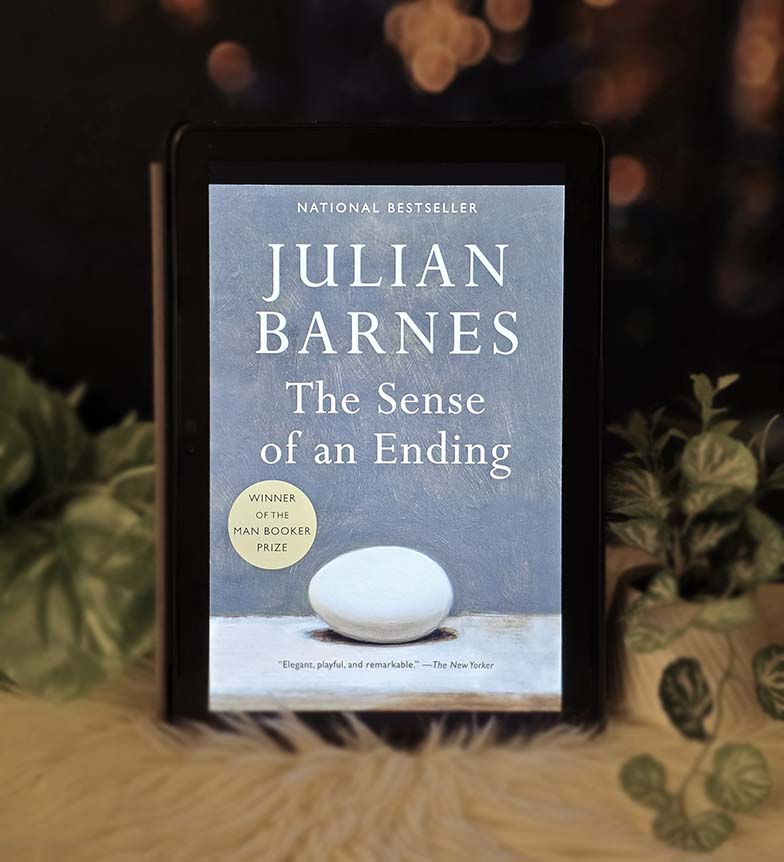
The Sense of an Ending
by Julian Barnes
Julian Barnes' Man Booker Prize-winning novel about Tony Webster, a retired Londoner who receives an unexpected bequest from the mother of a long-ago girlfriend and is forced to revisit the friendship, the breakup, and the suicide he thought he understood. A 163-page meditation on memory, documentation, and the way the stories we tell about ourselves quietly do us the favor of leaving things out.
Buy this book:
Spoiler Warning
This review may contain spoilers. Read at your own discretion if you haven't finished the book yet.
A 163-Page Novel That Spends Its First Half Setting Up a Memory and Its Second Half Showing You What You Missed
Julian Barnes won the Man Booker Prize on his fourth nomination for this book, and the win in 2011 was one of those decisions that felt both overdue for the author and exactly right for the novel. The Sense of an Ending is short enough to read in a single sitting and structured in a way that almost requires a second one. The first half is a retired man's reasonably fond reminiscence about school and university and a first serious girlfriend; the second half is the same retired man, four decades on, discovering that the reminiscence was, in several specific and uncomfortable ways, wrong.
Tony Webster is the narrator. He is divorced from a wife named Margaret on amicable terms, has a daughter named Susie, lives quietly in London, and considers his life - by his own assessment - to have been one of "peaceableness." He says so several times. He says so in a tone that, by the end of the book, the reader has come to understand as the tone of a man who has carefully arranged the furniture of his own life story so as not to bump into the sharp edges. A 4.0 reflects: a structurally precise, quietly devastating novel that earns its Booker on craft rather than reach; a narrator whose unreliability is built into the prose at the sentence level rather than announced; and one real reservation about how much the second half asks the reader to take on faith about what actually happened.
Part One: The Friendship, the Girl, and the Suicide That Lands First
The opening section moves quickly. Tony, Colin, and Alex are sixth-formers at a London day school - the kind of bookish, performatively clever boys who have a running competition to sound the most intellectually unimpressed at any given moment. Adrian Finn arrives as a transfer in their final year. He is genuinely brilliant in a way the other three are only pretending to be, and they absorb him into their group. There is a key scene in a history class where the master asks the boys what history is and Adrian, instead of giving the expected schoolboy answer, says something that the novel will quote back at the reader several times across its length: "History is that certainty produced at the point where the imperfections of memory meet the inadequacies of documentation." It is one of those lines that lands a little too neatly on first reading and lands very differently on the second.
There is a second scene in that same classroom that the novel makes the reader work to remember later. A schoolmate named Robson has gotten a girl pregnant and hanged himself. The boys discuss the suicide in their performatively detached way, and the history master uses it as an exercise in epistemology: what can we actually know about Robson's mental state? What can be inferred from a note? From an act? Barnes is doing structural work here that does not announce itself - Robson's suicide is a template the rest of the book will quietly lay over the events to come.
Adrian goes up to Cambridge on a scholarship. Tony goes to Bristol and meets Veronica Ford, who is his first serious girlfriend and the most precisely drawn character in the novel after Tony himself. She is bookish, mildly bemused by Tony, more sexually withholding than he would prefer, and from a family in Kent that strikes him as a little above his own. He spends a weekend at her parents' house - the awkward weekend that becomes, in retrospect, one of the most loaded passages in the book. Her father is mocking, her brother is cold, and her mother Sarah is warm in a way that surprises him. There is a moment when Tony comes downstairs in the morning and Sarah Ford is alone in the kitchen and tells him, more or less out of nowhere, not to let Veronica get away with too much. The detail Tony reports about that morning is that Sarah was breaking an egg and the egg broke wrong and she threw it casually into the sink, and the reader, the first time through, registers this as an oddity of remembered detail and nothing more.
The relationship with Veronica fails. Tony breaks up with her, they sleep together after the breakup, and within a year Adrian writes Tony a careful, fair-minded letter informing him that he and Veronica are now together and asking Tony's blessing. Tony writes back. The contents of that reply are not given to the reader in Part One. Tony tells us only that he wished them well, that he made a few sour observations, that he eventually got past it. Some months later, Adrian kills himself - opens a vein in a bathtub - and leaves a note for the coroner arguing that a person who has examined the nature of their life has the philosophical right to renounce it. Tony, Colin, and Alex absorb the suicide as a kind of awful confirmation of Adrian's seriousness, of the brilliance that the rest of them lacked. Tony marries Margaret, has Susie, divorces amicably, retires, and the first part of the book ends with him in late middle age, peaceable, settled, mildly proud of having made no particular mess of anything.
Part Two: The Bequest, the Letter, and the Documents That Refuse to Cooperate
What pulls the second half into motion is a solicitor's letter. Sarah Ford - Veronica's mother, the woman Tony met once forty years ago at that awkward Kent weekend - has died, and her will has left Tony £500 and two documents: a brief note and Adrian's diary. Tony has not seen or thought about Sarah Ford in four decades. He has no idea why she would have had Adrian's diary, and he has no idea why she would have left it to him.
He does not get the diary. Veronica has it and refuses to hand it over. The £500 arrives. The note arrives. Adrian's diary does not. Tony begins emailing, then meeting, the gray-haired Veronica who has spent forty years not seeing him, and she communicates - in fragments, in increasingly exasperated cryptic remarks, in the now-famous refrain "You just don't get it, you never did, and you never will" - that the past he thinks he remembers is not the past that happened. She gives him, in pieces, what she will give him: a single page from Adrian's diary that is mostly a chain of cumulative-wager equations, and, eventually, the actual letter that Tony wrote to Adrian forty years earlier.
The letter is awful. It is the document Part One quietly elided, and reading it for the first time alongside Tony is the structural pivot of the novel. Tony had described his reply to Adrian as "sour"; the letter is not sour. It is vituperative, jealous, sexually crude, and ends with the suggestion that Adrian should run his relationship with Veronica past Sarah Ford because Veronica was damaged in some way her mother could explain. The letter is also, retrospectively, a kind of curse - it points Adrian at Sarah, and the rest of the novel is the slow accumulation of what that pointing produced.
The disclosure that lands the book is staged with deliberate restraint. Veronica drives Tony to a pub, then to a small group of mentally disabled adults walking with a carer on a London street - a routine outing that the carer clearly does several times a week. She makes Tony watch them. One of the men in the group, perhaps forty years old, has features Tony eventually places. Veronica drives away without explaining. Tony, on his own, assembles it: the man is Adrian's son. He spends a long stretch of the novel assuming that the son is Veronica's - that Veronica was pregnant at the time of Adrian's suicide, that the suicide and the son are linked, that Veronica has been raising Adrian's child for forty years. When he finally understands that the son is not Veronica's but Sarah's, that Adrian and Sarah had an affair after Tony's letter pointed him at her, that Sarah became pregnant late in life and the child was born with significant disabilities, and that this is what Adrian's suicide note's "philosophical examination" had actually been examining, the recognition is quiet and total. Veronica's "you just don't get it" has been doing forty years of work in the space of a single line.
The Unreliable Narrator at the Sentence Level
What makes the book work, and what makes it deserve the prize it won, is that Barnes does not announce Tony's unreliability. He builds it into the texture of Part One in ways that are only legible on reread. The tone of Tony's "peaceable" self-description, the suspicious tidiness of the memories about Veronica's family weekend, the very fact that Tony reports the cracked egg in Sarah's kitchen at all (he reports nothing else about that morning - why does he remember the egg?), the careful skirt around the contents of the letter to Adrian - none of this is flagged. The first read processes Tony as a reasonably honest narrator with a foggy memory. The second read processes him as a man who has spent forty years constructing the version of his life he can live in.
Veronica's repeated refrain - "you just don't get it" - is the other half of this machinery. She is not given much screen time in Part Two and she is given almost no interiority. Barnes is playing fair: the reader is locked into Tony's perspective and only gets what Tony gets, which is a Veronica who appears cryptic and difficult because Tony can only see a Veronica who is responding to a version of events he no longer remembers correctly. The book's structural argument is that Tony is not malicious. He is, by his own ongoing description, a peaceable man. The horror is that peaceable men can write letters like the one he wrote, can forget that they wrote letters like the one they wrote, and can spend forty years narrating themselves as people who would not have written such a letter, all while the consequences of the letter quietly compound somewhere outside their attention.
Where It Earns the 4 and Where It Doesn't Earn a 5
The strengths are real and they are the kind of strengths the Booker tends to reward: structural ambition delivered at compressed length, a narrator whose unreliability is technique rather than gimmick, a leitmotif (Adrian's history-is-certainty line) that the book pays off rather than just repeats, and an ending that respects the reader's intelligence enough not to spell out what it has just done. The prose is plain and pleased with itself in a way that is recognizably Barnes - mildly aphoristic, given to small philosophical asides, occasionally pleased enough with a sentence to let it sit too long.
The reservations, though. The second-half mystery turns on a chain of inference that the reader has to take on Tony's authority, and Tony has just spent the entire first half proving that his authority is exactly the thing in question. There is a contested reading among critics and bloggers - a minority view, but one that has had its advocates since publication - that the disabled son is not Adrian's at all but Tony's, conceived during an affair with Sarah Ford that Tony has either forgotten or never told us about, and that Sarah's bequest of the £500 was meant to be read as a kind of arrears payment. The novel does not foreclose this reading. Several reviewers have argued that Tony's failure to fully accept his own past cruelty extends to the final reveal as well - that he settles on "Adrian was the father" because it is the version of the story he can live with, and that the reader who has been paying attention to Tony's documented unreliability should not necessarily settle along with him. The book is short enough that the second read is the read where you decide which reading is yours. Whether you find this productively unsettling or maddeningly underbuilt is a matter of temperament.
A 4.0 means: a deserved Booker winner, one of the best-built short novels of the 2010s, and a book whose ambiguity is the actual point rather than the cost of the design. If you want a clean resolution and an emotional catharsis, this is not the book; if you want a novel that demonstrates, at 163 pages, what the form can do when a writer is in full command of structure, it is.
Rating: 4.0/5 ⭐
Perfect for: Booker Prize completists, readers who like an unreliable narrator built into the sentences rather than declared by the prose, fans of British literary fiction that is more interested in memory and self-narration than in plot resolution, and readers who will enjoy rereading a 163-page book the day after they finish it.
Skip if: You need a definitive answer about what actually happened, you find late-in-life regret-and-recognition novels claustrophobic, or you want a novel whose narrator you can trust.
You Might Also Like

Sorry I Missed You
by Suzy Krause
Three lonely women living in the same apartment building form an unlikely friendship through notes, chance encounters, and the slow realization that connection is worth the risk.

Big Little Lies
by Liane Moriarty
Liane Moriarty's 2014 novel about three mothers at a Sydney kindergarten - Madeline, Celeste, and Jane - whose first school year together is structured around the countdown to a Trivia Night that ends with somebody dead on the pavement, and around the much smaller and much larger lies the rest of the parent community has been telling itself the whole time. Domestic-suspense with actual satire and an actual position on what it is taking on.

My Ántonia
by Willa Cather
Willa Cather's American masterpiece about Ántonia Shimerda, a Bohemian immigrant girl on the Nebraska prairie, told through the nostalgic memories of childhood friend Jim Burden. Luminous prose, elegiac tone, and one of literature's most enduring portraits of pioneer life and immigrant experience.