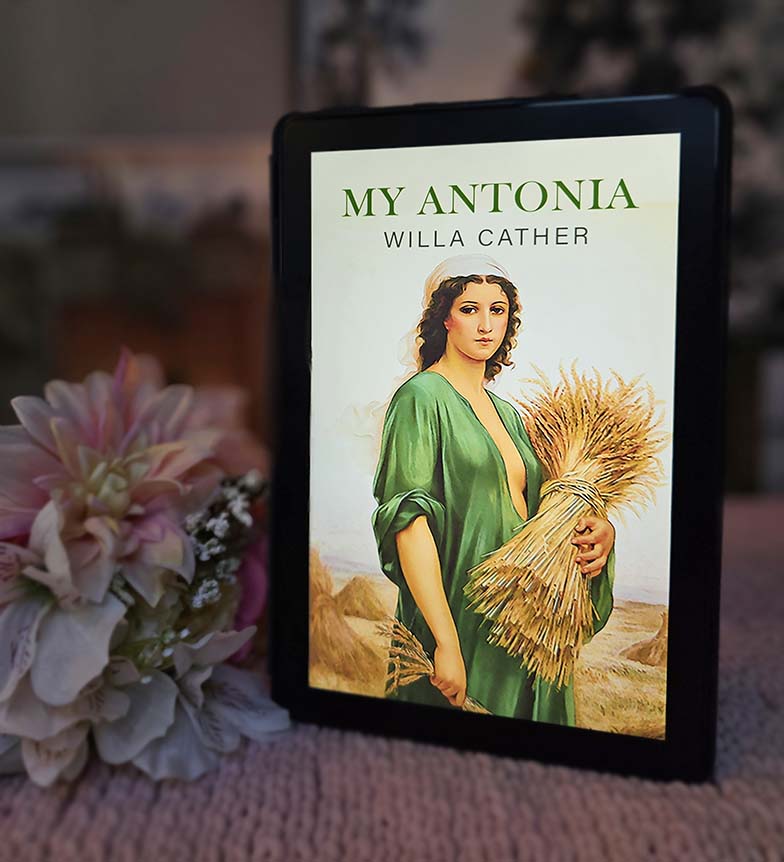
My Ántonia
by Willa Cather
Willa Cather's American masterpiece about Ántonia Shimerda, a Bohemian immigrant girl on the Nebraska prairie, told through the nostalgic memories of childhood friend Jim Burden. Luminous prose, elegiac tone, and one of literature's most enduring portraits of pioneer life and immigrant experience.
Buy this book:
Spoiler Warning
This review may contain spoilers. Read at your own discretion if you haven't finished the book yet.
Five Books of Memory, and the Bohemian Girl Jim Burden Never Quite Got Over
My Ántonia is one of those classics whose reputation turns out to be earned the slow way. Willa Cather published it in 1918, third in the trilogy that started with O Pioneers!, and it has held its place in the American canon for the same reason it almost slipped past me on the first read: it is not a plot novel. It is a memory novel - five short books of episodes, framed by a man writing about a woman he has not seen in twenty years, and the cumulative effect is the kind that creeps up rather than detonates.
The frame is the first thing to notice. An unnamed narrator meets Jim Burden on a train crossing Iowa; both grew up in Nebraska, both knew the same Bohemian girl in childhood, and Jim - now a railroad lawyer in New York with an unhappy marriage and a great deal of unfinished feeling - eventually mails the narrator a manuscript he has been writing about her. The book is that manuscript. The title's possessive ("My Ántonia") is doing actual work; everything in the book is Jim's recollection of her, never her own voice, which is both the engine of the novel's tenderness and the source of nearly every reservation critics have ever held about it.
The Shimerdas, the Burdens, and the First Winter
Book I, The Shimerdas, gets the pioneer material on the page with no romance attached to it. Jim, recently orphaned in Virginia, arrives at his grandparents' Nebraska farm at ten and finds the Shimerda family - immigrants from Bohemia - settling on a neighboring plot of land that turns out to be much worse than the one they were sold. They have almost no English. Their dugout home is the kind of structure a winter on the plains was designed to test. Ántonia, the older Shimerda daughter, becomes Jim's first real friend; her father, a gentle, cultured man badly out of place on a Nebraska homestead, becomes the book's first quiet casualty when he takes his own life in late January, broken by the cold and the displacement and the sense that he has lost a life he can never get back.
Around the suicide, Cather drops in the small set pieces that everybody who has read the book remembers: the visit to the two strange Russian neighbors, Pavel and Peter, with their late-night Old Country story of a wedding party and a wolf pack; the afternoon Jim kills an enormous old rattlesnake in a prairie dog town while Ántonia screams in Bohemian; the way the prairie itself is rendered, the grass and the sky and the wind, as if it were a sixth character with opinions about everybody on it.
The Hired Girls, the Town, and Lena Lingard
Books II and III, The Hired Girls and Lena Lingard, move off the farm. Jim's grandparents grow too old for arduous work and move into the nearby town of Black Hawk; Ántonia follows, taking work as housekeeper for the Harlings, a respectable town family. The book widens here into a portrait of a whole class - the immigrant farm girls who came in to work as cooks and laundresses and seamstresses for the established white American townspeople, and who, in Cather's reading, were the most alive people in Black Hawk. The dancing pavilion that pitches up in town for a summer becomes the book's small social engine; Ántonia and her friends - Lena Lingard, Tiny Soderball, the Bohemian Marys - dance with whoever asks them, and the town's respectable young men, Jim included, find them more interesting than the girls they are expected to marry. Cather's sympathy for all of these women, and her unwillingness to flatten the different lives they end up choosing, is the quietest radical thing about the book.
The Black Hawk section also contains the novel's strangest interlude. Ántonia takes a job with Wick Cutter, the town's predatory money-lender; when Jim's grandmother becomes convinced Cutter intends to assault Ántonia in her bed, she has Jim sleep in Ántonia's room in her place for a night. Cutter comes home and attacks. Jim is the one who fights him off, and the chapter is written with an unmistakable note of disgust - at Cutter, but also, uncomfortably, at Ántonia for having "let him in for all this." It is one of the moments where Jim's narration shows its limits, and it is worth reading carefully rather than past.
Book III is the shortest section and the one most reliant on Jim alone: he has gone off to the university in Lincoln, meets Lena again in town, has a near-romance with her that he eventually steps back from, and prepares to transfer east to Harvard. Lena, who becomes a successful dressmaker and chooses never to marry, ends up the closest the novel has to a sustained alternative to Ántonia.
What Becomes of Ántonia
Book IV, The Pioneer Woman's Story, is the one where the book's central life turns. While Jim is at Harvard, Ántonia gets engaged to a railroad conductor named Larry Donovan, follows him to Denver to be married, and is abandoned there - she comes home pregnant and quietly bears a daughter on her brother Ambrosch's farm. The community's judgment is exactly what one would expect for 1890s rural Nebraska, and Ántonia absorbs it without breaking and keeps working. Cather, who could have made this the tragic crater of the novel, instead lets it sit as one event among others - hard, not finishing.
Book V, Cuzak's Boys, jumps twenty years. Jim, now established in New York, finally comes back to visit. He finds Ántonia married to Anton Cuzak, a city-bred Bohemian who has reconciled himself to farm life, surrounded by a houseful of children who already know all of Jim's old stories because their mother has told them. The much-quoted late scene in the fruit cave - Ántonia opening the door and her children pouring out into the daylight one after another - is the book's emotional landing. She has not become the person Jim half-imagined or feared; she has become something more interesting, the matriarch of a small Bohemian-American world she has built out of the wreckage of every earlier disappointment. The book ends without wrapping anything, and that is, in the end, the right way for it to end.
Why a 4
The strengths: Cather's prose, which carries the elegiac weight without ever announcing itself; the prairie writing, which deserves its reputation; the unromanticized rendering of immigrant farm life and the particular cruelty of the first winters; the willingness to give the hired girls real interior dignity at a moment when most American fiction was not interested; Ántonia herself, who survives the framing well enough to come through as a person rather than a symbol. The reservations are mostly structural and worth being honest about. Ántonia is meaningfully present in only some of the five books; large stretches of her life arrive secondhand, summarized by other characters while Jim is elsewhere. The frame means we never get her own voice on her own life, and Jim's narration occasionally curdles in ways Cather notices but does not fully interrogate - the Wick Cutter chapter is the clearest example. The episodic build will read as drift rather than design to anyone who needs a forward motion that this book is not interested in providing.
A 4.0 means: a hundred-and-eight-year-old novel that still does what it set out to do, an Ántonia who has earned her place among American literature's permanent figures, and a memory-shaped structure that rewards the kind of reading it asks for - patient, accumulative, willing to let the book be what it is.
Rating: 4.0/5 ⭐
Perfect for: Readers who love literary classics that take the long way around, anyone interested in immigrant and prairie life rendered without sentiment, fans of beautiful prose, readers who appreciate fiction structured like memory rather than plot.
Skip if: You need a driving narrative spine, the absence of the title character from large stretches of her own book would frustrate you, or you have no patience for first-person narration whose limitations the author trusts you to notice.
You Might Also Like
Romance of the Three Kingdoms
by Luo Guanzhong
In 184 CE the Yellow Turban Rebellion broke the Han dynasty, and the next hundred years of warlord chaos resolved into three rival kingdoms - Cao Cao's Wei in the north, Liu Bei's Shu-Han in the west, Sun Quan's Wu in the south - before the Sima family quietly inherited everything and reunified China as the Jin dynasty in 280 CE; more than a thousand years later, in the 14th century, Luo Guanzhong took the long accumulation of historical chronicle, opera, and storytellers' embellishment around that century and produced one of the Four Great Classical Novels of Chinese literature, which Moss Roberts has rendered into 2,300-plus unabridged English pages featuring the Oath of the Peach Garden between Liu Bei, Guan Yu, and Zhang Fei; the strategist Zhuge Liang treated as something close to a demigod; the Battle of Red Cliffs as the inflection point; and hundreds of warlords, surrenders, sieges, and stratagems any modern Western reader is going to have to commit to in a way most modern novels do not ask for.
The Sense of an Ending
by Julian Barnes
Julian Barnes' Man Booker Prize-winning novel about Tony Webster, a retired Londoner who receives an unexpected bequest from the mother of a long-ago girlfriend and is forced to revisit the friendship, the breakup, and the suicide he thought he understood. A 163-page meditation on memory, documentation, and the way the stories we tell about ourselves quietly do us the favor of leaving things out.

The Call of the Wild
by Jack London
Jack London's 1903 short novel: Buck, a 140-pound St. Bernard / Scotch Shepherd mix living the comfortable life on Judge Miller's California ranch, is stolen one night by a gambling-debt-saddled gardener's helper, sold into the Klondike Gold Rush as a sled dog, and slowly discovers - through cold, club, fang, and the man named John Thornton he comes to love - the wolf that has always been inside him.