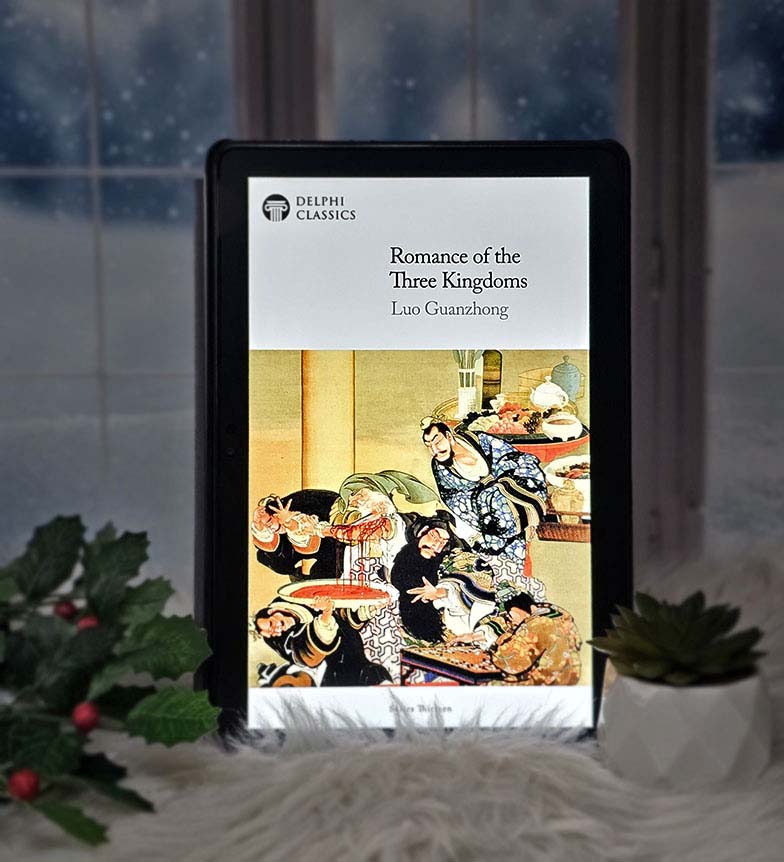
Romance of the Three Kingdoms
by Luo Guanzhong
In 184 CE the Yellow Turban Rebellion broke the Han dynasty, and the next hundred years of warlord chaos resolved into three rival kingdoms - Cao Cao's Wei in the north, Liu Bei's Shu-Han in the west, Sun Quan's Wu in the south - before the Sima family quietly inherited everything and reunified China as the Jin dynasty in 280 CE; more than a thousand years later, in the 14th century, Luo Guanzhong took the long accumulation of historical chronicle, opera, and storytellers' embellishment around that century and produced one of the Four Great Classical Novels of Chinese literature, which Moss Roberts has rendered into 2,300-plus unabridged English pages featuring the Oath of the Peach Garden between Liu Bei, Guan Yu, and Zhang Fei; the strategist Zhuge Liang treated as something close to a demigod; the Battle of Red Cliffs as the inflection point; and hundreds of warlords, surrenders, sieges, and stratagems any modern Western reader is going to have to commit to in a way most modern novels do not ask for.
Buy this book:
Spoiler Warning
This review may contain spoilers. Read at your own discretion if you haven't finished the book yet.
A 14th-Century Compilation Of A Hundred Years Of Chinese Civil War, Three Sworn Brothers, A Tactician Treated As A Demigod, And Two Thousand Three Hundred Pages To Get Through It
In 184 CE, peasants in yellow headbands rose against the Han emperor, and the four-century dynasty that had ruled China began to come apart. The warlord chaos that followed lasted nearly a hundred years and resolved into three rival kingdoms: Cao Cao's Wei in the north, Liu Bei's Shu-Han in the west, Sun Quan's Wu in the south. By 280 CE the Sima family - bureaucrats who had been quietly accumulating power inside the Cao-Wei state - had usurped Wei, conquered the other two, and reunified the empire as the Jin dynasty. The century of civil war between those two dates is, in Chinese cultural memory, the Three Kingdoms period. Out of more than a thousand years of subsequent oral retellings, historical chronicles (Chen Shou's Records of the Three Kingdoms among them), opera, and storytellers' embellishments came the 14th-century novel attributed to Luo Guanzhong, Romance of the Three Kingdoms, one of the Four Great Classical Novels of Chinese literature. Moss Roberts has translated it into a 2,300-plus-page unabridged English edition, which I worked through across roughly forty hours of reading.
A 3.0 reflects: the book's unquestioned status as a foundational text of Chinese literature, the genuine pleasure of finally meeting the source material for archetypes and references that turn up constantly in East Asian media, the structural exhaustion that comes from a novel built on hundreds of warlords with similar romanized names fighting essentially the same kind of battle over a century of in-novel time, and the honest fact that I read this for cultural literacy rather than for the experience of reading it.
The Three Rulers, The Sworn Brothers, And The Strategist
The novel orbits three central figures who become the rulers of the three kingdoms. Cao Cao - cunning, ruthless, militarily brilliant - rules the north, and the novel treats him as something close to a villain even as his enemies acknowledge his genius. Liu Bei, descended distantly from Han emperors but raised in poverty, is the virtuous foil; he becomes emperor of Shu-Han and represents the dream of restoring the fallen dynasty, even as Cao Cao's son Cao Pi formally ends the Han by founding the Wei kingdom on its ashes. Sun Quan, the third ruler, inherits power in the south, founds the Wu kingdom, and spends most of the novel navigating uncertain alliances between the other two.
Around these rulers cluster the characters who carry the book's iconic moments. Liu Bei's sworn brothers, Guan Yu and Zhang Fei, take the famous Oath of the Peach Garden in the opening chapters, swearing loyalty until death - a scene that has become shorthand for brotherhood across Chinese culture and is taught in schools, performed in opera, and quoted in films a thousand years downstream of itself. Guan Yu was later deified as Guandi, the god of war, and remains a temple figure venerated to this day. Zhuge Liang - also called Kongming - is Liu Bei's strategist and the novel's most magnetic figure: a borderline supernatural tactician whose schemes provide much of the book's most quoted material, including the celebrated empty-fort stratagem and the south-wind summoning that turns the Battle of Red Cliffs. Red Cliffs itself - the engagement where the combined forces of Liu Bei and Sun Quan crushed Cao Cao's much larger northern army - is the inflection point of the entire novel and the moment that locks in the three-way division. It has inspired its own corpus of adaptations, including John Woo's two-part film.
Where I Struggled
The sheer number of characters with similar romanized names made tracking who was fighting whom genuinely difficult. Battle after battle blurs together in repetitive detail - troop movements, casualty counts, surrendering generals, captured cities, all rendered in nearly identical structure. The translation gulf between 14th-century Chinese literary conventions and modern Western expectations is vast. Prose often feels stilted, dialogue formal, and pacing arrhythmic without extensive cultural context.
The characterization operates on different principles than Western literature. Characters are types defined by their moral and political role - loyal, treacherous, righteous, ambitious - rather than psychologically complex individuals who change over time. Confucian value judgments that would be transparent to original audiences can feel heavy-handed or arbitrary to modern Western readers. There is also the structural reality that most of the figures readers come to care about die before the end. After Liu Bei's death and the deaths of his sworn brothers, Zhuge Liang's six unsuccessful Northern Campaigns drive the narrative forward without the human anchors the early book had built. By the time the Sima family finally consolidates power and the Jin dynasty unifies the empire in 280 CE, the iconic characters have all been gone for a long time. The novel mirrors history at the cost of the kind of dramatic shape contemporary readers are trained to expect.
What I Took From It
There is real value in the encounter. The archetypes - the brilliant amoral northern ruler, the virtuous-but-fragile southern claimant, the strategist who is the smartest person in any room he enters, the sworn brothers whose loyalty is the moral spine of the work - are everywhere in East Asian media downstream of this book. Dynasty Warriors, Three Kingdoms films, the strategic and leadership concepts that get cited in business books and military histories all trace back to a text I had not read until I read it. Reading the Moss Roberts translation in full is to see the source.
It is not, however, a reading experience I enjoyed in the way I enjoy most novels. For readers with a specific interest in Chinese history, literature, or military strategy, the investment has real value. For readers approaching it for narrative entertainment, consider the Moss Roberts abridged edition or one of the many film and television adaptations - John Woo's Red Cliff films, the long-form Chinese television treatments of the same material - before committing to the unabridged twenty-three hundred pages.
Why a 3
The strengths: a 14th-century compilation that earns its status as one of the Four Great Classical Novels, a cast of characters whose archetypes you will recognize from media you have already consumed, an unabridged Moss Roberts translation whose footnotes are themselves a small course in classical Chinese commentary, and the genuine satisfaction of meeting the source for things you already half-knew.
The reservations: hundreds of similar-sounding romanized names that the novel does not slow down to help a non-Chinese reader hold onto; battle sequences that repeat their structure across the second and third thousand pages; a Confucian moral schema that the modern Western reader has to read against rather than through; and a length that is asking for forty hours of a kind of attention most contemporary readers no longer bring to fiction.
A 3.0 means: I am glad I read it. I do not recommend it as a novel. I recommend it as a cultural object, an encounter with a tradition, and a reading experience that would have been very different had I been raised inside the literature it is foundational to.
Rating: 3.0/5 ⭐
Perfect for: Students of Chinese history or literature, readers with deep interest in military strategy or Confucian political philosophy, fans of East Asian media who want the source material, anyone willing to commit forty hours to a foundational text.
Skip if: You are seeking narrative entertainment, you are not prepared for hundreds of similar-sounding names across thousands of pages, you struggle with characters defined by moral type rather than psychological depth, or you would be better served by an abridged edition or a film adaptation.
You Might Also Like
My Ántonia
by Willa Cather
Willa Cather's American masterpiece about Ántonia Shimerda, a Bohemian immigrant girl on the Nebraska prairie, told through the nostalgic memories of childhood friend Jim Burden. Luminous prose, elegiac tone, and one of literature's most enduring portraits of pioneer life and immigrant experience.

The Call of the Wild
by Jack London
Jack London's 1903 short novel: Buck, a 140-pound St. Bernard / Scotch Shepherd mix living the comfortable life on Judge Miller's California ranch, is stolen one night by a gambling-debt-saddled gardener's helper, sold into the Klondike Gold Rush as a sled dog, and slowly discovers - through cold, club, fang, and the man named John Thornton he comes to love - the wolf that has always been inside him.

Animal Farm
by George Orwell
George Orwell's 1945 fable: the animals of Manor Farm, inspired by an old prize boar named Major, rise up and drive out the drunk Mr. Jones, paint seven commandments on the barn wall, and over the next several years watch as two pigs - the idealist Snowball and the schemer Napoleon - turn the revolution into exactly the regime it was supposed to replace.