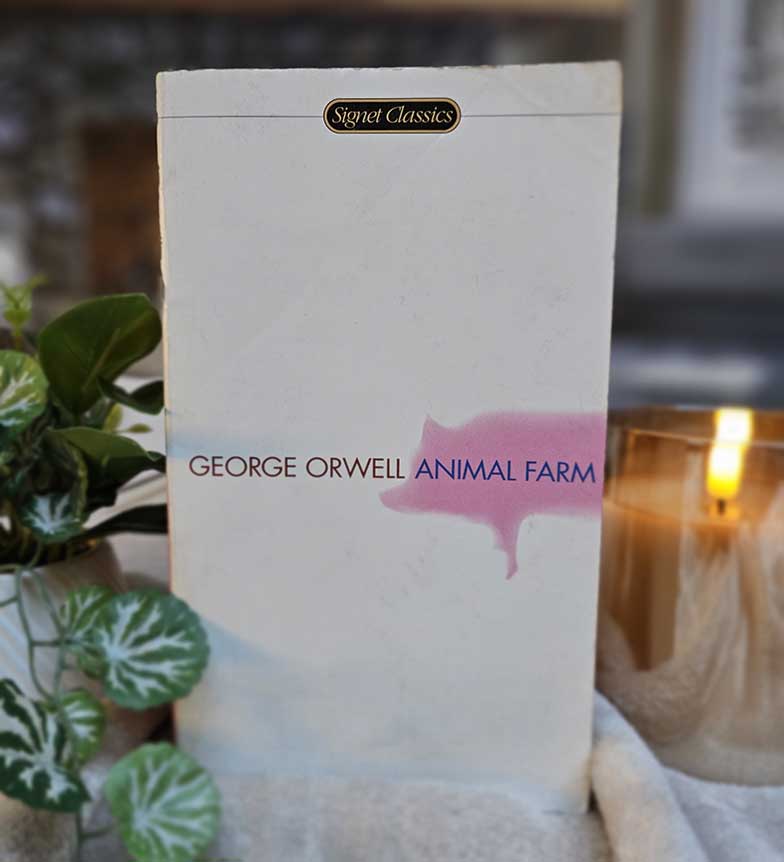
Animal Farm
by George Orwell
George Orwell's 1945 fable: the animals of Manor Farm, inspired by an old prize boar named Major, rise up and drive out the drunk Mr. Jones, paint seven commandments on the barn wall, and over the next several years watch as two pigs - the idealist Snowball and the schemer Napoleon - turn the revolution into exactly the regime it was supposed to replace.
Buy this book:
Spoiler Warning
This review may contain spoilers. Read at your own discretion if you haven't finished the book yet.
All Animals Are Equal, But - and Then the Pigs Walked Into the Farmhouse on Two Legs
You can read Animal Farm in an afternoon. It will keep coming back to you for years. George Orwell's 1945 novella - 176 pages, technically classifiable as a children's fable, structurally one of the most efficient political critiques the twentieth century produced - is the kind of book where the simplicity is the instrument. Orwell is not slumming when he writes about pigs and horses. He is using the form to do something a more sophisticated novel could not have done as cleanly.
The setup is fairy-tale brisk. Manor Farm is run by Mr. Jones, a drunk who has, in the book's careful phrase, "fallen on evil days," and who sometimes forgets to feed his animals at all. One night, Old Major - a prize Middle White boar nearing the end of his life - calls a meeting in the barn and delivers a sermon about humans, exploitation, and the future. He teaches the animals "Beasts of England," a song about a world without human tyranny. Three days later he dies. A few weeks after that, Jones stumbles home drunk and forgets the animals again, and the rebellion erupts almost without anyone planning it. The animals drive Jones off, rename the place Animal Farm, and paint seven commandments on the side of the barn. All animals are equal. No animal shall sleep in a bed. No animal shall drink alcohol. No animal shall kill any other animal. The barn wall, in the morning, says exactly what it should say.
Then, slowly, it doesn't.
A 4.0 reflects: a book that works as exactly the lean political fable it intends to be, with characters who are deliberately archetypes rather than people, and a closing image that has earned its place in every literate person's vocabulary. It is not the book to come to for novelistic interiority. It is the book to come to for the mechanism, rendered with terrible clarity.
Snowball, Napoleon, and the Dogs
The two pigs who emerge as leaders after Jones is gone are designed to oppose each other in every register Orwell needed them to. Snowball is the idealist - the pig who wants to build a windmill that will give every animal more leisure, who debates honestly at the weekly meetings, who took a shotgun pellet at the Battle of the Cowshed when Jones tried to retake the farm. Napoleon is the quiet one - the pig who doesn't speak in the meetings, who has been "taking a special interest" in the farm dogs' puppies, who has been raising those puppies in the loft, in private, where no one can see what they have been trained to do.
The book's pivot moment is Napoleon's debut of those dogs. The animals are debating the windmill, leaning toward Snowball; Napoleon stands up; nine enormous dogs come tearing in from somewhere; Snowball runs for his life and is never seen on the farm again. By that evening, Squealer, the silver-tongued propagandist pig, has explained to the bewildered animals that Napoleon was actually in favor of the windmill all along, that the plans had been stolen from him by Snowball, and that anyone who remembered it differently was misremembering. The animals are not sure. The dogs are very large and very close. They accept it.
From there, the corruption is incremental in exactly the way Orwell wants the reader to feel. The pigs need the milk and the apples - they are doing the brainwork; surely you wouldn't want Jones to come back, would you? The pigs move into the farmhouse - the commandment was that no animal shall sleep in a bed with sheets, and the original wording had clearly meant that the whole time. The pigs are observed drinking - the commandment was that no animal shall drink to excess. The pigs execute animals who confess, under pressure, to having collaborated with Snowball - the commandment was that no animal shall kill another animal without cause. By the end, only one of the seven commandments remains on the wall, rewritten: "All animals are equal, but some animals are more equal than others."
Boxer, Benjamin, and the Glue-Boiler's Van
The character that lifts the book past pure political mechanism is Boxer, the enormous cart-horse whose two mottos - "I will work harder" and "Napoleon is always right" - are the spine of his whole interior life. Boxer is the working person who does what is asked, who hauls the windmill stones up the hill until his lungs give out, who wakes earlier than anyone else, who believes the regime because believing the regime is what good citizens do. He is also the figure on whom the entire Animal Farm economy depends, and the pigs know it.
When Boxer finally collapses, the pigs announce that the veterinarian is on the way. A van arrives. Benjamin the donkey - the farm's resident cynic, who has always known what the pigs were and has chosen, until this moment, not to speak - reads the writing on the van's side: "Alfred Simmonds, Horse Slaughterer and Glue Boiler, Willingdon. Dealer in Hides and Bone-Meal." He starts shouting. The animals try to stop the van. They are too late. The pigs sell their most loyal worker to the knacker and use the money for a case of whisky. Squealer, a few weeks later, announces that Boxer died peacefully at the hospital, surrounded by professional care. The animals choose to believe him because the alternative is unbearable.
The Boxer-and-Benjamin sequence is the book's emotional center, and it works because Orwell refuses to make either character simple. Boxer's faith is the engine of his exploitation. Benjamin's clear-eyed cynicism, the form of intelligence that costs him nothing because he never acts on it, is its own kind of complicity.
Squealer, the Wall, and the Battle Over What Anyone Remembers
The book's argument about language is the part that has aged into urgency. Squealer is more important to the regime than Napoleon's dogs, because the dogs are only there for the moments when language fails. The everyday work of running the farm is Squealer explaining, justifying, reframing. The commandments on the wall are altered under cover of night and the animals find themselves uncertain what the wall used to say. The history of the Battle of the Cowshed is rewritten so that Snowball, the hero who took the shotgun pellet for the farm, becomes Snowball the secret traitor who was working with Jones the whole time. "Beasts of England," the song the rebellion was built on, is banned and replaced with a hymn praising Napoleon, on the grounds that the rebellion has now been completed and a song of liberation is no longer appropriate.
The animals' inability to read - most of them never finished learning - is what makes the manipulation possible. Squealer asks them whether they have any record in writing of what the commandment used to say. They don't. They cannot. So reality becomes whatever the wall says today, which is whatever Squealer painted there last night.
The Closing Image
The final scene is one of the most-quoted closing images in English fiction, and it holds up. The pigs are walking on two legs. They are wearing Mr. Jones's old clothes. They are carrying whips. They have invited the neighboring human farmers - including Pilkington from the next farm over - to a card game at the farmhouse, and through the window the other animals watch the pigs and the men toast each other and congratulate each other on running such efficient operations with such hardworking, low-fed laborers. A quarrel breaks out: Napoleon and Pilkington have both played the ace of spades. The animals look from pig to man, and from man to pig, and from pig to man again, and already it is impossible to say which is which.
Orwell wrote the book about Stalinism specifically. The pattern it diagrams - the corruption of revolutionary ideals, the manufacturing of consent, the betrayal of the workers, the consolidation of power by those most willing to use it - is broader than that, and the book has been borrowed by every political register in the eighty years since. Even Moses the raven, the religious figure who keeps the workers docile with stories of Sugarcandy Mountain in the sky, gets his place in the regime once the pigs realize what he is for. Orwell, who fought alongside revolutionaries in the Spanish Civil War and called himself a democratic socialist, was not anti-revolution. He was anti what revolutions become, and Animal Farm is the most efficient inventory of that becoming the language has produced.
A 4.0 reflects: an essential book, executed at the level of fable rather than novel, that does what it sets out to do with exactly the economy the form requires. Worth the afternoon. Will keep paying back the afternoon for a long time.
Rating: 4.0/5 ⭐
Perfect for: Anyone interested in political fiction, readers who appreciate compressed allegory, students of totalitarianism and revolution, anyone who has been told to read this for school and is now in a position to read it for themselves.
Skip if: You want novelistic depth in your characters rather than archetypes, you find allegorical fiction too on-the-nose, or you've already absorbed Orwell's argument from cultural osmosis and don't need the source.
You Might Also Like
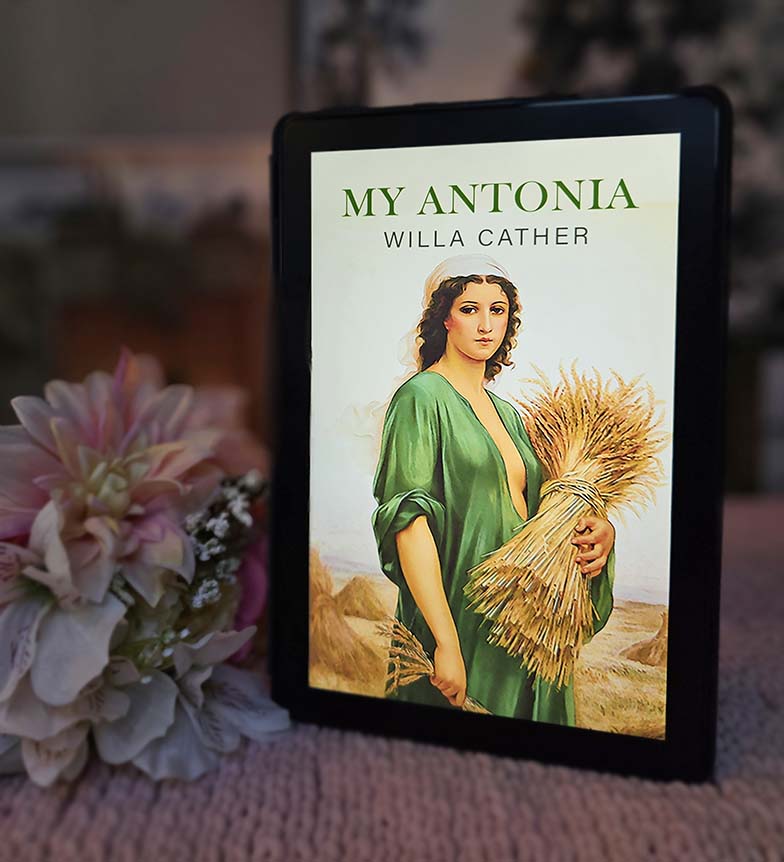
My Ántonia
by Willa Cather
Willa Cather's American masterpiece about Ántonia Shimerda, a Bohemian immigrant girl on the Nebraska prairie, told through the nostalgic memories of childhood friend Jim Burden. Luminous prose, elegiac tone, and one of literature's most enduring portraits of pioneer life and immigrant experience.
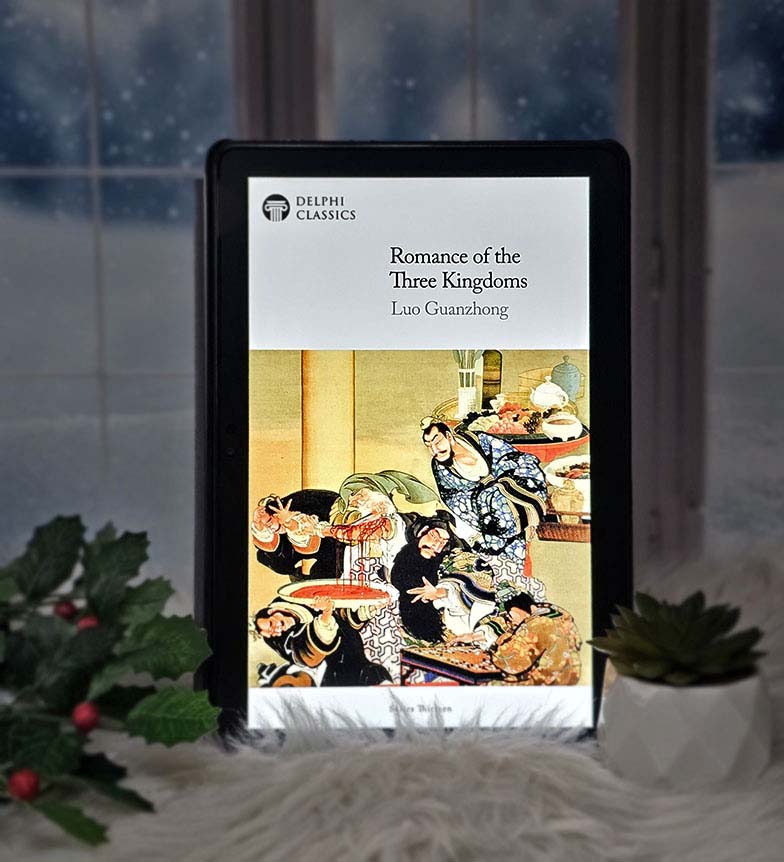
Romance of the Three Kingdoms
by Luo Guanzhong
In 184 CE the Yellow Turban Rebellion broke the Han dynasty, and the next hundred years of warlord chaos resolved into three rival kingdoms - Cao Cao's Wei in the north, Liu Bei's Shu-Han in the west, Sun Quan's Wu in the south - before the Sima family quietly inherited everything and reunified China as the Jin dynasty in 280 CE; more than a thousand years later, in the 14th century, Luo Guanzhong took the long accumulation of historical chronicle, opera, and storytellers' embellishment around that century and produced one of the Four Great Classical Novels of Chinese literature, which Moss Roberts has rendered into 2,300-plus unabridged English pages featuring the Oath of the Peach Garden between Liu Bei, Guan Yu, and Zhang Fei; the strategist Zhuge Liang treated as something close to a demigod; the Battle of Red Cliffs as the inflection point; and hundreds of warlords, surrenders, sieges, and stratagems any modern Western reader is going to have to commit to in a way most modern novels do not ask for.
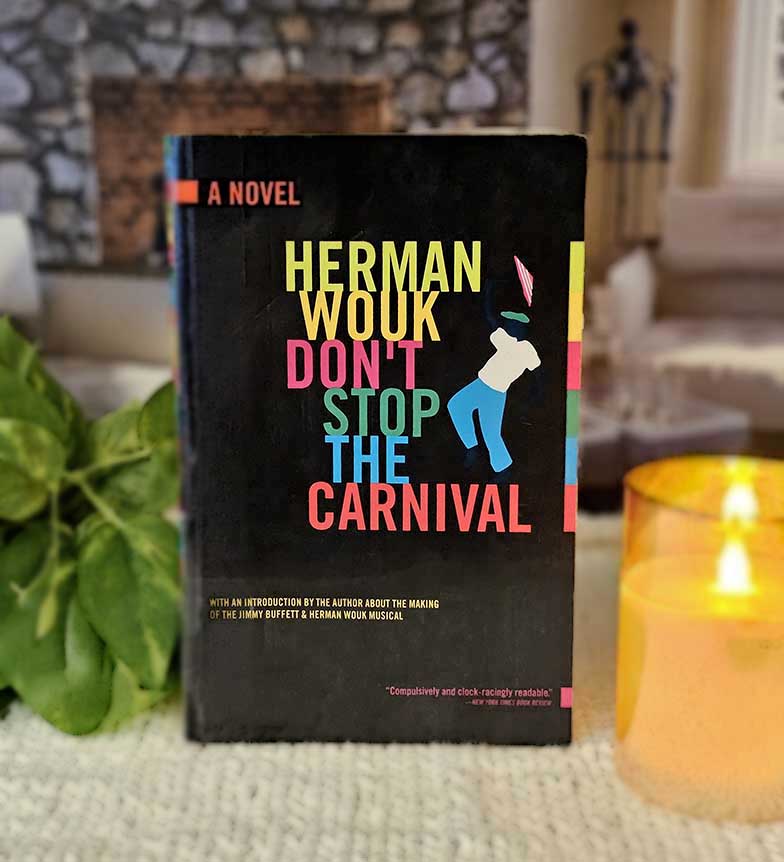
Don't Stop the Carnival
by Herman Wouk
Norman Paperman - a middle-aged Broadway press agent who has just had a heart attack and decided he is done with New York - flies to the fictional Caribbean island of Amerigo (which the people who live there still call by its old British name, Kinja) with his millionaire friend Lester Atlas, buys a faltering resort called the Gull Reef Club, leaves his wife Henny and daughter Hazel back home while he tries to make a go of it, nearly drowns on his first day and is rescued by a Navy frogman named Bob Cohn, takes up with a former actress named Iris Tramm who lives at the club, watches the hotel's water and electrical systems fail in sequence, watches Atlas fire his irreplaceable handyman Hippolyte while he is briefly off-island, and ends the novel agreeing with Henny to sell the hotel and go home. Herman Wouk's 1965 comic novel, drawn from the six years he and his wife actually spent running a small hotel in St. Thomas in the U.S. Virgin Islands.