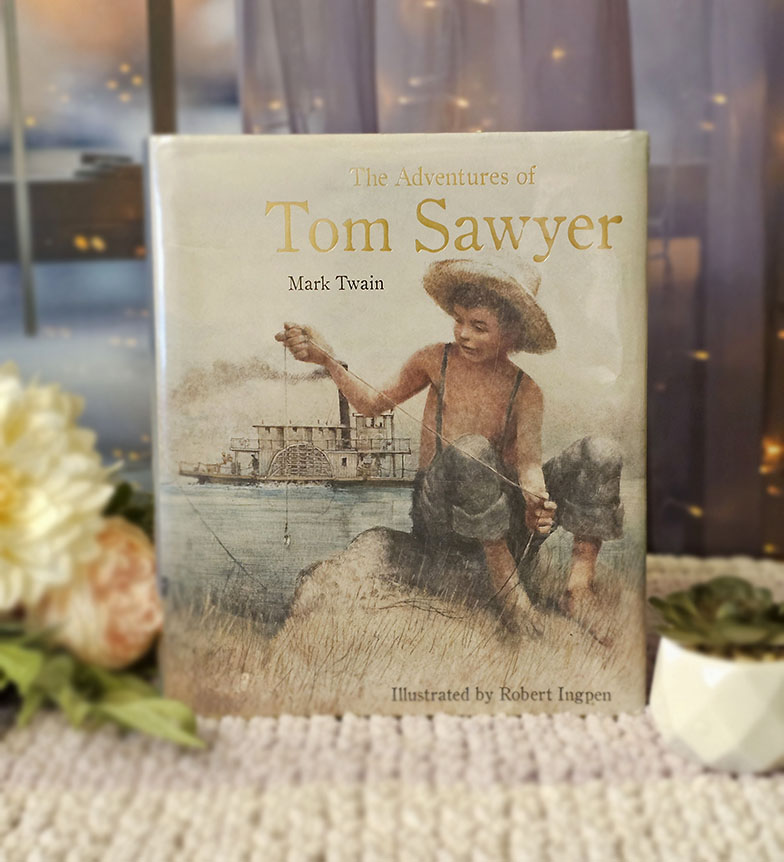
The Adventures of Tom Sawyer
by Mark Twain
Tom Sawyer - a clever, talkative, frequently dishonest small-town Missouri boy living with his Aunt Polly and his brother Sid in the fictional St. Petersburg, modeled on Mark Twain's own boyhood Hannibal - whitewashes a fence by selling the right to whitewash it, falls for the new judge's daughter Becky Thatcher, witnesses the murder of Dr. Robinson by Injun Joe one midnight in the graveyard with his friend Huckleberry Finn, swears a blood oath of silence and breaks it on the witness stand at the wrong man's trial, runs away with Huck and Joe Harper to Jackson's Island and returns in time to attend his own funeral, gets lost with Becky in McDougal's Cave on a school picnic, and ends the novel splitting twelve thousand dollars in buried gold with Huck. Mark Twain's 1876 boyhood novel, set on the 1830s-1840s Mississippi, and read for a century and a half as the canonical version of American childhood - alongside racial content that still requires the reader to do the work.
Buy this book:
Spoiler Warning
This review may contain spoilers. Read at your own discretion if you haven't finished the book yet.
A Whitewashed Fence, A Graveyard Murder, A Cave Picnic Gone Wrong, And One Hundred And Fifty Years Of American Boyhood
Mark Twain published The Adventures of Tom Sawyer in June 1876, set it in the 1830s or 1840s on the Mississippi River, and built the fictional town of St. Petersburg from his own boyhood Hannibal, Missouri. The book is about a clever, talkative, frequently dishonest, fundamentally decent boy named Tom Sawyer who lives with his Aunt Polly and his brother Sid; falls in love with the new judge's daughter, Becky Thatcher; takes up with the town pariah's son, Huckleberry Finn; and gets caught in a sequence of events that begins with a fence and ends with twelve thousand dollars in buried gold. Twain wrote it as a book for adults that children could read and was talked into framing it as a book for children that adults could read. The framing has stuck. The book is taught to twelve-year-olds, but it is being read by Twain. The voice on every page is the adult novelist's, looking back at a particular American childhood with the affection and the irony that the looking-back requires.
A 4.0 reflects: a comic novel that has not lost its comic engine in a century and a half, several individual scenes that have become foundational American literary set pieces, a third-act mystery plot that turns the boys' adventure book into something morally and structurally more serious, and unavoidable racial content - particularly the figure of Injun Joe and the language used about Black characters in the background - that any honest reading has to reckon with rather than skip past.
The Whitewashing, The Sunday School, And The Other Things The Book Is Famous For
The famous things are famous because they work. Aunt Polly catches Tom skipping school and sentences him to whitewash the fence on a Saturday morning. Tom, by the application of pure psychology, converts the punishment into a privilege so desirable that the other boys of St. Petersburg pay him in apples, marbles, a kite, and a one-eyed kitten for the right to do his chore. Twain follows the scene with one of the cleanest pieces of social satire he ever wrote: that work is whatever a body is obliged to do, and play is whatever a body is not obliged to do, and the difference is entirely a question of framing. The scene is funny, the boys are recognizable, and the joke is on every adult institution that has ever dressed up an obligation as an honor.
The Sunday school scene is the same trick run in reverse. Tom acquires the tickets that the school awards for memorized verses by the same trade-and-barter system, presents them to claim a Bible as a prize in front of the visiting Judge Thatcher and his daughter Becky, and is undone the moment the judge asks him a single question about scripture. The system rewards the form of piety and not the content. Tom has exploited the system perfectly. The system has, in the satirical sense, exploited itself.
The Graveyard, The Trial, And The Boys' Adventure Book Stops Being One
At the structural midpoint of the novel, the book turns. Tom and Huck go to the graveyard at midnight to test a wart-cure superstition that requires a dead cat. They witness three men robbing a grave: the young Dr. Robinson, the town drunk Muff Potter, and Injun Joe. The three start fighting over money. The doctor strikes Potter unconscious with a headboard. Injun Joe stabs the doctor dead, puts the knife in Potter's hand, and tells the waking Potter that he did it himself in a drunken blackout. Tom and Huck flee, swear a blood oath of silence by pricking their fingers with needles and signing their initials in blood, and live in terror of Injun Joe for the next several weeks while Muff Potter sits in jail for a murder he did not commit.
Tom breaks the oath. At Potter's trial, after watching the prosecution build its case toward a hanging, he takes the witness stand and tells the truth. Injun Joe escapes through a courthouse window. From that point on, the book is structurally a thriller. Injun Joe is at large. He has reasons to want Tom dead. He is operating disguised as a deaf-and-dumb Spaniard. The boys' game of pirates and treasure hunters - including the stretch in which Tom, Huck, and Joe Harper run away to Jackson's Island, are presumed drowned, and return to St. Petersburg in time to attend their own funeral - is now happening in a town with a murderer in it.
McDougal's Cave And The Resolution
The climax is the school picnic at McDougal's Cave. Tom and Becky wander away from the main party and become lost in the cave system for three days, traveling miles from the entrance, surviving on the scraps of food Tom has on him, and confronting starvation and the dark in a way the boys' adventure earlier in the book has not asked them to. Tom finds a way out. Inside the cave, in a separate part of the system, is Injun Joe, who has been hiding there with stolen money. Judge Thatcher, on learning that children had been lost in the cave, has the entrance sealed with a sheet-iron door. The town discovers what it has done when, days later, it reopens the cave and finds Injun Joe dead just inside it. Tom and Huck return to the cave and recover twelve thousand dollars in gold. They become, by the standards of St. Petersburg, rich children. The novel ends with the Widow Douglas adopting Huck and trying to civilize him, an arc Twain would pick up and complicate in Adventures of Huckleberry Finn less than a decade later.
What The Book Is And What It Carries
There is, in the literature of nineteenth-century American childhood, no other book that does what this book does. The voice is the adult Twain's; the affection for the small Mississippi town is real; the satire of its institutions - the Sunday school, the temperance pledge, the courtroom, the funeral - is exact; and the structural move from comic boyhood to grave-robbery, murder, and a child lost in the dark is the move that made the book outlast its imitators.
There is also racial content that has aged exactly as badly as it was always going to. Injun Joe is the novel's villain, and Twain renders him as a racial caricature; his Native ancestry is invoked as an explanation for his violence in a way any contemporary reader will recognize as the working logic of a racist culture writing its own villains. The language used about Black characters in the background of St. Petersburg is the language of 1876 talking about the 1840s, and the book uses period slurs throughout. Twain himself moved on from this material - Adventures of Huckleberry Finn is fundamentally a novel about the moral cost of the slavery the background of Tom Sawyer takes for granted - but the move comes later, and the move is not retroactively present in Tom Sawyer.
Why a 4
The strengths: a comic engine that still runs, a half-dozen scenes that have become canonical for reasons that hold up on the page, a structural shift at the midpoint that earns the book's reputation as more than children's literature, and the foundational status it holds in American literature regardless of what one makes of it. The reservations: female characters - Aunt Polly, Becky, the Widow Douglas - exist almost entirely in relation to the boys; the racial caricature of Injun Joe and the period language about Black townspeople need to be read as the historical artifacts they are rather than waved away; and the cave-and-treasure climax, while structurally earned, is theatrical in a way the satirical first half is not.
A 4.0 means: a foundational American novel that earns its reputation, that is genuinely fun to read, and that has to be read with the historical apparatus on. Read it with the apparatus on. The book is better for the honest engagement than for the comfortable forgetting.
Rating: 4.0/5 ⭐
Perfect for: Readers wanting the canonical 19th-century American boyhood novel on its own terms, fans of comic prose with satirical bite, anyone preparing to read _Huckleberry Finn next, parents or teachers willing to read alongside a child and discuss the harder material as it appears._
Skip if: You are not willing to engage with the racial caricature of Injun Joe and the period slurs in the background, you need a novel in which female characters have their own arcs, or you find the cave-and-treasure climax too theatrical for the comic register of the first half.
You Might Also Like

The Outsiders
by S.E. Hinton
S.E. Hinton's 1967 novel - written while she was a junior in high school - opens on fourteen-year-old Ponyboy Curtis getting jumped on his way home from a movie in Tulsa, and walks the next several days through a fountain killing, a hideout in an abandoned country church, a fire that saves schoolchildren, a rumble between greasers and Socs, a Robert Frost poem, and one of the more devastating closing arcs in YA literature.

Chaereas and Callirhoe
by Chariton
Chariton of Aphrodisias's mid-first-century AD Greek romance - the oldest surviving complete prose novel - sends the supernaturally beautiful Callirhoe and her Syracusan husband Chaereas through entombment, pirates, slavery in Miletus, an adultery trial in Babylon before the Persian king Artaxerxes, an Egyptian rebellion, and a naval battle on their two-thousand-year-old way back to each other.

The Call of the Wild
by Jack London
Jack London's 1903 short novel: Buck, a 140-pound St. Bernard / Scotch Shepherd mix living the comfortable life on Judge Miller's California ranch, is stolen one night by a gambling-debt-saddled gardener's helper, sold into the Klondike Gold Rush as a sled dog, and slowly discovers - through cold, club, fang, and the man named John Thornton he comes to love - the wolf that has always been inside him.