
Chaereas and Callirhoe
by Chariton
Chariton of Aphrodisias's mid-first-century AD Greek romance - the oldest surviving complete prose novel - sends the supernaturally beautiful Callirhoe and her Syracusan husband Chaereas through entombment, pirates, slavery in Miletus, an adultery trial in Babylon before the Persian king Artaxerxes, an Egyptian rebellion, and a naval battle on their two-thousand-year-old way back to each other.
Buy this book:
Spoiler Warning
This review may contain spoilers. Read at your own discretion if you haven't finished the book yet.
The Oldest Surviving Romance Novel Has Pirates, Persia, an Adultery Trial in Babylon, and Two People Who Refuse to Stay Apart
The premise of Chaereas and Callirhoe is the premise of every romance novel that has ever been written, and the one being written right now somewhere by someone on a deadline. Two beautiful people fall in love. They marry. Something separates them. They will spend the rest of the book trying to find each other. The thing that lifts this particular book - written in the mid-first century AD by Chariton of Aphrodisias, surviving in a single thirteenth-century manuscript and a handful of papyrus fragments - past the level of "early example of a familiar genre" is that it is, by the standard scholarly account, the oldest surviving complete prose novel in any language. Every romance, every adventure novel, every quest-and-reunion story that organizes itself this way is downstream of this book. The arrows of literary genealogy point back here.
A 4.0 reflects: a genuinely surprising read for a novel two thousand years old, one whose plot machinery and emotional beats land with a freshness that is hard to predict from the dating alone, and a short book whose scholarly significance and reading-pleasure significance both earn the rating.
Syracuse, the Kick That Looked Like a Death, and the Pirates Who Opened the Tomb
The action is set against a historical background of around 400 BC - which makes this, incidentally, also a strong candidate for the first historical novel ever written. Callirhoe is the daughter of Hermocrates, the real Syracusan general who defeated Athens in the Peloponnesian War, and the most politically important man in the city at the time the novel begins. Chaereas is a young man of comparable stature. They meet, they fall in love at the moment of a glance, and they marry. The disappointed suitors who lost out to Chaereas conspire to make him think Callirhoe has been unfaithful. Chaereas, in the kind of jealous rage Greek narrative loves, kicks her hard enough that she falls over and appears to be dead. There is a funeral. Callirhoe is shut up in her family's tomb.
She is not dead. She wakes up in the tomb, in the dark, alone. She is also pregnant by Chaereas, though she does not yet know it. While she is gathering the small coherence of someone waking up in their own tomb, pirates open the tomb to rob it - they have heard the funeral was for a wealthy young woman and figured the grave goods would be substantial. The pirates, briefly terrified by the woman they thought was a corpse sitting up among the gold, recover quickly, take both her and the grave goods, and decide to sell her as a slave at the next major city the route passes through. The next major city is Miletus, on the coast of what is now Turkey.
Miletus, Dionysius, and the Pregnancy She Cannot Hide Forever
In Miletus, Callirhoe is bought by Dionysius, the most powerful local nobleman. Dionysius falls in love with her almost immediately. He is, by the book's careful presentation, a genuinely good man - widowed, lonely, inclined to do right by the woman he has unexpectedly come to love - and Callirhoe, who knows herself to be already married and is now also pregnant by Chaereas, has to make the decision the book turns on. She marries Dionysius. She does not tell him about the pregnancy. The child, when it is born, is presented to Dionysius as his.
Chariton plays this with a moral seriousness that is, frankly, surprising for a book of this age. Callirhoe is not condemned for the bigamy, and not romanticized for it either. She is a woman trying to keep herself and a child alive in a structure that gives her almost no other levers. Dionysius is not the villain. The book lets the situation be the situation, complicated and unsolvable on its own terms, and lets the reader feel the weight of it.
Mithridates, Babylon, and the Trial That Goes Wrong for Everyone
Meanwhile, Chaereas and his loyal friend Polycharmus have set out from Syracuse to find Callirhoe (whom, plot mechanics, Chaereas does not yet know is alive). They are eventually sold as slaves themselves to Mithridates, governor of Caria, who has separately fallen in love with Callirhoe and has been trying to figure out how to win her. When Mithridates discovers that one of his new slaves is the husband Callirhoe spent her first marriage to, the politics get complicated fast. Dionysius accuses Mithridates of attempting adultery with Callirhoe. The case goes to Artaxerxes, the Persian king, in Babylon, where the entire cast eventually converges for an adjudication of who, exactly, Callirhoe is married to and what, exactly, the law has to say about her status.
The trial in Babylon is the structural climax of the novel's middle, and it is one of the more bravura scenes in ancient prose. Mithridates defends himself by producing a living Chaereas in front of the king, the court, and Dionysius - the man Callirhoe has spent the last several years convincingly mourning. Chaos. Artaxerxes himself starts falling in love with Callirhoe. The case becomes politically impossible to resolve.
The Egyptian Rebellion, the Naval Battle, and the Long Way Home
What resolves the trial is a coincidentally timed Egyptian rebellion against Persian rule. Artaxerxes goes to war. Chaereas, separated from Callirhoe again by the war's logistics, ends up fighting on the Egyptian rebel side, where his military gifts (which the book has been hinting at) suddenly matter. He storms Tyre. He wins a naval victory against the Persians. The reunion that closes the novel happens in the wake of military success rather than narrative coincidence, which is exactly the structural move the genre will keep making for the next two thousand years. They return to Syracuse. In one of the more charming meta moves the book makes, Chaereas, in the closing scene, summarizes the entire plot to the assembled people of Syracuse - the world's earliest surviving "and that, friends, is the story of how I got here" - while Callirhoe, in private, offers her thanks to Aphrodite, whose role as the goddess instigating the entire plot Chariton has been carefully laying out from the first chapter.
What Two Thousand Years Hasn't Faded
The strengths are: the plot machinery, which works; Callirhoe as a heroine with real interiority, who navigates the impossible bigamy plot with strategic intelligence rather than passivity; the Babylon trial as a scene; the willingness to take a five-act plot of love-loss-love through actual political and military scale rather than keeping it small. The reservations are reasonable: characters tend toward type rather than depth (this is, after all, romance two thousand years before psychological realism would be invented as a literary technique), the coincidences are stacked the way coincidences get stacked in a genre that hadn't yet had to apologize for them, and slavery functions as accepted plot machinery in a way the modern reader should register without expecting Chariton to have thought differently.
A 4.0 means: a book that genuinely paid me back for reading it, that sits at the headwaters of an enormous literary river, and that I would press on any reader curious about how old some of the moves we still use are. Chariton crammed kidnapping, slave trading, a buried-alive scene, an attempted crucifixion (Chaereas comes very close to one in the middle), a trial in front of a Persian king, and battles by land and by sea into 123 pages, and the result reads better than its age would predict.
Rating: 4.0/5 ⭐
Perfect for: Classics readers, anyone curious about the prehistory of the romance and adventure novel, students of literary genealogy, readers who want a short ancient text that delivers narrative pleasure rather than only scholarly value.
Skip if: You want psychological realism in your fiction, you find coincidence-heavy plotting frustrating, or you're not in a position to register the era's treatment of slavery and women's agency in historical context.
You Might Also Like
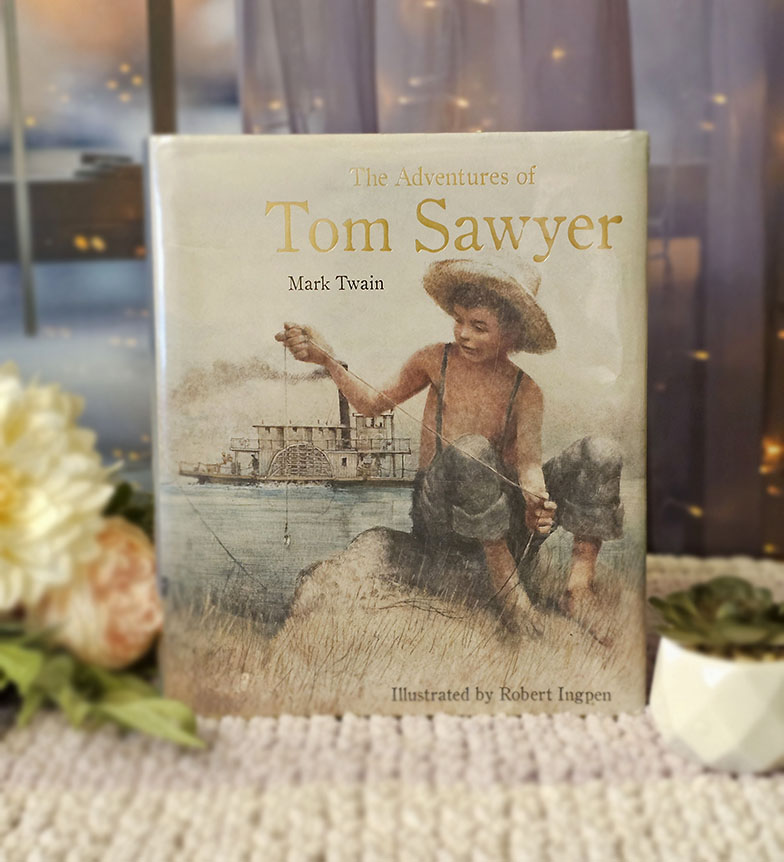
The Adventures of Tom Sawyer
by Mark Twain
Tom Sawyer - a clever, talkative, frequently dishonest small-town Missouri boy living with his Aunt Polly and his brother Sid in the fictional St. Petersburg, modeled on Mark Twain's own boyhood Hannibal - whitewashes a fence by selling the right to whitewash it, falls for the new judge's daughter Becky Thatcher, witnesses the murder of Dr. Robinson by Injun Joe one midnight in the graveyard with his friend Huckleberry Finn, swears a blood oath of silence and breaks it on the witness stand at the wrong man's trial, runs away with Huck and Joe Harper to Jackson's Island and returns in time to attend his own funeral, gets lost with Becky in McDougal's Cave on a school picnic, and ends the novel splitting twelve thousand dollars in buried gold with Huck. Mark Twain's 1876 boyhood novel, set on the 1830s-1840s Mississippi, and read for a century and a half as the canonical version of American childhood - alongside racial content that still requires the reader to do the work.

The Outsiders
by S.E. Hinton
S.E. Hinton's 1967 novel - written while she was a junior in high school - opens on fourteen-year-old Ponyboy Curtis getting jumped on his way home from a movie in Tulsa, and walks the next several days through a fountain killing, a hideout in an abandoned country church, a fire that saves schoolchildren, a rumble between greasers and Socs, a Robert Frost poem, and one of the more devastating closing arcs in YA literature.

Pride and Prejudice
by Jane Austen
Jane Austen's 1813 masterpiece follows Elizabeth Bennet through misjudgment and revelation - a Hunsford proposal that goes horribly, a letter that rearranges everything, a visit to Pemberley that changes what she thought she knew - in the great Regency comedy of manners about what we get wrong about other people and ourselves.