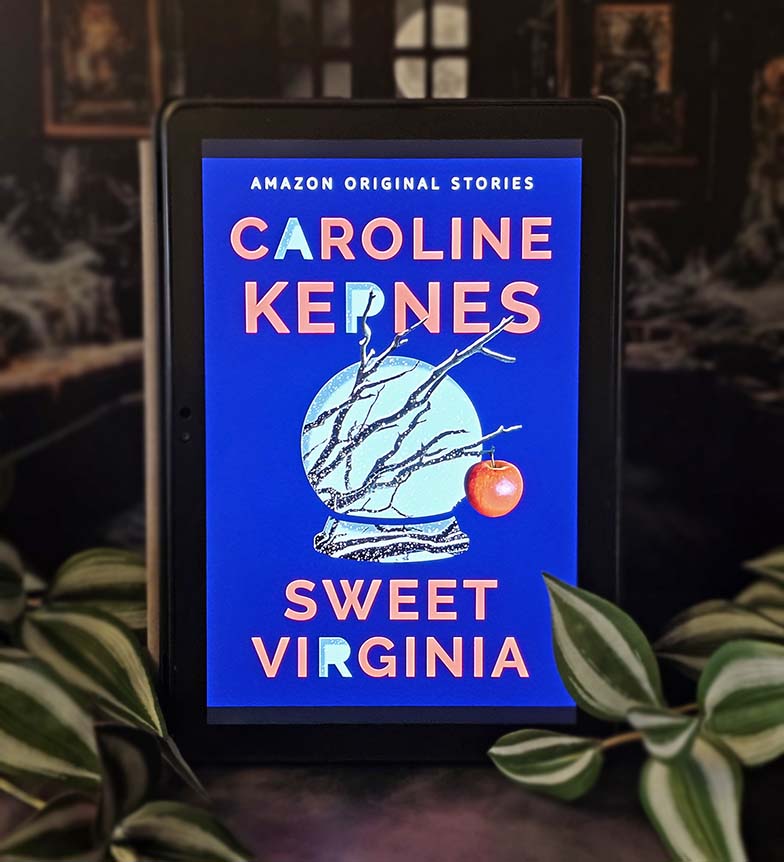
Sweet Virginia
by Caroline Kepnes
Caroline Kepnes's contribution to Amazon's Out of Line collection sends an exhausted, recently-fired new mother named Shelby chasing a Hallmark-movie fantasy with a secret admirer - and lands her, in a darkly comic Stepford Wives-meets-The Prisoner pivot, on a rehabilitation ranch for women classified W2 who must be retrained into W1 before they're allowed to go home.
Buy this book:
Spoiler Warning
This review may contain spoilers. Read at your own discretion if you haven't finished the book yet.
A Story That Looks Like Hallmark and Ends Like Stepford
Shelby has been recently fired, has a new baby, has a passive-aggressive mother she still can't get out from under, has a strained marriage, and has just lost the family dog under circumstances she blames herself for. The one place her life resembles anything she'd want to live in is the inside of the Hallmark Channel movies she watches on a loop - the small-town heroines, the handsome locals, the pumpkin spice, the ninety-minute resolutions. When a secret admirer arrives offering to sweep her into exactly that life, the temptation is heady. Shelby goes.
What Caroline Kepnes is doing in Sweet Virginia - her contribution to Amazon's Out of Line short-story collection, narrated on audio by Kristen Bell - is bait-and-switch in the best Kepnes tradition. The story you think you're reading is a dark-comic meditation on the Hallmark fantasies women use to survive ordinary catastrophes. The story you're actually reading takes a hard left at the midpoint into something closer to The Stepford Wives crossed with The Prisoner, where the sweep-away the secret admirer promised turns out to be a kidnapping with a curriculum. A 3.0 here reflects how cleverly the pivot lands and how much the ending leaves on the table.
Shelby's Ordinary Wreck
Kepnes spends the first half of the story building exactly the kind of life a Hallmark movie would want to redeem. Shelby is exhausted in the specifically isolating way new motherhood produces. Her mother is the variety of passive-aggressive that hides instructions inside compliments. Her marriage is the variety of strained that doesn't quite count as failing yet. The dog is dead and Shelby is sure it's her fault. The unemployment letter is recent. None of these is melodramatic on its own; together they form the standard-issue domestic suffocation that is Kepnes's preferred starting weather. The Hallmark obsession is rendered with affection rather than mockery - Kepnes is not interested in dunking on women who use ninety-minute small-town romances to get through a Tuesday, and the story is clearer for that.
Then the secret admirer materializes. He says all the right things. He offers exactly the rescue the movies promised. Shelby, drowning, lets him.
The Ranch, and W1 Versus W2
The pivot is where the story becomes itself. Shelby wakes up not in a Hallmark small town but at a rehabilitation ranch for women, where a mysterious authority figure cheerfully explains the categorization system. Women here are sorted into two groups: W1, who are good wives and good mothers, and W2, who are not. Shelby has been classified W2. Her stay at the ranch will continue until she has been transformed from a W2 into a W1, at which point she will be permitted to return home. Whether this is a literal program, a metaphor for how the culture actually treats women who fall behind on the script, or both at once is the story's deliberate ambiguity. The Stepford comparison reviewers reach for is fair; so is the Prisoner comparison; the closed-system register Kepnes locks the story into is something both of those reference texts taught their readers to recognize.
What Kepnes does well in the ranch chapters is keep her tonal control. The cheerfulness of the regime is the horror. Nobody is yelling. Everyone is helpful. The categorization is presented as a kindness; the rehabilitation is presented as a service. The only thing missing is Shelby's consent.
Why a 3
The strengths are the setup, the pivot, the tonal control, and Kristen Bell's audiobook narration, which sells the Hallmark register and the ranch register equally well. The reservation - and it's the same reservation a number of Goodreads reviewers landed on - is the ending. Several readers have flagged that the conclusion feels abrupt and too open-ended; others have said the story is hard to fully parse on a single read. Both notes are fair. The story is committed to its ambiguity, and ambiguity at forty-five pages is harder to land than ambiguity at three hundred. Kepnes has built a premise that could carry a novel; the short-story compression makes it land somewhere between sharp parable and unfinished sketch.
A 3.0 means: a clever piece by a writer I trust, with an excellent middle and a final stretch I wished she'd had more room for. If you came for You-style psychological thriller, this isn't that. If you came for darkly comic short fiction about the small print on the Hallmark dream, it delivers - up until the moment it asks you to sit with what it isn't going to spell out.
Rating: 3/5 ⭐
Perfect for: Caroline Kepnes readers willing to follow her outside the You universe, fans of darkly comic Stepford-adjacent dystopias, anyone who wants a forty-five-minute audiobook with Kristen Bell narrating.
Skip if: You want a tightly resolved ending, you'd prefer Kepnes in full thriller mode rather than parable mode, or stories about kidnapping and forced "rehabilitation" of women are too close to current anxieties for comfort.
You Might Also Like
This Telling
by Cheryl Strayed
An Ancestry.com match arrives in the inbox of a woman who has spent forty-plus years pretending the baby she gave up for adoption in 1964 never existed - and Cheryl Strayed traces, in a tight short story for Amazon's Out of Line collection, what happens when a teenager named Geraldine Waters has to integrate the life she actually lived with the one she's been telling.
The Contractors
by Lisa Ko
A tech reporter's misdirected email connects two women eight thousand miles apart - both named Sandra Guzman, both contract content moderators for the same mega social media platform, one in New Jersey and one in the Philippines - and the friendship that grows between them across the inbox starts to look, by the end, like the beginning of a campaign.
Halfway to Free
by Emma Donoghue
Emma Donoghue's contribution to Amazon's Out of Line collection imagines a 2060 in which the climate crisis has been answered by a society that strongly disincentivizes having children - and Miriam, who has accepted the rules her whole life, finds at a work retreat that she and a coworker named Ned both want what almost no one is allowed to want anymore.