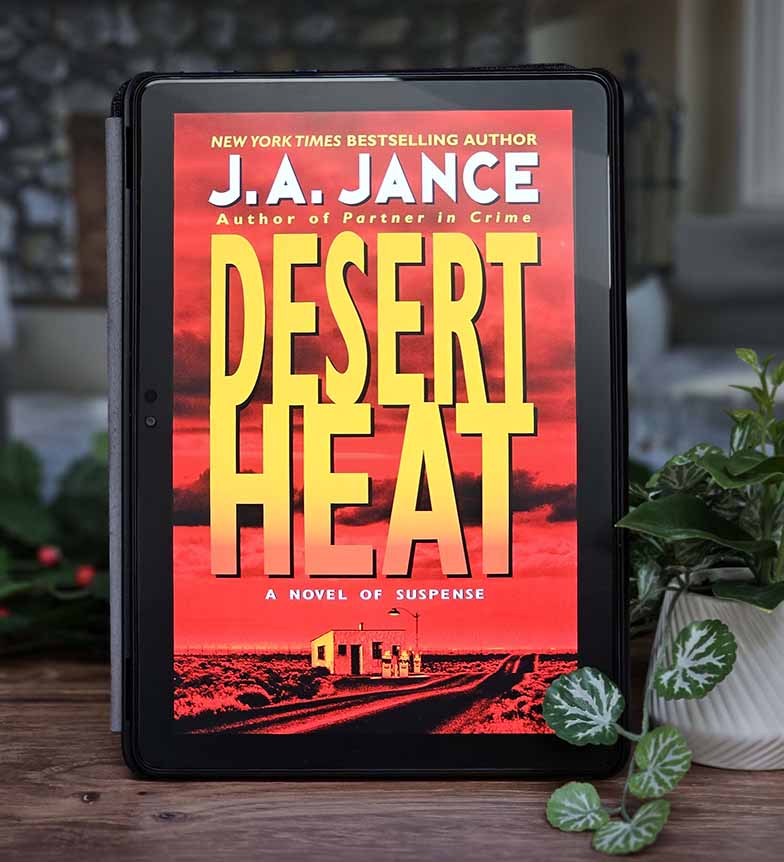
Desert Heat
by J.A. Jance
When her deputy husband is shot and killed in the Arizona desert - then accused of being a crooked cop - Joanna Brady refuses to accept the lies and launches her own investigation to clear his name and find his killer.
Spoiler Warning
This review may contain spoilers. Read at your own discretion if you haven't finished the book yet.
A Widow Becomes a Detective
Life is good for Joanna Brady in the small desert community of Bisbee, Arizona. She has Jenny, her adored nine-year-old daughter, and Andy, her solid, honest, loving husband - a full-time Cochise County sheriff's deputy who's running for Sheriff against his longtime boss, Walter McFadden. Then, on the night of their tenth wedding anniversary, Joanna finds Andy shot in the Arizona desert. He dies soon after in the hospital under suspicious circumstances - circumstances that suggest someone wanted to make sure he didn't survive to talk about what happened.
But that's only the beginning of the nightmare. Police rule Andy's shooting an attempted suicide. Then he's implicated as the hit man in a mob killing and fingered as a crooked cop with drug cartel connections. Allegations of an extramarital affair surface. The DEA comes after Joanna. At school, classmates taunt nine-year-old Jenny with the accusations against her dead father. The comfortable world Joanna built is being systematically destroyed - and she knows a cover-up when she sees one, even if nobody believes her.
J.A. Jance - who grew up in Bisbee herself, which gives the setting an authenticity that's palpable on every page - introduces Joanna Brady in Desert Heat, the first book of what would become a beloved twenty-plus book series. It's the origin story of a woman who wasn't a detective, wasn't trained in law enforcement, and had no business investigating a murder - except that the murder was her husband's, the official story was a lie, and nobody else was going to fix it.
The Investigation Joanna Has No Business Running
Joanna isn't a cop. She's a grieving widow who refuses to let her husband's name be dragged through the mud by people she knows are lying. Despite having no law enforcement experience, despite being consumed by grief so fresh it hasn't even had time to harden into anger yet, despite skepticism from nearly everyone around her - including her own mother, Eleanor Lathrop, who has spent the better part of two decades at odds with her daughter ever since Joanna's father D.H. Lathrop died when Joanna was fifteen - she launches her own investigation into who killed Andy and why.
The narrative cross-cuts between Joanna's determined amateur detective work and the perspective of Tony Vargas, the contract killer who shot Andy. We see the conspiracy from both sides - the widow methodically piecing together what happened, and the dangerous man whose choices destroyed her family. Vargas is not a sympathetic character, but Jance gives him enough interiority that he functions as more than a shadowy villain. His scenes create a mounting dread that intensifies as Joanna's investigation brings her closer to people who've already killed once and have every reason to kill again.
The key break comes from an unexpected source: Angie Kellogg, a former prostitute who had been Tony Vargas's prisoner and girlfriend. Angie knows Tony was responsible for Andy's murder, and she escapes from him to seek out Joanna and tell her the truth. Multiple reviewers have called Angie the real hero of the story, and it's hard to argue - without her testimony, the corruption that killed Andy would have stayed buried under the official suicide narrative. Angie's courage, which costs her far more than it costs Joanna, gives the book's message about unlikely heroism a sharper edge than the protagonist's story alone could provide.
Grief as Obstacle and Fuel
What makes Joanna compelling from page one is that Jance doesn't make her superhuman. She's grieving in that raw, first-week way that makes everything harder - thinking clearly is a struggle, eating is impossible, every room in the house holds a memory that ambushes her. She has Jenny to raise alone now. She has Eleanor's opinions about what she should and shouldn't be doing. She has a community that watched her husband accused of crimes she knows he didn't commit and a justice system that seems perfectly content to let a dead man take the blame for a conspiracy he was trying to expose.
Jance captures the specific texture of grief that coexists with fury - the way Joanna can be sobbing one moment and ice-cold determined the next, the way the need to protect Andy's memory becomes indistinguishable from the need to protect Jenny's future. Publishers Weekly called the book "a taut and poignant mystery" that "crackles with tension," and the tension comes as much from Joanna's emotional state as from the external danger. She's not just investigating a murder. She's fighting to keep her husband's reputation from being the second thing she loses.
The mother-daughter dynamic between Joanna and Eleanor adds a layer that's less about the mystery and more about the kind of woman Joanna is becoming. Eleanor is critical, controlling, and thoroughly convinced that Joanna should stop this dangerous foolishness and focus on raising Jenny. Joanna resists not because Eleanor is always wrong - sometimes her mother's caution is justified - but because accepting Eleanor's framework would mean accepting that Andy was what they say he was. The conflict between them is one of the series' longest-running threads, and it starts here with enough specificity to make it feel like a real relationship rather than a genre shorthand.
Bisbee and the Desert
The Sonoran Desert becomes almost a character in this novel. Jance grew up in Bisbee, and it shows - she captures everything about rural Arizona with the familiarity of someone writing about home rather than setting. The stark beauty, the oppressive heat, the unique mix of cultures along the border, the way small-town politics have long memories and longer grudges. Bisbee and Cochise County feel specific and real, not like generic Southwest backdrop painted behind a crime story.
The setting shapes the crime and the investigation. Drug cartels operate across the nearby border, making the false drug-connection accusation against Andy feel plausible enough that even sympathetic people half-believe it. Small-town visibility means Joanna's investigation is public in a way that a city detective's wouldn't be - every question she asks is noted, every ally she cultivates is observed, every step she takes toward the truth is a step that the people who killed Andy can track. The landscape itself - vast, dry, indifferent - mirrors Joanna's emotional isolation. Nobody is coming to help. The desert doesn't care who's right. If she wants justice, she has to walk out into it and find it herself.
Where the Origin Story Lands
By the book's end, Joanna has solved Andy's murder and cleared his name. But she hasn't become Sheriff - not yet. What she does is decide to run for Sheriff, picking up the campaign Andy started and carrying it forward. She'll win that election in the second book, Tombstone Courage, and begin her career as Cochise County's first female sheriff. Desert Heat is the origin story, not the coronation, and that distinction matters. Joanna earns the right to seek the office by proving - to herself as much as anyone - that she has the determination, the intelligence, and the moral backbone the job requires.
The book does everything a series starter should: it establishes a protagonist worth following across twenty-plus novels, creates a setting vivid enough to sustain them, introduces supporting characters who will develop over decades of storytelling, and tells a complete murder mystery while leaving room for the larger story of who Joanna Brady is becoming. Publishers Weekly noted that "the post-showdown ending seems trite," and there's some truth to that - the final pages wrap up a compressed three-day timeline a bit too neatly, and some of the plot coincidences strain credibility. Jance's prose also leans on adverbs in ways that can feel clunky, and some of the violent and sexual content involving Tony Vargas is more graphic than the mystery genre typically demands.
But these are the rough edges of a debut in what would become one of the strongest female-detective series in American crime fiction. Joanna Brady at the start of Desert Heat is a woman who has no idea what she's capable of. By the end, she has an idea - and twenty books ahead of her to prove it.
Rating: 4.0/5 ⭐
Perfect for: Anyone looking for a great mystery series to start from the beginning, fans of strong female protagonists who earn their authority rather than starting with it, readers who love Southwestern settings and character-driven crime fiction.
Skip if: You prefer your detectives already established and confident, the graphic violence around Tony Vargas is difficult, or you need airtight plotting without convenient coincidences.
You Might Also Like

Dead to Rights
by J.A. Jance
When the town veterinarian who killed a woman while driving drunk is found murdered by pitchfork in his burning barn, Sheriff Joanna Brady must prove that the obvious suspect - the victim grieving widower - is innocent while juggling multiple crises including a hostage situation involving her own daughter.

Tombstone Courage
by J.A. Jance
Two months into her job as the first female sheriff of Cochise County, Joanna Brady investigates when rancher Harold Patterson is found dead at the bottom of a mine pit - along with a second, older set of remains that raises disturbing questions about long-buried family secrets.
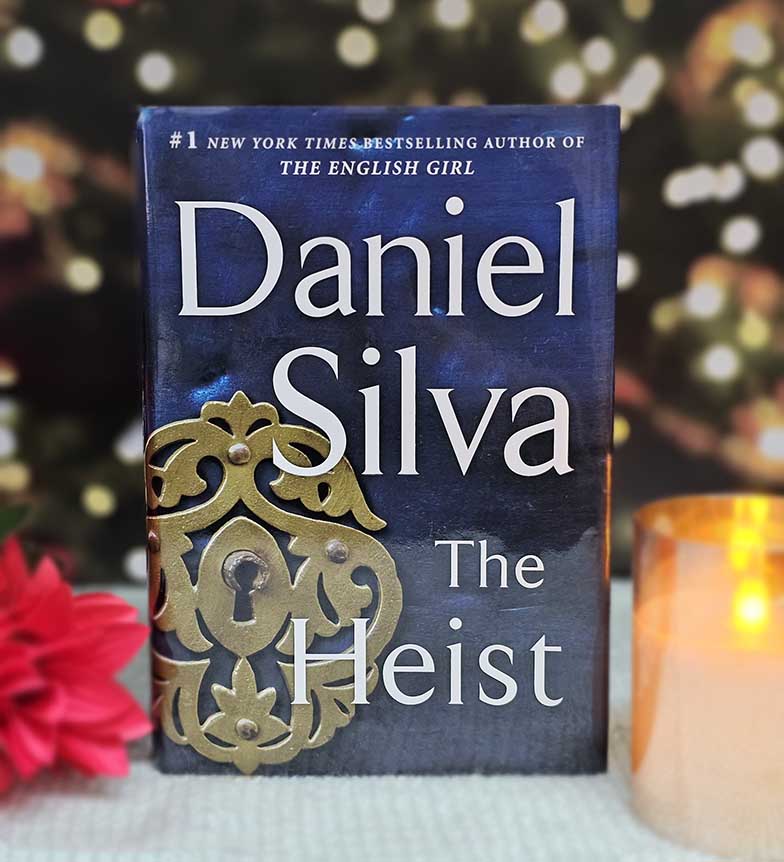
The Heist
by Daniel Silva
Daniel Silva's fourteenth Gabriel Allon novel: when London art dealer Julian Isherwood finds his colleague Jack Bradshaw - a former British intelligence officer turned art trafficker - tortured and murdered at a villa on Lake Como, Allon, the Israeli spy and master art restorer, is pulled in by the Italian Art Squad to recover a Caravaggio stolen in 1969, and the hunt leads through the Geneva Freeport and a private Austrian bank to the looted billions that Syria's Bashar al-Assad has hidden across Europe.