
Outlaw Mountain
by J.A. Jance
When free-spirited elderly widow Alice Rogers is found dead in the desert clutching an insulin vial - despite not being diabetic - Sheriff Joanna Brady investigates her greedy children, her mysterious younger boyfriend, and a web of land development corruption.
Spoiler Warning
This review may contain spoilers. Read at your own discretion if you haven't finished the book yet.
A Vial of Insulin in the Hand of a Woman Who Wasn't Diabetic
Alice Rogers, an elderly widow with a taste for Scotch and the glitter of Las Vegas, is found dead in the Arizona desert covered in vicious cholla cactus spines. In her hand is a vial of insulin. Alice wasn't diabetic. The cactus didn't finish her off either - she was injected by someone who watched her writhe in pain, then killed her there. That's the kind of opening that makes a reader sit up, and it's the puzzle Sheriff Joanna Brady is handed at the start of Outlaw Mountain, the seventh entry in J.A. Jance's long-running Cochise County series.
By book seven, Jance has settled into a rhythm: a vivid Arizona crime, a sprawling family of suspects, a half-dozen subplots that thread the personal into the procedural, and a sheriff growing into the job. Kirkus has called Jance's prose "not much dash" but credited her with a "reassuring sturdiness," and that's a fair read of what this book is and isn't. It isn't going to dazzle anyone with sentence-level pyrotechnics. It is going to deliver a satisfying mystery, a richly populated small town, and another step forward in Joanna's complicated life - and on the strengths Jance has chosen to play to, this is one of the more confident installments.
Alice Rogers and the People Who Stood to Inherit
Alice was something of a free spirit, and the kind of relative whose adult children grit their teeth at her choices. She loved her Scotch. She loved Vegas. And she had recently taken up with Farley Adams, a handyman roughly twenty years her junior who came to do work on her house and stayed when the work was done. To her hot-tempered daughter Susan, that arrangement looked exactly like what it tends to look like: a man positioning himself for an inheritance. Susan blames her brother Cletus - the irascible, do-nothing mayor of Tombstone - for failing to break up Mom's winter romance and protect what she sees as their estate. The book opens with Susan driving down to her mother's house in Cochise County and finding it ransacked. From that moment, the family's quiet greed is no longer hypothetical.
Joanna's first instinct is to look hard at the people closest to the money. The arrogant son and the irascible daughter are both visibly motivated; the mysterious handyman turned suitor is too obvious to ignore. It would be tempting to wrap things up around the teenagers caught driving Alice's car across the Mexican border, but Joanna isn't in a hurry to take an easy answer. The further she pushes, the less the pieces line up - and the more the case starts to feel less like a family quarrel and more like the surface of something a lot uglier underneath.
The Handyman's Fingerprints
The Farley Adams angle is where the book's plotting really earns its keep. Farley vanishes after Alice's death, leaving behind no fingerprints, no paper trail, nothing that suggests the man who lived in Alice's house was ever quite who he said he was. When his prints finally do surface, they belong to a dead Las Vegas detective who had been investigating corruption - a revelation that turns the case from a domestic murder into something with reach. The investigation widens into a heroin ring and into political pockets that don't enjoy being looked into. What started as a quarrel over an old woman's estate becomes a question about who else benefited from her staying out of the way.
Jance is good at this kind of slow widening of the lens. The personal motivations don't disappear when the case gets bigger - Susan's resentment, Cletus's cowardice, the family's ugly arithmetic all stay on the page - but they sit inside a larger frame. Publishers Weekly noted that some character motivations in the book are "murky," and that's a real critique; not every secondary player gets the development they deserve. But the central engine - a small-town widow's death rippling outward into corruption that crosses state lines - is the kind of structure the Brady series does well.
Side Trails Through the Cactus
Around the central case, Jance lets the texture of Cochise County breathe. The construction of a new mountain subdivision on previously pristine land has drawn environmental protesters, and the friction between developers and activists threatens to tip into eco-terrorism, with sabotage at the construction site bringing Joanna's department in. A woman is hauling rattlesnakes around the desert in an effort to preserve their habitat from the bulldozers. A developmentally disabled man named Junior is abandoned by scheming relatives at a local event, and Joanna takes responsibility for finding someone who will actually take care of him. None of these subplots is the case, but each one is the kind of thing a real rural sheriff actually deals with on a Tuesday, and they make the county feel inhabited.
That said, this is also where the book's structural flaws are most visible. Some reviewers have felt the two main plot threads - the Rogers murder and the development conflict - compete for attention rather than weave together, and that the narrative occasionally bobs awkwardly between them. The Junior storyline, while warmly intended, has drawn criticism for the way his disability is handled. Worth flagging both, particularly the second. The book is generally a humane one, but the late-1990s framing of Junior shows its age, and a reader sensitive to that won't be wrong to find it uncomfortable.
Butch, Eleanor, and a Sheriff's Personal Pile-Up
The personal layer of the book is where this entry shifts the series. Joanna's relationship with Butch Dixon - the sweet-natured former restaurateur she met back in Shoot, Don't Shoot - moves decisively from will-they to when. Butch presses honorable intentions; Joanna stops hedging; an engagement settles into place and a wedding starts to look real. Publishers Weekly has flagged that Butch can read as "sometimes too perfect," and there's truth to that - he is, in genre terms, a remarkably accommodating love interest - but the commitment is a meaningful turning point for Joanna after several books of professional and personal upheaval, and Jance writes it with warmth.
Not everyone takes the engagement well. Joanna's chief deputy Dick Voland, who has carried a quiet torch for her across earlier books, gets drunk and hands in his resignation. Her mother Eleanor remains, as ever, controlling and exhausting in roughly equal measure. Her young daughter Jenny is growing up and the demands of the sheriff's job aren't getting any kinder to a single mother. The fairness of the criticism that Joanna's wardrobe - skirts and pantyhose for an active law-enforcement role - feels off-key is hard to argue with; that's a real wobble in the texture of the character. But the personal pile-up is also exactly what makes Joanna feel like a person rather than a procedural function. By book seven, Jance has earned the trust to spend pages on the engagement and the resignation and the mother-in-law and still bring the murder home.
Rating: 4.0/5 ⭐
Perfect for: Readers following the Joanna Brady series in order, fans of southwestern mysteries with a strong sense of place, anyone who enjoys procedurals where the sheriff's personal life carries as much weight as the case.
Skip if: You want sentence-level prose pyrotechnics, you'd rather not start a series at book seven, or you find late-1990s portrayals of disability dated and prefer to skip books that haven't aged well on that front.
You Might Also Like
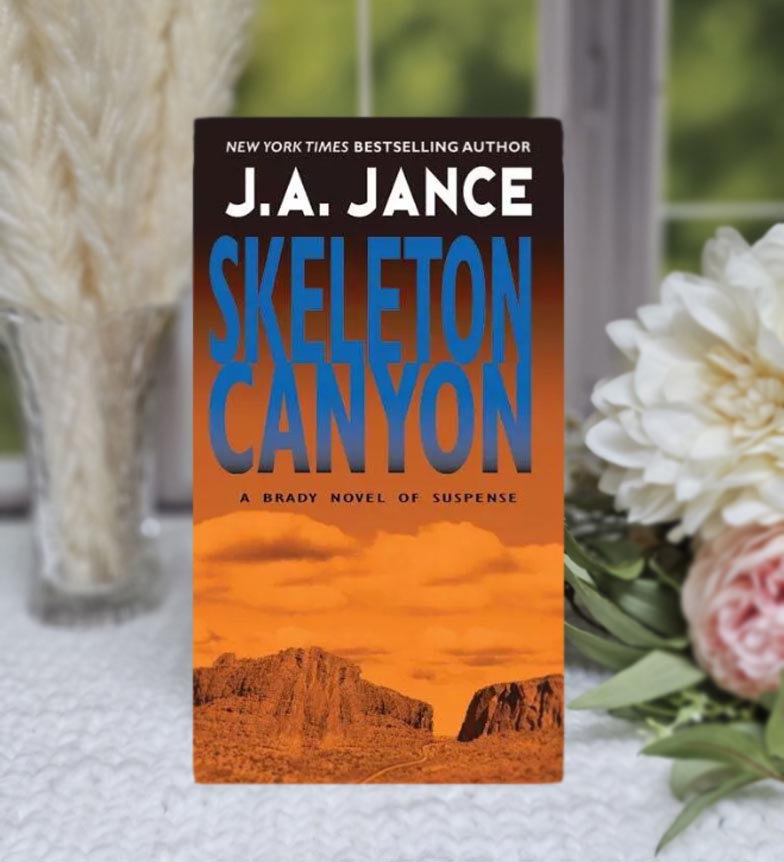
Skeleton Canyon
by J.A. Jance
When high school valedictorian Brianna O'Brien is found murdered in remote Skeleton Canyon, her wealthy parents blame her forbidden Hispanic boyfriend - but Sheriff Joanna Brady suspects the family racism masks darker secrets involving smugglers using their land.

Dead to Rights
by J.A. Jance
When the town veterinarian who killed a woman while driving drunk is found murdered by pitchfork in his burning barn, Sheriff Joanna Brady must prove that the obvious suspect - the victim grieving widower - is innocent while juggling multiple crises including a hostage situation involving her own daughter.

Shoot Don't Shoot
by J.A. Jance
Sheriff Joanna Brady attends the Arizona Police Officers Academy for mandatory training, but when a serial killer begins targeting women on campus and a man sits in jail wrongly accused of murder, her coursework becomes a matter of life and death.