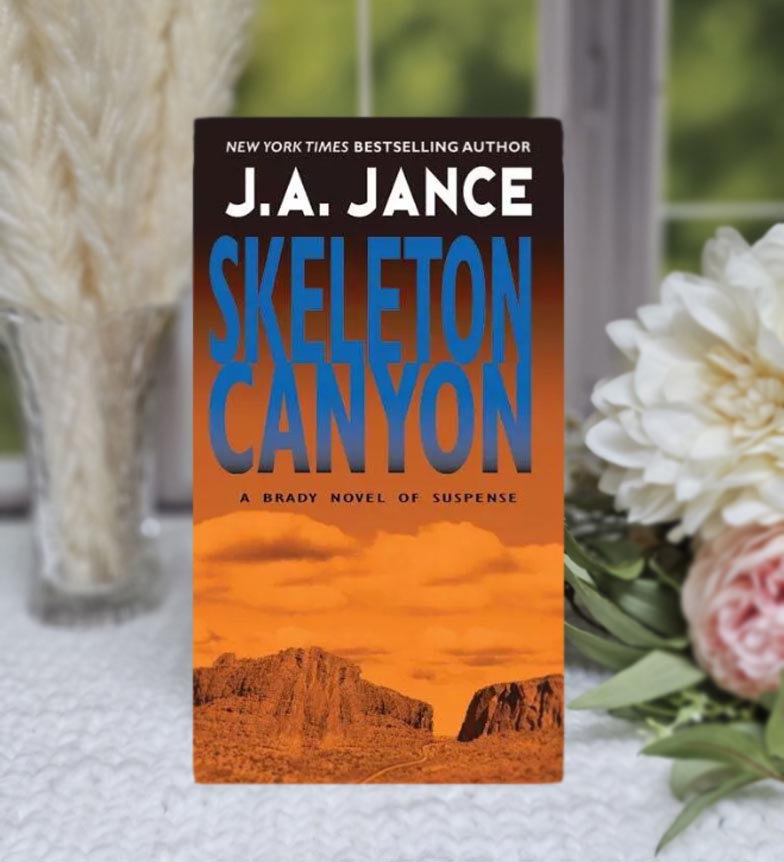
Skeleton Canyon
by J.A. Jance
When high school valedictorian Brianna O'Brien is found murdered in remote Skeleton Canyon, her wealthy parents blame her forbidden Hispanic boyfriend - but Sheriff Joanna Brady suspects the family racism masks darker secrets involving smugglers using their land.
Spoiler Warning
This review may contain spoilers. Read at your own discretion if you haven't finished the book yet.
Romeo and Juliet in the Arizona Desert
A year ago, Brianna O'Brien and Ignacio Ybarra were paired to play the Romeo and Juliet balcony scene at a two-week fine arts session at the University of Arizona in Tucson. It was the end-of-session finale - two teenagers performing forbidden love for an audience. Now they're living it for real. Bree is a wealthy rancher's daughter - valedictorian, cheerleader, everything her parents ever wanted. Nacio is a hardworking Hispanic football star. Their love is forbidden by parents horrified that their girl could be involved with a Mexican boy. When Bree is found dead under her truck in remote Skeleton Canyon - waiting for a romantic tryst that would never happen - her parents know exactly who to blame.
In Skeleton Canyon, the fifth Joanna Brady mystery, Sheriff Brady must confront the blatant racism of the O'Brien family while digging into secrets they'd rather keep buried. The last words in Bree's journal haunt the investigation: "My Mother is a liar." And the question of what, precisely, Katherine O'Brien has been lying about will drive Joanna toward a truth that has nothing to do with teenage love and everything to do with the criminal enterprises hidden behind the O'Briens' respectable facade.
Green Brush Ranch and the Family Behind It
David O'Brien is a wealthy rancher, wheelchair-bound after an accident that also killed his first wife and two of his children. He later married Katherine, his nurse, and together they rebuilt a family centered on Bree - their valedictorian, their cheerleader, the daughter who was supposed to validate every sacrifice they'd made. Green Brush Ranch is their compound: isolated, secured, the kind of place where a family's privacy is absolute and its secrets stay internal. A security employee named Alf - "one of those middle-aged men who gave Bree the creeps," a disreputable ex-cop who she suspected made unnecessary sweeps past her bedroom window - patrols the property, and the security apparatus that's supposed to protect the family takes on a sinister cast as the investigation deepens.
Katherine maintains the image of a perfect family, pillars of the community. But Bree's journal entry - "My Mother is a liar" - suggests the image was built on something Katherine didn't want anyone, including her daughter, to see. When Nacio becomes the obvious suspect - the Hispanic boyfriend the O'Briens never approved of - Joanna is the only one who refuses to accept the easy answer. The parents' racism is ugly and undeniable, but Joanna senses it's hiding something darker than prejudice. The question isn't whether the O'Briens are bigots. They clearly are. The question is whether their bigotry has been serving as camouflage for something worse.
The Freon Connection
As Joanna investigates, the case pivots away from teenage romance entirely. A smuggling cartel has been using O'Brien land to move illegal freon across the Arizona-Mexico border - cashing in on high black-market prices for the refrigerant, which had been phased out under environmental regulations but was still in massive demand. The O'Brien ranch's isolation and proximity to Mexico made it a perfect corridor for smugglers who don't hesitate to eliminate witnesses.
Bree wasn't killed by a jealous boyfriend. She wasn't killed over a forbidden love affair. She was killed because she stumbled onto criminal operations running through her own family's property - operations that someone in the O'Brien orbit either enabled or failed to stop. The shift from domestic tragedy to border crime is one of Jance's effective structural moves: the reader, like the community, assumes this is a story about a girl who loved the wrong boy. It turns out to be a story about a girl who knew the wrong thing.
Publishers Weekly praised how Jance "skillfully ties the mystery to the southeastern Arizona landscape" and the smuggling subplot gives the border setting genuine narrative function rather than just atmosphere. The freon angle is specific and unglamorous - not drugs, not weapons, but refrigerant - which makes it feel more realistic than a standard cartel thriller.
Angie Kellogg Returns
One of the book's most effective threads brings back Angie Kellogg, the former prostitute Joanna helped in Desert Heat - the woman who escaped from contract killer Tony Vargas and provided the testimony that cleared Andy Brady's name. Four books later, Angie has rebuilt her life. She's working as a bartender at the Blue Moon Saloon and Lounge in Brewery Gulch, Old Bisbee. She's trying to be legitimate. And she goes missing.
Angie disappears after accompanying Dennis Hacker, a birding enthusiast, on a hummingbird-watching outing in the Skeleton Canyon area - the same territory where Bree was killed. The two cases intertwine, and the stakes for Joanna become personal in a way she didn't anticipate. Angie isn't just a witness or a case file. She's someone Joanna saved once and feels responsible for. Her disappearance adds urgency to an investigation that was already running on multiple tracks, and it reminds the reader - and Joanna - that the Cochise County community these books have been building across five novels is a community where what happens to one person matters to the people around her.
The return of a character from the first book is one of the series' quiet strengths. Jance builds her world the way real communities build themselves - through recurring faces, accumulated history, relationships that deepen over time. Angie Kellogg isn't the same woman she was in Desert Heat, and Joanna isn't the same sheriff. The distance between who they were and who they've become gives their connection a weight that a standalone novel couldn't achieve.
Jenny and the Shadow of Bree
The personal thread that runs beneath the investigation is Joanna's awareness that Jenny is approaching the age when teenagers start keeping secrets from their parents. Bree was only a few years older than Jenny - a good girl, a valedictorian, a daughter who seemed to have everything figured out, and who was hiding a forbidden relationship, a disturbing journal, and knowledge that got her killed. The case forces Joanna to confront what she doesn't know about her own child's interior life, what she might miss as Jenny becomes a young woman in a world that's more dangerous than the one Joanna grew up in.
It's a subtle thread - Jance doesn't hammer it - but it gives the investigation an emotional undertow that the procedural elements alone wouldn't provide. Joanna isn't just solving Bree's murder. She's imagining a future in which she could be the parent who didn't see it coming, the mother who missed the signs because she was too busy, too trusting, or too afraid to look.
Where the Fifth Book Lands
Skeleton Canyon does several things well. The racial dynamics between the O'Briens and the Ybarra family are drawn without flinching - the casual, confident bigotry of wealthy white parents who can't conceive of their daughter choosing a Mexican boy, and the institutional weight that bigotry carries when the family has money and influence. The freon-smuggling subplot grounds the mystery in the specific realities of Arizona border crime without glamorizing it. And Angie Kellogg's return gives the series a sense of continuity and consequence that rewards readers who've been following from the beginning.
The weaknesses are structural. Kirkus called the book "overextended" with "lightweight" intrigues, and the criticism has some merit - Jance juggles the Bree murder, the smuggling operation, Angie's disappearance, the Jenny parallels, and the O'Brien family dynamics, and not all of these threads carry equal weight. The book delays revealing that Bree is dead for nearly half its length, which means the actual murder investigation doesn't begin until the reader has already invested significant time in setup. Some readers found the pacing in the first half slow enough that they nearly abandoned the book before the final quarter picked up.
There's also a pattern emerging in the series - one that Kirkus flagged - where multiple separate crimes always end up being connected. It's a satisfying structural device when it works, but by book five, the coincidence of everything tying together can strain credibility. Real law enforcement in a rural county deals with cases that have nothing to do with each other, and the series would benefit from occasionally acknowledging that randomness rather than forcing every thread into a single conspiratorial knot.
But the core of the book works: a dead girl, a wrongly accused boyfriend, parents whose racism conceals a deeper corruption, and a sheriff who refuses to accept the easy answer. Jance's Arizona remains one of the best-drawn settings in the mystery genre, and Joanna Brady - now five books into a career she never planned - continues to grow into a protagonist worth following through every canyon the series explores.
Rating: 4.0/5 ⭐
Perfect for: Fans of the Joanna Brady series, readers who appreciate mysteries involving border-area crime and racial dynamics, anyone who enjoys series fiction that rewards long-term investment through recurring characters.
Skip if: The slow first half tests your patience, stories about teenage victims are too difficult, or the convenience of interconnected cases frustrates you.
You Might Also Like

Dead to Rights
by J.A. Jance
When the town veterinarian who killed a woman while driving drunk is found murdered by pitchfork in his burning barn, Sheriff Joanna Brady must prove that the obvious suspect - the victim grieving widower - is innocent while juggling multiple crises including a hostage situation involving her own daughter.

Shoot Don't Shoot
by J.A. Jance
Sheriff Joanna Brady attends the Arizona Police Officers Academy for mandatory training, but when a serial killer begins targeting women on campus and a man sits in jail wrongly accused of murder, her coursework becomes a matter of life and death.

Tombstone Courage
by J.A. Jance
Two months into her job as the first female sheriff of Cochise County, Joanna Brady investigates when rancher Harold Patterson is found dead at the bottom of a mine pit - along with a second, older set of remains that raises disturbing questions about long-buried family secrets.