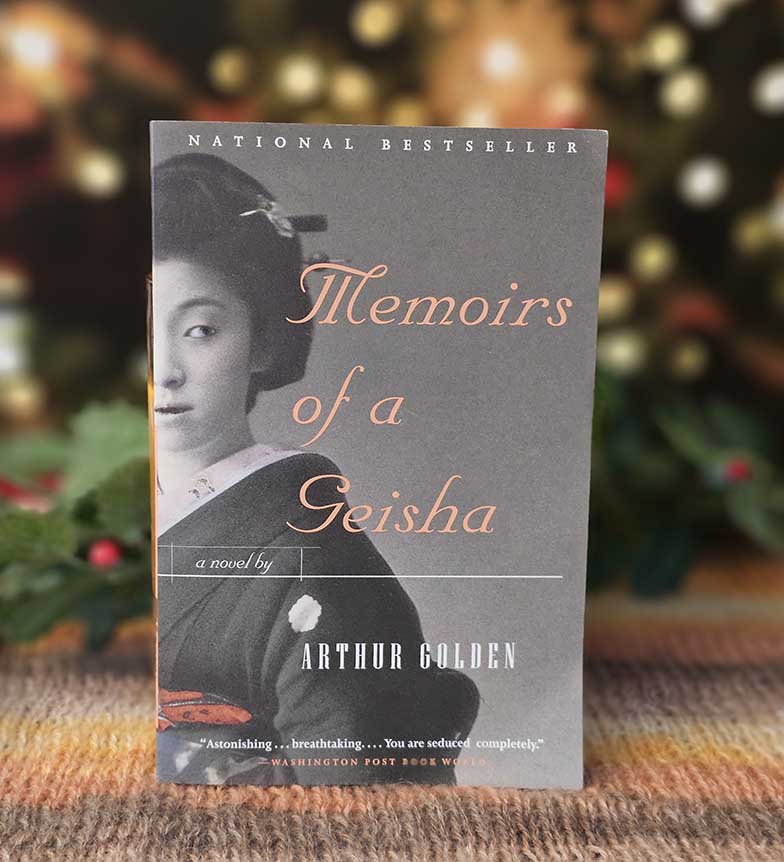
Memoirs of a Geisha
by Arthur Golden
A stunning portrait of a geisha's life in pre-war and wartime Japan. Through the eyes of Sayuri, we witness the beauty, artistry, and complex world of geisha culture.
Spoiler Warning
This review may contain spoilers. Read at your own discretion if you haven't finished the book yet.
A Hidden World Brought to Life
The novel opens with a fiction that sets the tone for everything that follows: a "Translator's Note" by one Jakob Haarhuis, a professor of Japanese history who explains how an elderly Japanese woman named Sayuri Nitta dictated her life story to him in New York in 1985. Haarhuis doesn't exist, and neither does Sayuri - but the device creates the illusion of testimony, of a real woman telling you what it was actually like inside a world most people know only from woodblock prints and movie scenes. That illusion is Memoirs of a Geisha's greatest achievement and its most controversial one. Arthur Golden, an American man who studied Japanese art history and spent years in Tokyo, wrote this novel in the first person as a Japanese woman - and the question of whether he had the right, and whether he got it right, has followed the book since 1997.
What he undeniably got right is the immersion. The novel drops you into pre-war Kyoto's Gion district with such sensory precision - the weight of a silk kimono, light through rice-paper screens, the rituals of tea and dance and conversation - that the world becomes physical around you. Golden spent roughly fifteen years researching and writing, discarding an 800-page third-person first draft entirely, and the novel as it exists - first person, intimate, voiced as memory - has the quality of something polished until every surface reflects.
From Chiyo to Sayuri
The story begins in the fishing village of Yoroido, where nine-year-old Chiyo Sakamoto and her older sister Satsu are sold by their dying father and taken to Kyoto. They're separated immediately - Satsu disappears into a different part of the city, and Chiyo is delivered to the Nitta okiya, a geisha house in Gion, where she becomes the property of Mother, a shrewd businesswoman whose interest in her is entirely financial. The okiya's star geisha is Hatsumomo, beautiful and vicious, who sees Chiyo as a future rival and torments her from the first day - destroying her belongings, sabotaging her opportunities, making it clear that survival in this house depends on never becoming good enough to threaten her.
Chiyo's transformation into Sayuri is engineered by Mameha, one of Gion's most celebrated geisha, who persuades Mother to reinvest in Chiyo's training by becoming her "older sister" - her mentor through the elaborate social world of the geisha districts. Mameha teaches her everything: how to move, how to speak, how to read a room, how to wield beauty as a form of power within a system that otherwise leaves women with very little. The training scenes are among the book's best - detailed enough to feel educational, specific enough to feel lived, and always shadowed by the awareness that this extraordinary education is also a form of control. Chiyo is being shaped into something exquisite and profitable; her autonomy exists only insofar as it serves the okiya.
The Sayuri-Hatsumomo rivalry gives the first half its dramatic spine. As Sayuri ascends under Mameha's guidance, Hatsumomo spirals - drinking, alienating clients - and her eventual expulsion from the okiya is both satisfying and sad, because Golden has written her with enough dimension that you understand she's not just a villain. She's a woman whose only currency was her beauty and position, and watching both erode is watching someone lose the only things that gave her life structure.
The Chairman and the Bridge
The novel's emotional engine is Sayuri's love for the Chairman - Ken Iwamura, co-founder of Iwamura Electric. She first encounters him as a child, crying on a bridge in Gion; he stops, buys her a shaved ice, gives her his handkerchief, and presses some money into her hand. It's a small kindness in a life that has offered almost none, and it lodges permanently. She decides to become a geisha out of a child's logic: if she enters his world, she might see him again. "Every step I have taken, since I was that child on the bridge," she says near the end, "has been to bring myself closer to you."
The complication is Nobu Toshikazu, the Chairman's business partner - a war veteran, missing an arm, his face scarred by burns - who pursues Sayuri as a patron with an intensity both devoted and possessive. The conventions of the geisha world make it nearly impossible to refuse his attention without offending the Chairman in the process. The triangle drives the novel's second half, and Golden handles it with more restraint than a romance novelist would - the feelings are real, but constrained by a system that doesn't allow women to simply choose who they love.
The Mizuage and What It Reveals About the Book
The novel's most controversial element is the mizuage - depicted as a ceremony in which a young apprentice geisha's virginity is auctioned to the highest bidder. Mameha orchestrates a bidding war between Dr. Crab, a physician known for collecting mizuage, and the Baron, her own wealthy patron; the record winning bid of 11,500 yen clears all of Chiyo's debts and cements her future.
Here's the problem: actual former geisha, most prominently Mineko Iwasaki - Golden's primary source - have stated that by the twentieth century, mizuage was a purely symbolic coming-of-age ceremony with no sexual component. What Golden describes, critics argue, conflates geisha with oiran, the courtesans of Japan's licensed pleasure quarters - a significant distinction, since geisha were artists and entertainers, not sex workers. Whether his depiction reflects faded pre-twentieth-century practices or a misunderstanding drawn from sources that blurred the line is a scholarly debate. But the effect is undeniable: the mizuage scenes have shaped Western understanding of geisha more than anything else in the book, and if that understanding rests on a conflation, the responsibility lies partly with the novel.
War, Loss, and the World After
The second half sweeps through the 1940s at a pace matching the upheaval. When the war intensifies and the geisha districts are ordered closed, Sayuri asks Nobu for help avoiding factory conscription, and he sends her north to live with his friend Arashino, where she spends the war years dyeing kimonos by hand - her hands permanently stained, her beauty fading, the elegant world she spent years entering as distant as a dream. Golden captures the specific grief of watching a way of life end not through a single dramatic event but through the slow accumulation of closures and dispersals.
After the war, Nobu brings Sayuri back to a Gion that's rebuilding but changed - American soldiers everywhere, the old social order shifted, and the Chairman still present, still kind, still formally off-limits. The resolution - the Chairman eventually becomes her danna, her patron and lover, and she relocates to New York in 1956 to open a small tea house in the Waldorf Towers - is romantic in the way the novel has always been romantic: a woman who has spent her life navigating a system of constraint finally arriving at something resembling choice.
The Iwasaki Controversy and What It Means for the Reader
I can't review this book honestly without the Mineko Iwasaki situation, because it shapes how I think about what I read. Golden interviewed Iwasaki extensively starting in 1992 - on the explicit condition of complete anonymity. She gave him an insider's tour of Gion and answered his questions with remarkable candor. He then named her in the acknowledgments and identified her as a source in interviews. In a community where discretion is paramount, this was a devastating breach: Iwasaki received criticism and death threats for violating the code of silence. She sued Golden and his publisher in 2001, the case settled out of court in 2003, and in 2002 she published her own autobiography, Geisha: A Life, which presents a markedly different picture of the profession.
None of that makes the novel less beautifully written. But the book carries a weight beyond its pages - a real woman's trust was violated in the making of it, and the version of geisha life it presents is contested by the very person who provided much of its raw material. There's also the broader Orientalism critique: that an American man writing as a Japanese woman exoticizes and sexualizes his subject for Western consumption, fitting the Madame Butterfly template of a passive Asian woman devoted to a powerful man. The book was far more popular in the United States than in Japan, which suggests something about whose expectations it satisfies.
These limitations are real, and worth sitting with. But they coexist with a novel that is, page by page, extraordinarily crafted - luminous prose, meticulous world-building, a genuinely moving emotional arc, and one of historical fiction's most compelling portraits of a woman navigating impossible constraints with intelligence and grace. Reading it as a gorgeous, absorbing novel: four and a half stars easily. Reading it as an accurate representation of geisha culture: proceed with caution.
Rating: 4.5/5 ⭐
Perfect for: Lovers of immersive historical fiction, readers interested in Japanese culture and pre-war Kyoto, anyone who appreciates beautiful prose and complex female protagonists navigating systems of power.
Skip if: Western men writing as Japanese women is a dealbreaker for you, the conflation of geisha and courtesan traditions bothers you on principle, or you prefer faster-paced narratives.
You Might Also Like

Nemesis
by Philip Roth
In the summer of 1944, a polio epidemic sweeps through Newark's Jewish community. Playground director Bucky Cantor watches helplessly as children in his care fall ill - then flees to a mountain camp where he believes he brings the disease with him, destroying his life with guilt.

A Gate at the Stairs
by Lorrie Moore
A coming-of-age story set in the Midwest after 9/11. Tassie Keltjin takes a job as a nanny and finds herself drawn into a complex family dynamic that challenges her understanding of race, identity, and belonging.

The Second Summer of the Sisterhood
by Ann Brashares
The pants are back for a second summer as Carmen, Tibby, Bridget, and Lena face new challenges, deeper heartbreak, and the continued magic of their unbreakable friendship.