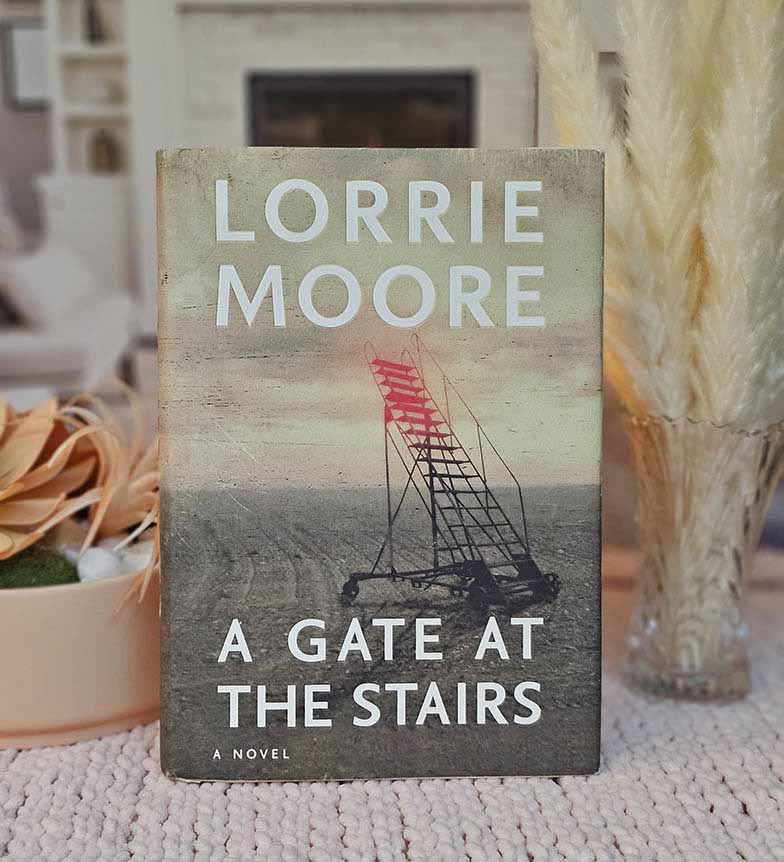
A Gate at the Stairs
by Lorrie Moore
A coming-of-age story set in the Midwest after 9/11. Tassie Keltjin takes a job as a nanny and finds herself drawn into a complex family dynamic that challenges her understanding of race, identity, and belonging.
Spoiler Warning
This review may contain spoilers. Read at your own discretion if you haven't finished the book yet.
A Novel I Admired More Than Loved
Lorrie Moore writes sentences that stop you mid-page. "Things between us were dissolving like an ice cube in a glass: the smaller it got, the faster it disappeared." "Perhaps we had at last reached that stage of intimacy that destroys intimacy." "Life was unendurable, and yet everywhere it was endured." A Gate at the Stairs is full of moments like these - prose that balances poetry and puns on the seesaw of the same sentence. And yet I finished the book feeling more impressed than moved. It's a strange experience, recognizing brilliance while remaining emotionally detached from it - and the reasons for that detachment are as interesting to think about as the novel itself.
The story follows Tassie Keltjin, a twenty-year-old college freshman in the fictional town of Troy - Moore's thinly disguised Madison, Wisconsin, where Moore herself teaches. Tassie's course schedule signals a student who hasn't figured herself out yet: Intro to Sufism, Intro to Wine Tasting, Soundtracks to War Movies. She plays bass. She's from a farm family - her father a boutique potato cultivator whose "Keltjin potatoes" are locally famous, her mother a Jewish East Coast transplant who never quite belongs in their churchgoing community. Tassie herself doesn't quite belong anywhere: too rural for the college kids, too educated for home, too young for the adult world she's about to stumble into.
That stumble begins when she takes a nannying job with Sarah Brink, the nervous, compulsively witty owner of an upscale French restaurant, and Sarah's husband Edward Thornwood, an eye cancer researcher whose wandering attention will eventually turn uncomfortably toward Tassie. Sarah and Edward are adopting a biracial toddler named Mary-Emma - Emmie - and the job pulls Tassie into a family more fractured than it appears, into questions about race and adoption she isn't equipped to answer, and into a post-9/11 America where hidden identities are everywhere she looks.
The Support Group and the Contradictions of Good Intentions
The novel's sharpest sequences are the Wednesday evening support group meetings Sarah organizes after teenagers shout a racial slur at Emmie while Tassie is out with her. The group - parents of non-white and biracial children, meeting weekly at the house - becomes Moore's vehicle for examining white liberal progressivism with a precision closer to vivisection than satire. Tassie babysits the children upstairs while the "caustic talk floats upward unimpeded," and what floats up is a masterclass in well-meaning people saying exactly the wrong things while convinced they're doing everything right.
Moore captures the discomfort without reducing anyone to caricature. A speaker representing Native American nations delivers a blistering monologue that silences the room. Tassie is told she can't sing "I Been Working on the Railroad" to Emmie because of its associations with slave labor. The parents nod along, perform their awareness, and go home to lives that remain fundamentally unchanged. Moore isn't mocking these people - she's observing how progressive ideals and actual understanding sit at a distance that good intentions alone can't close. It's the most uncomfortable and most valuable section of the book, and it's where her particular gift - seeing hypocrisy without condemning the hypocrites - is most fully on display.
Reynaldo, Robert, and the Identities People Hide
The post-9/11 atmosphere pervades the novel not as plot but as an anxiety warping every relationship. Tassie falls in love with Reynaldo, a classmate from her Sufism course who claims to be Brazilian - though his Portuguese is perplexingly shaky, since he actually speaks Spanish. The reason, when it emerges: he's from Hoboken, New Jersey, and he's Muslim, hiding behind a false nationality because post-9/11 America has made his real background dangerous to acknowledge. He ends the relationship by telling Tassie he's suspected of terrorist activities and must disappear. "It is not the jihad that is the wrong thing," he tells her. "It is the wrong things that are the wrong things." Whether he's genuinely involved in something or simply paranoid - or whether the distinction even matters in a country where suspicion is its own reality - is left unresolved.
Meanwhile, Tassie's younger brother Robert, unable to get into a four-year college, enlists in the Army and is killed in Afghanistan almost immediately. The notification letter arrives written in impenetrable bureaucratic acronyms - "There was a BBIED but no QRD..." - the machinery of war reducing a boy's death to initials his family can't decode. Robert's death is devastating precisely because of how quickly it happens - how the war reached into rural Wisconsin and took someone who enlisted because he didn't have better options, not because he believed in the mission.
The Secret That Destroys the Family
The other late-stage revelation concerns Sarah and Edward. The adoption process uncovers a secret: they previously had a biological son, a four-year-old, who died in a highway accident after Edward, punishing him for misbehaving, made him get out of the car at a rest stop. When this comes to light, Emmie is taken back into foster care, and Tassie loses a child she has loved through months of daily care - not through death but through the kind of bureaucratic removal that doesn't allow for grief because, technically, Emmie was never hers.
Moore handles the revelation with characteristic indirection - Sarah's confession is almost matter-of-fact, the horror emerging through understatement. It connects back to the title: the gate at the stairs is literally a baby gate meant to keep children safe, and metaphorically every barrier between people and the truths they can't face. When Tassie first arrives at the house, the front gate is "slightly off its hinges" - dysfunction barely concealed, fixed repeatedly in a make-do fashion. The symbolism is quiet but unmistakable.
The Brilliance and the Distance
Here's why this is three stars despite prose that's frequently extraordinary. The novel is structured as a slow, observational first two-thirds followed by a final third where devastating events cascade: Reynaldo's disappearance, the adoption collapse, Robert's death. The problem is that the observational distance Moore cultivates so carefully never releases when the tragedies arrive. Tassie watches her own life fall apart with the same wry, detached precision she brought to watching Sarah's support group, and the reader experiences the devastation at a similar remove.
Moore's wordplay, thrilling in the first half, works against the emotional impact in the second. Her technique of taking figurative language literally - Tassie hears "hogwash" and thinks about actually washing hogs - initially reads as charming naiveté and gradually reveals how language obscures truth. It's a brilliant device. But in the sections where Robert dies and Emmie is taken away, the same verbal dexterity keeps the prose at a slight angle from the feeling, as if Moore can't let go of the wit long enough to let the grief breathe. The Sunday Times reviewer observed that "the quirkiness stifles deeper emotions and makes grief almost kitsch"; Jonathan Lethem, in the New York Times, called Moore "a discomfiting, sometimes even rageful writer, lurking in the disguise of an endearing one." Both feel right. The disguise is part of the point, but it keeps the reader at arm's length during the moments when closeness would have been more powerful.
The structure has a related problem: Tassie's family subplot - the potato farm, her mother's outsider status, Robert's enlistment - runs parallel to the adoption story but never fully integrates with it. Both threads explore the gap between who we claim to be and who we are, but they operate at different speeds and emotional registers, and the connections between Tassie's rural world and Sarah's urban one stay thematic rather than structural. The ambitious scope occasionally becomes a pacing problem, particularly in the middle, where Moore's observations, individually precise, accumulate without always building toward something.
None of which should discourage you from reading it. Moore is one of the finest prose stylists in American fiction, and the support group sequences are some of the sharpest writing about race and liberalism in recent memory. I just wish the book had trusted its emotional material as fully as it trusts its intellectual material. Moore sees everything. She just doesn't always let herself - or the reader - feel it.
Rating: 3.0/5 ⭐
Perfect for: Readers who appreciate literary prose and precise social observation, those interested in explorations of race, adoption, and post-9/11 America, fans of Lorrie Moore's earlier work who want to see her tackle a full novel.
Skip if: You need emotional engagement to stay connected to a story, prefer tighter pacing, or find that verbal cleverness at the expense of feeling frustrates rather than enriches you.
You Might Also Like
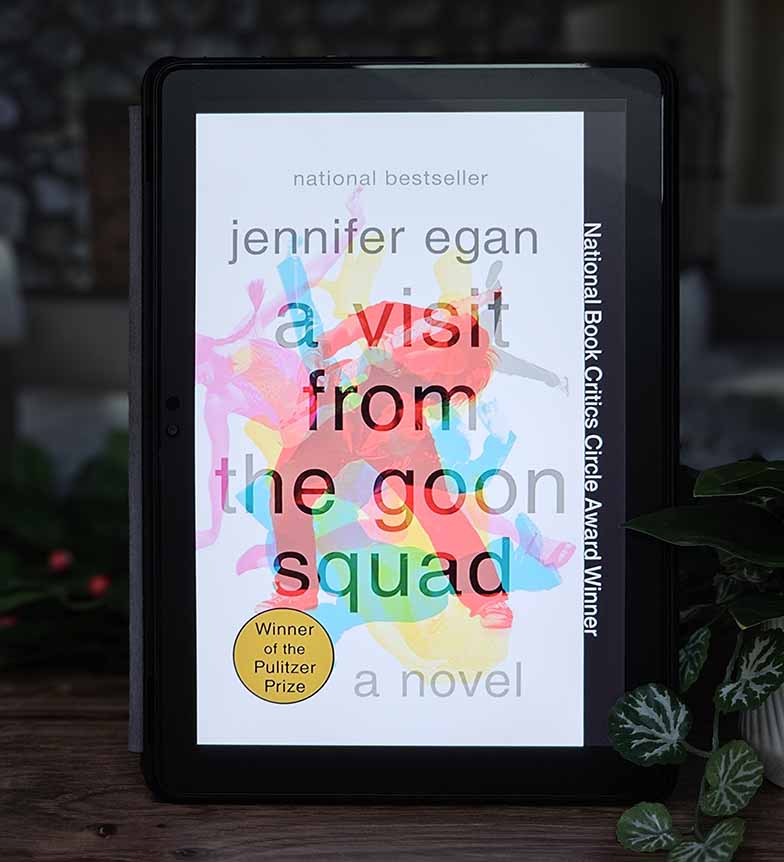
A Visit from the Goon Squad
by Jennifer Egan
A Pulitzer Prize-winning novel that weaves together interconnected stories about a group of characters connected to the music industry, exploring themes of time, memory, and aging through an innovative narrative structure.

Handle with Care
by Jodi Picoult
To pay for a lifetime of medical care for her six-year-old daughter Willow, who has severe osteogenesis imperfecta, Charlotte O'Keefe sues her best friend - Willow's obstetrician - for wrongful birth, forcing her to testify in open court that she would have terminated the pregnancy had she known.

The Cast
by Danielle Steel
A 54-year-old advice columnist creates a TV show inspired by her grandmother's WWII story, and the cast becomes the family she didn't know she needed.