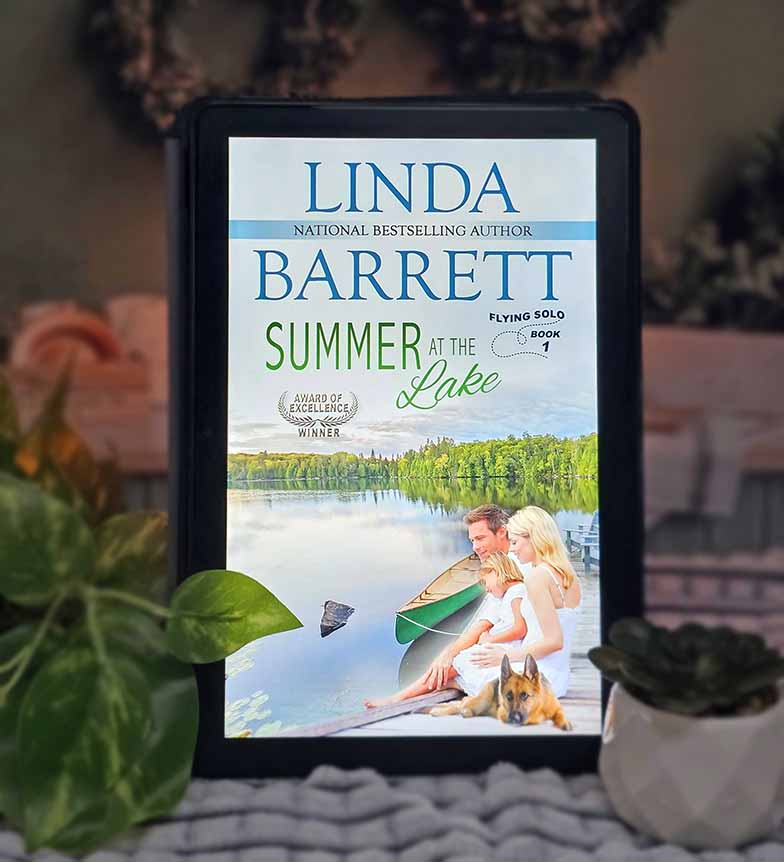
Summer at the Lake
by Linda Barrett
An NYPD veteran who lost a child during a hostage negotiation retreats to Morningstar Lake with his German Shepherd Quincy and his saxophone; a widow named Kristin McCarthy borrows her friend Marsha's Catskills cottage and brings her eleven-year-old daughter Ashley, a recent rape survivor who has stopped being able to be in her own house - and the music carries across the water in Linda Barrett's first Flying Solo novel.
Buy this book:
Spoiler Warning
This review may contain spoilers. Read at your own discretion if you haven't finished the book yet.
Two People Hiding at the Same Lake, and a Dog That Decides They Should Meet
Rick Cooper is a veteran NYPD cop who lost a child during a hostage negotiation, and he is not in any condition to be in the city right now. He has retreated to his family's place on Morningstar Lake in the Catskill Mountains - three hours northwest of New York City - with his German Shepherd Quincy and his saxophone, intending to fish, play, and figure out whether he can still do his job or whether he needs a different one. Kristin McCarthy is a widow whose eleven-year-old daughter Ashley was recently raped. Ashley has stopped speaking. She cannot be in her own house. Kristin's friend Marsha has offered her summer cottage on Morningstar Lake, and Kristin has accepted because she is out of options. The two adults arrive at the same lake without knowing the other is there. One night, Ashley hears a saxophone drifting across the water. Quincy is a curious dog. The bridges build themselves.
Linda Barrett's 2014 novel Summer at the Lake is the launch of what would become her Flying Solo series, and it is - as the prior review of this title noted, accurately - a book whose summer-romance packaging undersells what it is actually doing. The book is dealing with childhood rape, parental grief, and PTSD inside the structural template of a sweet contemporary lakeside romance, and the tonal mismatch is, depending on the reader, either the book's most defensible move or the source of its biggest problem. A 3.0 reflects: a book with real emotional clarity about trauma and a therapy-dog plotline rendered with care, dragged toward the middle by genre-formula compromises and a closing third that resolves more cleanly than the setup earned.
Quincy, the Saxophone, and How the Bridge Gets Built
What works most consistently is the dog. Quincy is, by some distance, the best-rendered character in the book - Barrett writes him with the specific intelligence of a working German Shepherd whose job is to read humans, and the chapters in which Quincy slowly, patiently, demonstrates to Ashley that he is safe to be near are some of the more genuinely moving therapy-dog scenes I've read in the genre. Ashley responds to the dog before she responds to any human. That sequence - dog first, music second, Rick third, the wider world last - is how trauma actually unwinds in children, and Barrett has clearly done either the research or the lived observation to render it well.
The musical material is the second strong thread. Rick plays saxophone. Ashley plays piano and flute. The early scenes in which Ashley begins to answer Rick's playing across the lake - then later, in person, alongside it - are doing the work the genre needs: showing rather than telling that something inside Ashley has not been broken, only locked, and that music is one of the keys her family didn't know she still had. Rick's plan to call local clubs and sit in on sets gives him a small adult life of his own that the book occasionally remembers to develop.
Kristin and Rick, the Romance the Book Earns Slowly
The romance arc, to Barrett's credit, takes the entire summer rather than a long weekend. Kristin is a widow whose grief is recent enough that she is not in the market for anything; Rick is a man whose PTSD is loud enough that he is not, either. They meet around Ashley. The relationship grows out of shared work - Rick's presence with the dog is good for Ashley, Ashley's slow improvement is good for Rick, the household texture they make together is good for Kristin in ways she has not yet given herself permission to want. The pace is right. The slow-burn is the point.
What pulls the romance toward genre formula in places is the dialogue, which can read polished-quippy in the way commercial contemporary romance sometimes does, and the supporting cast (the friends, the local townspeople, Ashley's specific therapists and teachers), which is sketched cleanly but not deeply. By the third act, the will-they-won't-they is running on the schedule the genre demands rather than the schedule the trauma plot would set.
Where the Tone Strains
The book's hardest structural question is the one its marketing positioning makes for it. Summer at the Lake is being sold as a sweet contemporary lakeside romance, and inside the book is a plot built around the rape of an eleven-year-old child and a hostage negotiation in which an officer was unable to save another child. Barrett keeps the rape entirely off the page, which is the right choice; she keeps the hostage death mostly in Rick's interior reflections, which is also right. What she cannot quite do, at this length and inside this genre register, is hold both the gravity the trauma demands and the warmth the romance promises in the same hands. Some readers will find the gentleness of her treatment respectful. Other readers - including survivors with messier, more nonlinear experiences of recovery - will find the recovery arc smoother than feels honest. Both reactions are defensible.
The closing pages run the genre's expected resolution beats: things settle, the romance lands, Ashley is meaningfully better. The trauma, real to begin with, is bowed up a little too cleanly by the end.
Why a 3
The strengths: Quincy, the saxophone-and-music scenes, the patience of the romance arc, Barrett's evident care about getting child trauma right at the level she's working at. The reservations: the genre formula visible underneath the harder material; the supporting cast functioning more as setting than as people; a third act that resolves more tidily than the setup deserves. The book has won industry awards (the Award of Excellence and the Write Touch Readers' Award), which tells you the genre community recognized what Barrett is doing. A 3.0 reflects: a book I respected without being entirely won over, recommended to readers who specifically want healing-narrative romance with a therapy dog and music, and gently warned about for readers who would rather their trauma fiction not wear a sweet-romance wrapper.
Rating: 3.0/5 ⭐
Perfect for: Readers who want healing-narrative romance, anyone who specifically loves therapy-dog stories, fans of slow-burn lakeside romance with the patience to let the relationship grow over an entire summer.
Skip if: You need content warnings before reading about child rape, you find sweet-romance treatment of difficult material too soft, or you want trauma fiction that doesn't resolve into a tidy romantic happy ending.
You Might Also Like

Honeysuckle Season
by Mary Ellen Taylor
Wedding photographer Libby McKenzie - newly home to Virginia after a divorce, multiple miscarriages, and her father's death - takes a job photographing a wedding at the Woodmont estate in the Blue Ridge Mountains, becomes drawn to its honeysuckle-overgrown greenhouse, and pulls a thread that runs back through the estate's owner Elaine, a 1940s teen named Sadie, and the closed adoption Libby has carried questions about her whole life.

Silver Linings
by Debbie Macomber
When two wounded souls cross paths in a small Washington town, they discover that sometimes the hardest battles are fought in the heart. A heartwarming story about finding hope and love after loss.

Your Perfect Year
by Charlotte Lucas
When a mysterious diary falls into his hands on New Year's Day, a rigid businessman embarks on a life-changing journey of tasks and self-discovery that connects him with a free-spirited woman and changes both their lives forever.