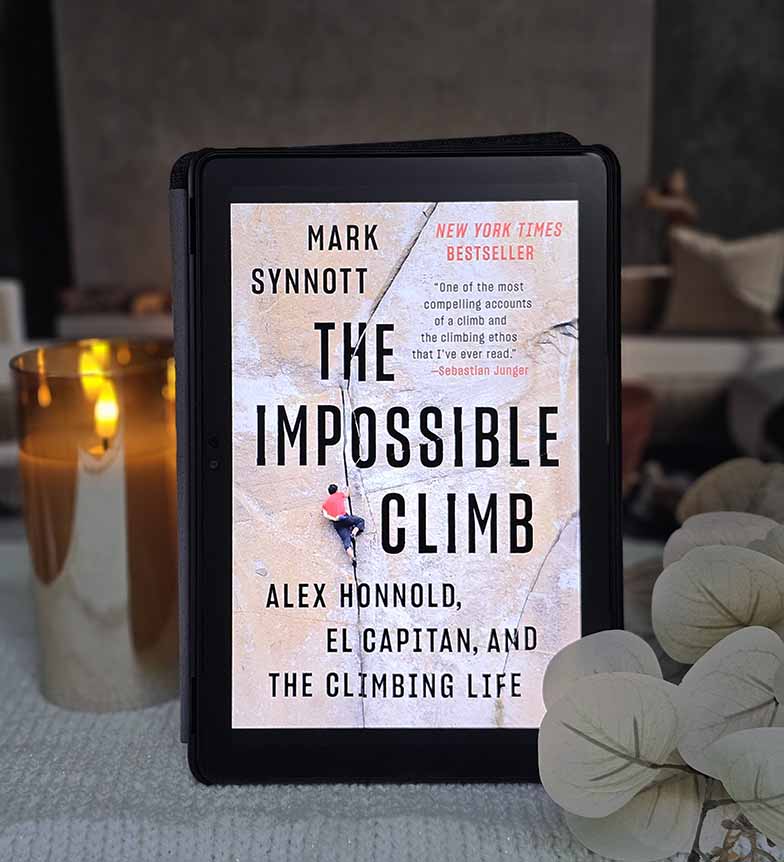
The Impossible Climb
by Mark Synnott
The riveting story of Alex Honnold's historic free solo climb of El Capitan's 3,000-foot Freerider route, and the obsessive pursuit of perfection in one of the most dangerous athletic achievements ever attempted.
Spoiler Warning
This review may contain spoilers. Read at your own discretion if you haven't finished the book yet.
3,000 Feet with No Rope
On June 3, 2017, Alex Honnold stood at the base of El Capitan in Yosemite Valley, looked up at 3,000 feet of vertical granite, and started climbing. No rope. No harness. No safety equipment of any kind. Just his climbing shoes, a chalk bag, and his hands and feet on the rock. The route he'd chosen - Freerider, one of the most iconic lines on El Capitan - would take him through thirty-three pitches of increasingly difficult climbing, including sections where his entire body weight depended on the friction of his fingertips against polished granite, where the footholds were barely wider than a coin, and where the exposure below him was so vast that a fall at any point meant death. Not possible death. Certain death. "Free soloing is binary," Mark Synnott writes. "You succeed, or you die. There is no middle ground, no second place, no safety net."
Synnott's The Impossible Climb is the definitive account of that day and everything that led to it, and it's a far richer, more complicated book than a simple adventure narrative. Synnott is a professional climber himself - a veteran of National Geographic expeditions, big wall ascents, and decades in the climbing community - and his relationship with Honnold is one of the book's quiet strengths. He knows Honnold personally, has climbed with him, and understands the world of elite climbing from the inside. But he also maintains the outsider's bewilderment at what Honnold was attempting. He can explain the technical details in a way that makes them accessible to non-climbers while simultaneously conveying that even for someone with Synnott's experience, what Honnold did is almost incomprehensible. The book operates on three levels simultaneously: it's a thriller about the climb itself, a psychological portrait of one of the most unusual athletes alive, and a history of the climbing culture that produced him.
The Brain That Doesn't Feel Fear
The psychological dimension is what elevates the book beyond adventure writing. The central question isn't whether Honnold succeeded - the climb made international news, and the documentary Free Solo, directed by Jimmy Chin and Elizabeth Chai Vasarhelyi, won the Academy Award - but how a human being can stand on a six-inch ledge 2,000 feet above the valley floor with nothing preventing a fall and not be paralyzed by terror. Synnott explores this from every available angle, and the answers are more complicated than "he's brave."
The most famous piece of evidence is the fMRI brain scan. Researchers at the Medical University of South Carolina put Honnold in a scanner and showed him images designed to provoke fear and disgust - graphic violence, faces in distress, close-up spiders. In a normal brain, the amygdala - the region responsible for processing fear - lights up immediately. Honnold's amygdala barely responded. It's not that he suppresses fear consciously; his brain literally doesn't generate the fear response at the intensity that other people experience. The researchers described it as if his amygdala's threshold for activation was set dramatically higher than normal - he needs a much more intense stimulus to trigger the fight-or-flight reaction that most people feel automatically.
But Synnott is careful not to reduce Honnold to a neurological curiosity. The brain scan explains some of the hardware, but it doesn't explain the software - the years of deliberate practice, the meticulous route preparation, the mental rehearsal that Honnold uses to turn a terrifying climb into a series of manageable, practiced movements. For the Freerider free solo, Honnold spent over a year climbing the route with ropes, memorizing every hold, every sequence, every rest position. He rehearsed specific crux sections - the Boulder Problem, a notoriously difficult sequence around pitch 23 where the holds become tiny and the movement requires a delicate karate-kick-style maneuver - until the moves were as automatic as walking. "For Alex, the free solo wasn't a single day's achievement but the culmination of years of preparation, thousands of hours on the wall, and an almost obsessive attention to detail." When he stepped onto El Capitan without a rope, he wasn't gambling. He was executing a plan so thoroughly rehearsed that the margin for error, while never zero, was as close to zero as human preparation could make it.
The People Watching Him Fall or Fly
One of the book's most compelling threads is the emotional experience of the people around Honnold - the ones who had to watch him attempt something that might kill him and decide how to respond. Jimmy Chin, who directed Free Solo and is an elite climber himself, describes the moral vertigo of positioning cameras to document his friend's climb while knowing that any footage he captured could turn into footage of his friend's death. The film crew discussed this openly: what would they do if Alex fell? How would they handle the footage? Could they even bring themselves to look through the viewfinders during the most dangerous sections? Chin has said that during the crux sequences, some of the camera operators looked away.
Honnold's girlfriend at the time, Sanni McCandless, adds another dimension of tension. Their relationship - which the documentary captured with unflinching honesty - was strained by the fundamental incompatibility between building a shared life with someone and that someone's commitment to an activity where a single bad day means they don't come home. McCandless is articulate about the impossibility of her position: she doesn't want to be the person who asks Alex to stop climbing, because climbing is who he is. But she also doesn't want to be the person who watches him die. Synnott handles this dynamic with sensitivity, showing how Honnold's single-mindedness - which is the very quality that makes the climb possible - creates real damage in his personal relationships, and how McCandless's presence in his life forced him to confront the question of whether the climb was worth the cost to the people who loved him.
Synnott also weaves in the broader climbing community's reaction, which was far from uniformly celebratory. Many elite climbers - people who understood better than anyone what Honnold was attempting - were openly uncomfortable with the media attention, worried that glorifying free soloing would inspire less-prepared climbers to attempt things that would get them killed. The history of free soloing is littered with fatalities: John Bachar, Derek Hersey, Dan Osman - legends of the sport who all died falling. Synnott includes these stories not to argue that Honnold is reckless but to establish that even for the most gifted climbers, free soloing at this level is playing a game where the odds eventually catch up with almost everyone. Honnold's response - that he's not gambling because he's eliminated the uncertainty through preparation - is either the most rational thing anyone has ever said about risk or the most elaborate self-deception, and Synnott leaves room for both interpretations.
June 3rd
The description of the climb itself occupies a relatively small portion of the book - which is the right choice, because the preparation and context are what give the four hours on the wall their meaning. But when Synnott reaches June 3rd, the writing tightens and the pacing accelerates in a way that produces genuine physical tension in the reader. He describes the pre-dawn start, the cool granite under Honnold's fingers, the mechanical precision of the early pitches where the climbing is well within Honnold's ability. Then the difficulty ramps up. The Freeblast section, where the rock face is smoother and the holds thinner. The Enduro Corner, a long, sustained section of crack climbing that demands both power and efficiency because fatigue is the enemy at this altitude. And then the Boulder Problem - the crux, the section Honnold had rehearsed more than any other, the sequence where the margin for error is measured in millimeters.
Synnott describes the karate kick - a dynamic move where Honnold has to kick his left foot up to a hold while his right foot smears against nearly featureless granite - with enough technical detail that you understand exactly what's happening and enough narrative tension that your palms sweat reading it. He made the move. He made every move. Three hours and fifty-six minutes after leaving the ground, Honnold stood on the summit of El Capitan, having completed the most significant single athletic achievement in the history of climbing.
The book's one limitation is structural rather than substantive. Synnott alternates between Honnold's story and his own climbing experiences - including an expedition to a remote wall in Borneo that takes up several chapters - and while these personal sections are interesting on their own terms, they occasionally slow the momentum of the Honnold narrative. Synnott is an engaging writer and a good storyteller, but the Borneo material sometimes feels like it belongs in a different book, and readers who came for the El Capitan story may find their attention wandering during the detours. It's a minor complaint about a book that gets the big things spectacularly right, but a tighter edit would have served the central narrative.
What stays with you after finishing isn't just the climb. It's the question the climb raises and that Synnott wisely refuses to answer: Is this inspiring or insane? Is Honnold a visionary who expanded the boundaries of human possibility, or a man whose brain chemistry allows him to make choices that would be suicidal for anyone else? The honest answer is probably both, and the tension between those readings is what makes The Impossible Climb more than an adventure story. It's a book about the outer edge of what a human being can do, and about the people who stand at the base and watch.
Rating: 5.0/5 ⭐
Perfect for: Adventure and sports enthusiasts, readers interested in the psychology of extreme performance, anyone who saw Free Solo and wants the deeper, more complete story behind the climb.
Skip if: Descriptions of extreme danger and mortal risk give you anxiety you'd rather avoid, or climbing-specific detours test your patience.
You Might Also Like
We Die Alone
by David Howarth
The extraordinary true story of Jan Baalsrud, a Norwegian commando who survived alone in the Arctic wilderness for months after a failed sabotage mission during World War II.

The Shetland Bus
by David Howarth
The true story of the secret World War II operations between Shetland and Norway. A gripping account of courage, danger, and resistance during the Nazi occupation.

Playing Big
by Tara Mohr
A practical guide for women looking to step into their power and pursue their ambitions. Tara Mohr offers tools to quiet your inner critic, recognize your unique calling, and take bold action.