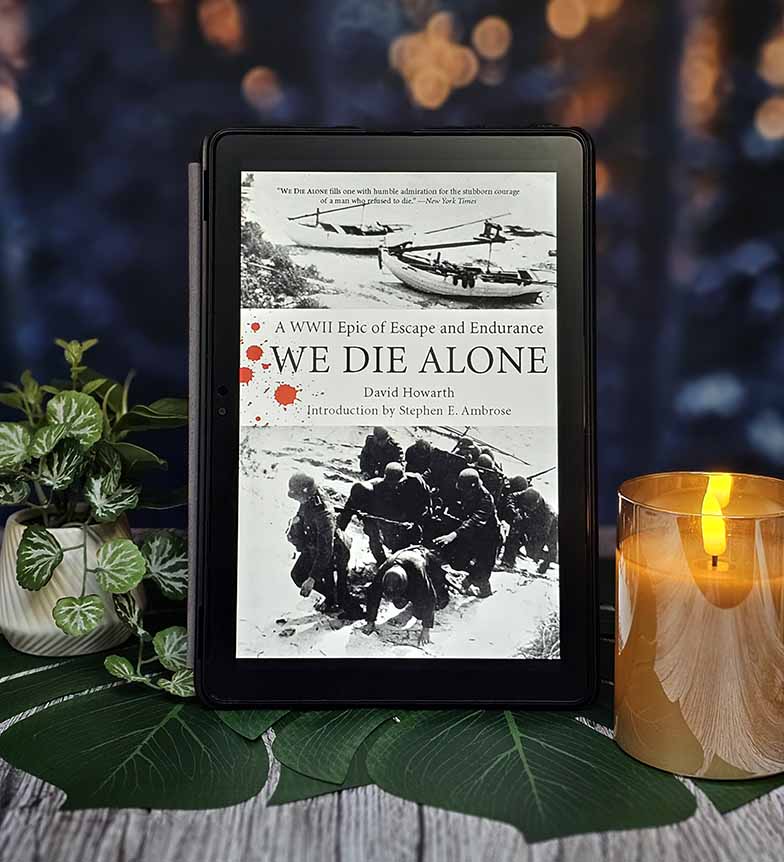
We Die Alone
by David Howarth
The extraordinary true story of Jan Baalsrud, a Norwegian commando who survived alone in the Arctic wilderness for months after a failed sabotage mission during World War II.
Spoiler Warning
This review may contain spoilers. Read at your own discretion if you haven't finished the book yet.
Survival at the Edge of Possible
In March 1943, a small boat carrying twelve Norwegian commandos crossed the Arctic Sea from the Shetland Islands toward occupied Norway. Their mission, code-named Operation Martin, was to sabotage a German airfield control tower at Bardufoss and organize resistance groups in the Tromsø region, deep inside the Arctic Circle. The team had trained in Britain, were armed and supplied by the Allied forces, and were operating under radio silence. They never reached their target. The team's contact on shore had been compromised - they accidentally approached a shopkeeper who shared the same name as their intended resistance contact but wasn't part of the network. Fearing he was being tested by the Germans, the shopkeeper reported them to the local police, who notified the German military. In the firefight that followed at the small island of Toftefjord, the commandos' boat was destroyed, most of the team was killed or captured, and a single man escaped into the freezing water: Jan Baalsrud, twenty-five years old. He'd been shot in the foot during the firefight and lost one of his sea boots in the icy water - he crawled ashore wearing only one.
What happened next - and what David Howarth documents with harrowing precision in We Die Alone - is one of the most extraordinary survival stories ever recorded. Not because of a single dramatic moment, but because of the accumulation of moments across two months in the Arctic, each one requiring Baalsrud to choose survival over the overwhelmingly logical alternative of lying down and dying. This is not a thriller. It's not an adventure story, though it contains elements of both. It's a meticulously researched account of what the human body and spirit can endure when the only alternative to endurance is death - and of the ordinary people who decided, again and again, to risk everything they had to keep a stranger alive.
The Escape and the Mountain
Baalsrud's escape from Toftefjord sets the tone for everything that follows. He swam through Arctic water in March - water cold enough to kill most people within minutes - dragged himself onto the shore, and began climbing a snow-covered mountain in his single remaining boot, leaving a trail of blood from the foot that was bare and already freezing. German soldiers were pursuing him. He could hear them behind him. The climb took hours in conditions that Howarth describes with the kind of clinical specificity that makes the cold feel physical on the page: the way ice forms on exposed skin, the particular pain of frozen toes versus frozen fingers, the disorientation that comes when cold begins to affect cognitive function and simple decisions - which direction to turn, whether to rest or keep moving - become genuinely difficult.
He made it over the mountain. The Germans didn't follow. And then he was alone in the Norwegian Arctic in late winter, with no food, no shelter, one boot, and the beginning of what would become catastrophic frostbite in his exposed foot. Howarth traces the next several days with excruciating detail - Baalsrud stumbling through snowfields, hallucinating from cold and exhaustion, finding and losing trails, sleeping in snow hollows where his body heat melted just enough ice to soak his clothes and make the cold worse. He found his way to a remote farmhouse, and the family inside faced the decision that would define not just their lives but the lives of everyone who encountered Baalsrud over the next two months: help a fugitive being hunted by the Gestapo, knowing that discovery meant execution for your entire family, or turn him away and live.
The Network That Kept Him Alive
They helped him. And then the next family helped him. And the next. What Howarth documents is not one act of heroism but a relay of them - dozens of ordinary Norwegians, living under brutal German occupation, making the decision individually and repeatedly to risk their lives for a man most of them had never met. Farmers hid Baalsrud in barns and outbuildings. Fishermen moved him by boat between coastal settlements at night. Families fed him, treated his wounds with whatever limited supplies they had, and passed him along to the next link in a resistance network that operated entirely on trust, verbal communication, and the shared understanding that the Germans could be listening at any moment.
Howarth gives these helpers names and stories, and this is one of the book's most powerful choices. They aren't background figures in Baalsrud's hero journey. They're people with their own families, their own fears, their own calculations about risk. A farmer and newspaper correspondent named Marius Grønvold became one of the key organizers of Baalsrud's passage north toward the Swedish border, coordinating the dangerous transport across Lyngenfjord and connecting with the wider resistance network. In the village of Furuflaten, Grønvold's sister Hanna Pedersen took Baalsrud in while a German platoon was quartered in the village school just paces away - the troops could see almost every inch of the valley mouth from the schoolhouse windows. Moving Baalsrud through the village meant passing directly below the Germans' only blind spot, along the foot of a riverbank. The tension Howarth creates in these scenes is almost unbearable, because you know the story is true, you know these people actually lived through these minutes of silent terror, and you know that the consequences of discovery were not dramatic arrest but mundane, bureaucratic murder.
The moral weight of what these helpers did is something Howarth refuses to simplify. Helping Baalsrud wasn't a single courageous choice made in a moment of inspiration. It was a sustained, daily decision to accept mortal risk on behalf of a stranger, renewed every morning and every time a German patrol passed close. Some of the helpers were motivated by patriotism. Some by religious conviction. Some, Howarth suggests, by a simpler and more profound impulse: a man was dying, and they could help, and not helping was something they couldn't live with. "When helping a stranger means risking your family's life," Howarth writes, "every act of assistance becomes a profound moral choice." The book takes that choice seriously, never glamorizing it, always showing what it actually cost.
The Toes, the Snow Cave, and the Breaking Point
The section of the book that's hardest to read - and that most clearly demonstrates what sets We Die Alone apart from conventional survival narratives - covers the weeks Baalsrud spent trapped in a snow cave on a mountainside, too injured to be moved and too pursued to stay where he was. His frostbite had progressed to gangrene. Several of his toes had turned black and were beginning to rot. Infection was spreading. Without medical attention - which was impossible under the circumstances - the gangrene would kill him. So Baalsrud, alone in a snow cave, used a pocket knife to amputate his own gangrenous toes - nine in total, over multiple agonizing sessions, using brandy to cope with the pain and cod liver oil ointment on the wounds.
Howarth describes this scene with restraint that makes it more devastating, not less. There's no dramatic buildup, no cinematic slow-motion. Baalsrud assessed the situation, understood the medical reality, and did what needed to be done to survive. The pain is acknowledged but not dwelled on; the focus is on the decision and what it reveals about a human mind pushed to a place most of us will never go. It's the moment in the book where the survival narrative transcends the genre entirely and becomes something closer to philosophy - a meditation on what it means to choose life when life requires things of you that seem impossible.
After the amputation, Baalsrud was moved - slowly, agonizingly - north toward the Swedish border by a changing cast of helpers. An avalanche buried him at one point, and he was dug out barely alive. His condition deteriorated to the point where his helpers debated whether moving him was cruelty rather than rescue. The final leg of the journey was accomplished with the help of Sami reindeer herders - two brothers who loaded Baalsrud onto a sled and drove him through the mountains and across the border into neutral Sweden. The Sami had their own relationship with the occupation, their own traditions of quiet resistance, and their own expertise in surviving the Arctic landscape that made them uniquely capable of completing what the coastal resistance network had started. Baalsrud crossed into Sweden on June 1, 1943 - sixty-four days after the ambush at Toftefjord. He weighed roughly eighty pounds.
What Howarth Built
David Howarth wrote We Die Alone in 1955, roughly a decade after the events. He didn't just interview Baalsrud - he traveled with him back to northern Norway to reconstruct the escape route in person, retracing the journey and interviewing the helpers who had kept him alive along the way. His prose style is British, restrained, and precise - he doesn't editorialize or emote, trusting the facts to carry their own weight. This approach works extraordinarily well for this material. Any attempt to heighten the drama would have diminished it, because the bare facts are already beyond what fiction would dare to propose. The restraint is the book's greatest stylistic achievement: you feel the cold, the terror, the moral weight of each decision to help, precisely because Howarth doesn't tell you how to feel about any of it. He shows you what happened and lets the events speak.
The book's one limitation - and it's a limitation of scope rather than quality - is that Howarth was writing in the 1950s, and his understanding of trauma, both physical and psychological, reflects the period. Baalsrud's ordeal is presented primarily as a story of triumph: he survived, he was rescued, he recovered. What Howarth doesn't explore - couldn't have explored, given the era - is what surviving something like this does to a person in the years afterward. Baalsrud lived until 1988, but the psychological costs of his ordeal, the survivor's guilt over the teammates who died at Toftefjord, the long recovery from injuries that left him permanently disabled - these are barely touched. A modern account would likely give more space to the aftermath, and the book is slightly incomplete without it.
But that's a small reservation about a book that does something no fiction could replicate. We Die Alone is a true story that reads with the tension of a thriller, the moral seriousness of a philosophical text, and the emotional power of the best war literature. It will make you believe things about human endurance and human compassion that you might otherwise dismiss as impossible. Baalsrud's survival is remarkable. The courage of the people who saved him is, if anything, more remarkable still. Howarth has the wisdom to give both their full weight, and the result is a book that's stayed in print for seventy years for exactly the right reasons.
Rating: 5.0/5 ⭐
Perfect for: History enthusiasts, survival story fans, readers interested in World War II resistance movements, anyone who wants to understand what ordinary people are capable of under extraordinary circumstances.
Skip if: Detailed descriptions of extreme physical suffering and wartime violence are difficult for you.
My Notes & Takeaways
Key Themes and Moments
Human Endurance Beyond Limits: "The human body and spirit can endure far beyond what seems possible when survival is the only alternative to death."
Baalsrud's survival - including self-amputation of frostbitten toes and months of hiding in snow caves - demonstrates the extraordinary resilience of human beings under extreme conditions.
The Power of Community Resistance: "In occupied Norway, ordinary people became heroes not through grand gestures but through quiet acts of courage that risked everything."
The network of civilians who helped Baalsrud survive shows how resistance movements depend on countless individual acts of bravery by people who could have chosen safety instead.
Moral Courage Under Occupation: "When helping a stranger means risking your family's life, every act of assistance becomes a profound moral choice."
The book explores how occupied populations navigate impossible ethical decisions where compassion and self-preservation conflict.
Nature as Both Enemy and Ally: The Arctic landscape serves simultaneously as protective shelter from Nazi forces and deadly threat to human survival, creating constant tension between seeking help and avoiding capture.
You Might Also Like
The Shetland Bus
by David Howarth
The true story of the secret World War II operations between Shetland and Norway. A gripping account of courage, danger, and resistance during the Nazi occupation.

The Impossible Climb
by Mark Synnott
The riveting story of Alex Honnold's historic free solo climb of El Capitan's 3,000-foot Freerider route, and the obsessive pursuit of perfection in one of the most dangerous athletic achievements ever attempted.

Playing Big
by Tara Mohr
A practical guide for women looking to step into their power and pursue their ambitions. Tara Mohr offers tools to quiet your inner critic, recognize your unique calling, and take bold action.