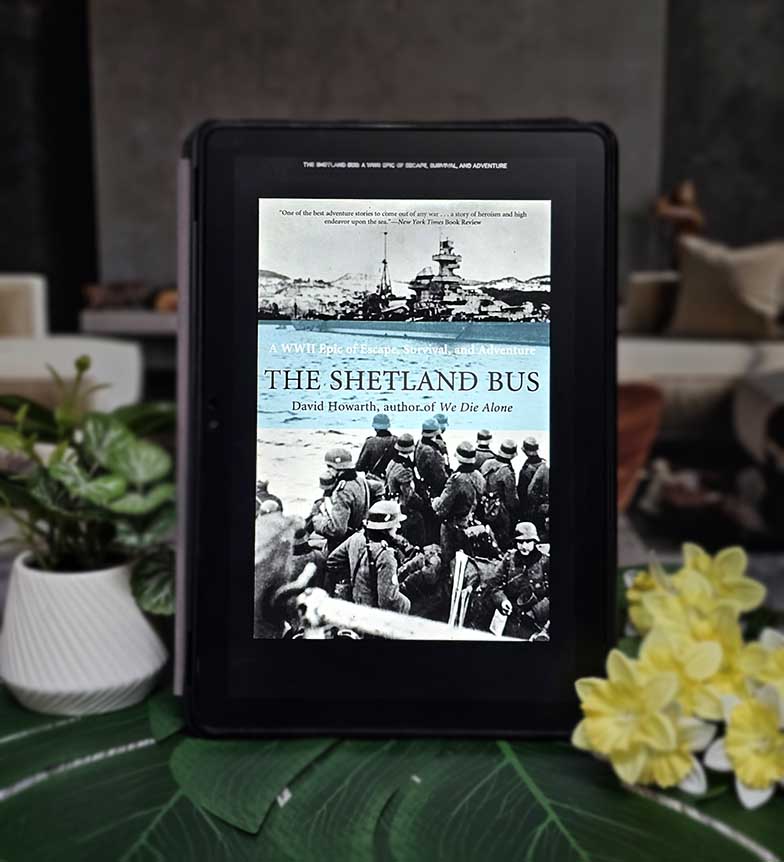
The Shetland Bus
by David Howarth
The true story of the secret World War II operations between Shetland and Norway. A gripping account of courage, danger, and resistance during the Nazi occupation.
Spoiler Warning
This review may contain spoilers. Read at your own discretion if you haven't finished the book yet.
Ordinary Fishermen, Extraordinary Courage
The "Shetland Bus" wasn't a bus at all. It was a secret wartime operation - Norwegian fishing boats, mostly fifty to seventy feet long, crossing one of the most dangerous stretches of ocean in the world to ferry agents, weapons, and refugees between Shetland, Scotland and Nazi-occupied Norway. The crews were mostly fishermen, not soldiers. The boats - wooden More Cutters with semi-diesel engines - were designed for coastal fishing, not for evading German destroyers and aircraft patrols across the open North Sea in winter. And yet from 1941 to 1945, they made the crossing again and again - 198 documented trips - knowing that capture meant torture and execution, and that the sea itself was trying to kill them even without the Germans' help.
David Howarth wasn't just a historian who researched this story after the fact. He was there. A lieutenant in the Royal Naval Volunteer Reserve assigned to the Special Operations Executive, Howarth served as assistant to Major Leslie Mitchell, the British officer who organized the Shetland Bus operation, and functioned as second in command at the base. He spent four years in the Shetland Islands overseeing day-to-day operations - dispatching boats, receiving returning crews, and absorbing the losses when boats didn't come back. The Shetland Bus, published in 1951, is his firsthand account, and it carries the weight of someone who stood on the dock and watched men he knew sail into darkness toward occupied territory, not knowing if he'd see them again.
Lunna, Scalloway, and the Boats That Shouldn't Have Made It
The operation began in 1941 at Lunna Voe, a sheltered harbor on the northeast coast of Shetland - chosen because it was off the main road, away from shipping lanes, and the small local population wasn't overly curious. Lunna House served as crew quarters. But Lunna had a critical problem: no boat repair facilities. The fishing boats took a battering on every crossing - the North Sea in winter generates hundred-foot waves, gale-force winds, and temperatures that freeze spray into ice on deck - and without the ability to repair them, the operation was losing boats to mechanical failure as well as enemy action.
In 1942, the base moved to Scalloway, a small port on Shetland's west coast, primarily because of one man: Jack Moore, owner of William Moore & Sons, the local shipyard. Moore's yard gave the operation the repair capacity it desperately needed. Howarth himself designed a purpose-built slipway at the Moore shipyard, constructed by Norwegian shipwrights working alongside Moore's local engineers. When Crown Prince Olav of Norway visited in October 1942, the slipway was named the Prince Olav Slipway in his honor. Moore's contribution was recognized after the war with the Knight of the Royal Norwegian Order of St. Olav - the highest Norwegian honor available to a civilian.
The boats themselves are characters in Howarth's account. The Aksel, skippered by August Naeroy, made the very first Shetland Bus crossing on August 30, 1941. It was sunk in the North Sea on December 8, 1942, with all six crew lost. The Blia, under skipper Ingvald Leroy, departed Norway on November 14, 1941, carrying seven crew and thirty-five refugees - men, women, and families fleeing the occupation. It was never seen again. No wreckage, no bodies, no distress signal. Just gone. Howarth describes these losses with the spare precision of someone who watched them happen from the other end of the crossing, who stood on the dock as the hours stretched past the expected arrival time and the silence became its own kind of answer.
Leif Larsen and the Men Who Kept Going Back
The Norwegian crews are the heart of the book, and the most extraordinary of them was Leif Andreas Larsen - known as "Shetlands Larsen" - who completed fifty-two crossings and became, by some accounts, the most highly decorated Allied naval officer of the Second World War. Larsen was a fisherman, not a military man, but he had an instinct for the sea and for survival that kept him alive through missions that killed dozens of his colleagues. His most audacious operation was Operation Title in the autumn of 1942 - an attempt to sink the German battleship Tirpitz in Trondheimsfjord. Larsen skippered the fishing vessel Arthur, towing two human-guided torpedoes called Chariots across the North Sea. They arrived undetected within five miles of the Tirpitz, but the Chariots broke loose in rough seas before they could be deployed. The mission failed. The crew had to flee to Sweden. British Able Seaman Robert Evans was captured and shot. Larsen received the Conspicuous Gallantry Medal - the first non-Briton ever to receive it.
Kare Iversen, primarily an engineer, made fifty-seven crossings - more than anyone else in the operation. Howarth writes about these men not as heroes in the mythic sense but as people - frightened, exhausted, grieving for friends lost on previous crossings, and going back anyway because the resistance needed weapons, the agents needed transportation, and the refugees needed a way out. The courage Howarth describes isn't the absence of fear. It's the presence of fear alongside the decision to go, which is a harder thing to write about honestly and a harder thing to read without being moved.
The Brattholm Disaster and the Connection to We Die Alone
One of the book's most devastating chapters covers the Brattholm disaster of March 30, 1943. A team of Norwegian SOE agents aboard the fishing vessel Brattholm was intercepted by German patrol boats near the island of Rebbenesoy after a contact on shore was compromised. The vessel was scuttled. Eight of the eleven men aboard were shot, their bodies thrown into a mass grave. Two were tortured to death. A single man survived - Jan Baalsrud, who swam to shore, shot a German officer, and escaped into the Arctic wilderness with one boot, beginning a sixty-four-day ordeal that would end with self-amputated toes and a desperate rescue by Sami reindeer herders who smuggled him across the border into Sweden.
Howarth would later tell Baalsrud's story in full in his 1955 book We Die Alone, but its origin is here, in The Shetland Bus, as one loss among many - which is itself a devastating realization. The Brattholm disaster, extraordinary as Baalsrud's survival was, was not an anomaly. It was the kind of thing that happened to the Shetland Bus crews with terrible regularity. Forty-four men were killed over the course of the operation. At least ten boats were lost from the Scalloway base alone. Howarth doesn't dwell on these numbers - he gives them, and moves on to the next crossing, because that's what the surviving crews did.
The Submarine Chasers and the Turning Point
The losses during the 1942-43 winter season - the Aksel, the Bergholm strafed by German aircraft with one crew member killed, the Brattholm - forced a reckoning. The wooden fishing boats were too slow, too vulnerable, and too fragile to sustain the operation through another North Sea winter. The solution came from the United States. On October 26, 1943, three American-built submarine chasers were officially transferred to the operation: the Hitra, commanded by Ingvald Eidsheim; the Vigra, commanded by Leif Larsen; and the Hessa, commanded by Petter Salen. At 110 feet long, powered by twin 1,200-horsepower diesel engines, and capable of twenty-two knots, the submarine chasers were a different category of vessel entirely - fast enough to outrun German patrol boats, armed enough to fight back against aircraft, and seaworthy enough to handle the North Sea in conditions that would have swamped the fishing boats.
The transformation was immediate and total. The operation was reorganized as the Royal Norwegian Naval Special Unit, formally part of the Royal Norwegian Navy. The submarine chasers completed over a hundred crossings with zero losses - no boats, no men. Howarth describes this transition without triumphalism, because the cost of reaching it - the men and boats lost in the fishing-boat years - can't be recovered by better equipment arriving late. The sub-chasers were the right tools for the job. The fishing boats were never the right tools. The men who sailed them did it anyway, and the ones who didn't come back are the reason the better boats eventually arrived.
What the Numbers Add Up To
By the war's end, the Shetland Bus operation had transported 192 agents into occupied Norway and extracted 73. It evacuated 373 refugees. It delivered 383 long tons of weapons, explosives, and supplies to the Norwegian resistance. It provided intelligence that shaped Allied strategy in the North Atlantic. These numbers don't capture the individual acts - the families in Norway who hid agents in their attics, the radio operators who transmitted from basements knowing that German direction-finding equipment was hunting them, the fishermen who sailed into winter darkness toward a coastline patrolled by an enemy that would kill them on sight. Howarth captures those individual acts with a prose style that's spare and understated, trusting the facts to carry their own emotional weight.
The book's limitation is the same one I noted in We Die Alone - Howarth was writing in the early 1950s, and his understanding of trauma reflects the era. The psychological cost of what these men endured - the cumulative grief of losing friends on crossing after crossing, the strain of years of mortal risk, the transition back to ordinary life after the war - gets almost no attention. Howarth wrote about the operation, not the aftermath, and a modern account would likely give more space to what the survivors carried home with them. There are also stretches in the middle of the book where the operational details - which boat went where, which agent was dropped at which fjord - accumulate at a pace that can feel more like a logbook than a narrative. Readers without a specific interest in WWII naval operations may find these sections slower going than the more dramatic episodes.
But those are small reservations about a book that accomplishes something remarkable: it makes you understand, viscerally, what it meant to resist. Not resistance as grand heroic narrative, but resistance as a daily, grinding, terrifying choice made by ordinary people who could have stayed safe and didn't. The Shetland Bus crews were fishermen, not commandos. Their boats were built for herring, not for warfare. And what they did - 198 crossings, 44 men lost, four years of sustained courage in the face of odds that would have broken most people - is one of the great untold stories of the Second World War. Howarth, who watched it happen from the Scalloway dock, tells it with the authority and restraint it deserves.
Rating: 5.0/5 ⭐
Perfect for: History enthusiasts, readers who appreciate true stories of courage and resistance, anyone interested in the operational details of WWII's secret war, those who loved We Die Alone and want the broader context.
Skip if: Detailed wartime operational accounts aren't your thing, or the accumulation of losses across a sustained campaign is emotionally difficult to read.
You Might Also Like
We Die Alone
by David Howarth
The extraordinary true story of Jan Baalsrud, a Norwegian commando who survived alone in the Arctic wilderness for months after a failed sabotage mission during World War II.

Everything is Figureoutable
by Marie Forleo
A revolutionary mindset and practical action plan for when you feel stuck, overwhelmed, or lost. Marie Forleo shares her philosophy that any problem, challenge, or dream is figureoutable.

Playing Big
by Tara Mohr
A practical guide for women looking to step into their power and pursue their ambitions. Tara Mohr offers tools to quiet your inner critic, recognize your unique calling, and take bold action.