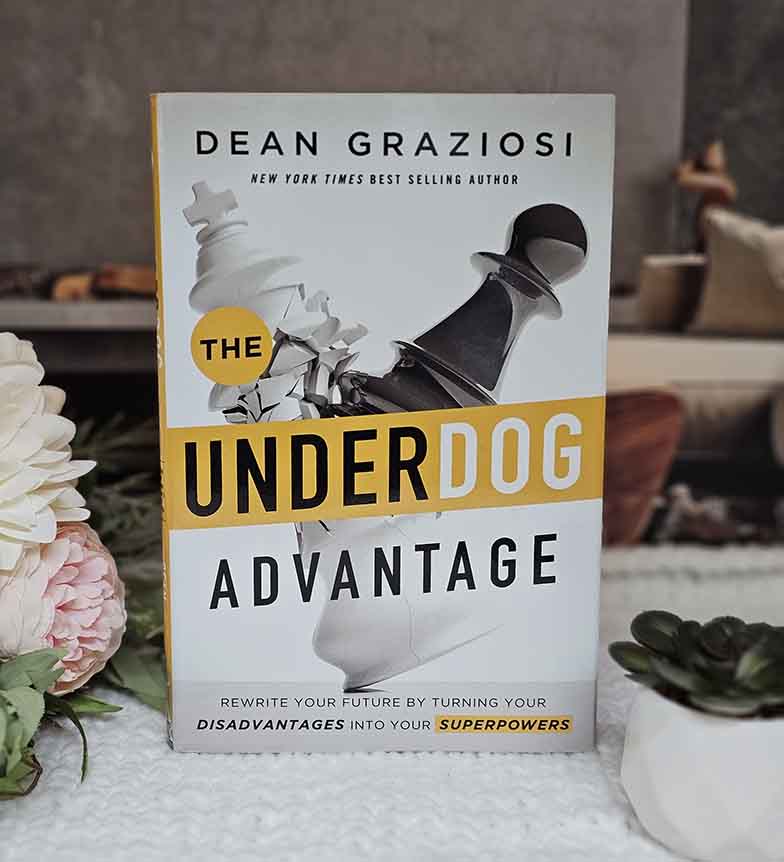
The Underdog Advantage
by Dean Graziosi
Dean Graziosi argues that being an underdog is actually an advantage in achieving success, providing strategies for leveraging disadvantages and turning obstacles into opportunities.
Spoiler Warning
This review may contain spoilers. Read at your own discretion if you haven't finished the book yet.
The Upside of Starting Behind
Dean Graziosi grew up in a trailer park in Marlboro, New York. His parents divorced when he was young, money was always tight, and the kind of advantages that grease the path to conventional success - connections, education, financial cushion - were simply not available to him. He started working at his father's auto repair shop as a kid, not because he was passionate about cars but because the family needed every dollar it could scrape together. By his early twenties, he'd talked his way into the real estate business with no credentials, no capital, and no network, and built it into a multi-million dollar operation through sheer resourcefulness and a willingness to outwork everyone around him. He later became one of the most recognizable faces on late-night television through his real estate infomercials, built multiple companies, and wrote bestselling books. The Underdog Advantage is his attempt to codify what he learned along the way: that starting with nothing isn't just an obstacle to overcome - it's a competitive advantage that people with comfortable backgrounds can never replicate.
The core argument is captured in one of the book's sharpest lines: "Your greatest disadvantage can become your greatest advantage when you learn to leverage what makes you different instead of trying to fit in." Graziosi isn't claiming that poverty is a gift or that suffering builds character in some abstract, noble way. He's making a more specific point: that the skills you develop when you have no safety net - hustle, creativity, emotional resilience, the ability to read people and situations quickly because you can't afford to get them wrong - are precisely the skills that matter most in business and life. People who've always had resources never had to develop them. That's their disadvantage, and they don't even know they have it.
The Hunger That Privilege Can't Manufacture
The book's first section dismantles the assumption that having advantages leads to success. Graziosi describes meeting wealthy entrepreneurs' kids who had every resource imaginable - the best schools, startup capital from family, introductions to powerful people - and who still couldn't build anything that worked. Not because they were stupid or lazy, but because they'd never needed to figure things out from scratch. When you've always had a safety net, you never develop the reflex of finding solutions under pressure. When failure has no real consequences, you never learn the kind of focused, desperate creativity that produces breakthroughs.
He contrasts this with his own early real estate deals, where a mistake didn't mean losing some of dad's money - it meant not eating. That pressure, Graziosi argues, sharpened his instincts in ways that no MBA program could have. He learned to read a property, a negotiation, a person's motivations, because his survival depended on getting it right. He learned to sell because he had no choice - nobody was going to hand him a client list or a marketing budget. He tells a story about his first real estate deal, where he had to negotiate with a seller while wearing clothes he'd borrowed because he didn't own anything that looked professional enough. The deal closed. The seller never knew. And the lesson Graziosi took from it wasn't about clothes - it was about the fact that resourcefulness beats resources every time, if you're willing to be uncomfortable.
Your Story Is Your Strategy
The middle section is where Graziosi gets most practical, and it's organized around what he calls the underdog's toolkit - a set of strategies for people who don't have traditional advantages. The most interesting of these is his argument about authenticity as competitive strategy. "Stop trying to be someone else's version of successful," he writes. "Your authentic self, including your struggles and imperfections, is your greatest asset." His point is that in a world saturated with polished branding and curated personas, genuine human story cuts through the noise in a way that corporate-speak can't.
He illustrates this with his own experience in infomercials. The conventional wisdom in that industry was to present yourself as already wealthy, already successful, already the person your audience aspires to be. Graziosi went the opposite direction - he talked about growing up poor, about the trailer park, about the struggle. Not for pity, but for connection. His audience wasn't the wealthy looking for more wealth. It was ordinary people who saw themselves in his story and thought, if this guy from a trailer park can do it, maybe I can too. The authenticity wasn't just morally preferable - it was strategically superior. People trust struggle more than they trust polish, and trust is the foundation of every business relationship.
His chapter on networking without a network is similarly practical. Graziosi describes approaching potential mentors and business partners not with the typical "can I pick your brain" requests that busy people hate, but by figuring out what they needed and providing it first. He'd research someone he wanted to connect with, identify a problem they were facing, and show up with a solution - or at least a useful insight - before ever asking for anything in return. It's relationship-building through demonstrated value rather than credential-waving, and it works precisely because people with advantages rarely bother to do it. They don't have to. Underdogs do, and that necessity produces a relational skill set that privilege never develops.
Imperfect Action Beats Perfect Inaction
The book's strongest recurring theme is the argument against overthinking. "Perfect planning is often just procrastination in disguise," Graziosi writes. "Imperfect action beats perfect inaction every single time." He traces this back to the underdog experience: when you don't have enough resources to plan perfectly, you learn to start before you're ready and iterate based on real feedback rather than theoretical preparation. You try something, it half-works, you adjust, you try again. The tolerance for messiness that this builds becomes an enormous advantage in competitive environments where privileged competitors are still refining their business plans while you're already in the market learning from actual customers.
Graziosi describes his own approach to launching businesses as deliberately imperfect - getting a minimum viable version out as quickly as possible and letting the market tell him what needed to change, rather than spending months (and money he didn't have) trying to get everything right before launch. It's a lean-startup philosophy before that term existed, born not from reading Eric Ries but from not having the luxury of doing it any other way. The chapter is genuinely useful for anyone stuck in analysis paralysis, and Graziosi's credibility as someone who built real businesses this way gives the advice a weight that purely theoretical frameworks lack.
Where the Argument Gets Thin
Here's where I have to be honest about the book's limitations, because they're significant enough to affect how useful it is for different readers. Graziosi's entire framework rests on a foundation of survivorship bias - he's telling you about the advantages of being an underdog because he's an underdog who succeeded. But for every Graziosi who parlayed a trailer-park childhood into millions, there are thousands of people from similar circumstances who worked just as hard, hustled just as creatively, and didn't make it - because structural barriers, bad luck, discrimination, health crises, or any of the dozens of factors that aren't captured by "mindset" got in the way. Graziosi acknowledges obstacles exist, but he consistently frames them as mindset problems that can be overcome through effort and reframing, which is true often enough to be useful advice and untrue often enough to be frustrating.
The book also gets repetitive in its second half. Graziosi has a handful of core ideas - disadvantage breeds resourcefulness, authenticity beats polish, action beats planning - and he restates them in different contexts across multiple chapters without always adding enough new material to justify the length. The anecdotes start to feel interchangeable: someone started with nothing, embraced their underdog status, worked incredibly hard, succeeded. The pattern is clear by chapter four, and the remaining chapters reinforce rather than deepen it. A tighter book - maybe 180 pages instead of 272 - would have delivered the same message with more impact.
His writing style also leans heavily on the motivational-speaker register - exclamation points, high-energy exhortations, the "you can do this!" cadence that works beautifully from a stage but can feel overwrought on the page. "Underdogs don't wait for permission, they don't expect things to be handed to them, and they don't make excuses. They make moves." That's a great line in a keynote. In a book, surrounded by dozens of similar lines, the intensity starts to flatten. Readers who respond to that energy will find it galvanizing. Readers who prefer their advice delivered at a lower volume may find their attention drifting.
None of which erases the book's genuine value. The core reframe - that your disadvantages have equipped you with skills that privileged competitors don't have - is a powerful idea, and Graziosi earns the right to make it through his own lived experience. For readers who feel held back by where they started, who look at people with better credentials and connections and assume the game is rigged, this book offers a genuinely useful counternarrative. The game may be tilted, but the tilt has given you muscles the other players don't have. Whether that's enough depends on factors Graziosi doesn't fully address, but the permission to see your starting point as asset rather than liability is worth something real.
Rating: 4.0/5 ⭐
Perfect for: Aspiring entrepreneurs, career changers, anyone feeling held back by their background who wants a motivational reframe grounded in real business experience.
Skip if: Survivorship-bias success narratives frustrate you, or you prefer tactical business strategy over mindset-focused motivation.
My Notes & Takeaways
"Underdogs have to be innovative. They have to be creative, because they don't have all the assets somebody else has."
"Underdogs have a passion to prove themselves."
"Underdogs are people that you never see coming."
"Underdogs are always underestimated."
"Underdogs can harness the power that comes from people telling them they can't."
"Underdogs can be humble learners, and use that to propel themselves to success."
"Underdogs have to face the truth, and not hide from their problems, and this is what helps them succeed."
You Might Also Like

Everything is Figureoutable
by Marie Forleo
A revolutionary mindset and practical action plan for when you feel stuck, overwhelmed, or lost. Marie Forleo shares her philosophy that any problem, challenge, or dream is figureoutable.

Girl, Wash Your Face
by Rachel Hollis
A motivational self-help book that encourages women to stop believing lies about themselves and start living authentically. Rachel Hollis shares personal stories and practical advice for overcoming self-doubt.
How Successful People Grow
by John C. Maxwell
A practical guide to personal and professional development from leadership expert John C. Maxwell, exploring the habits and mindset that drive continuous growth.