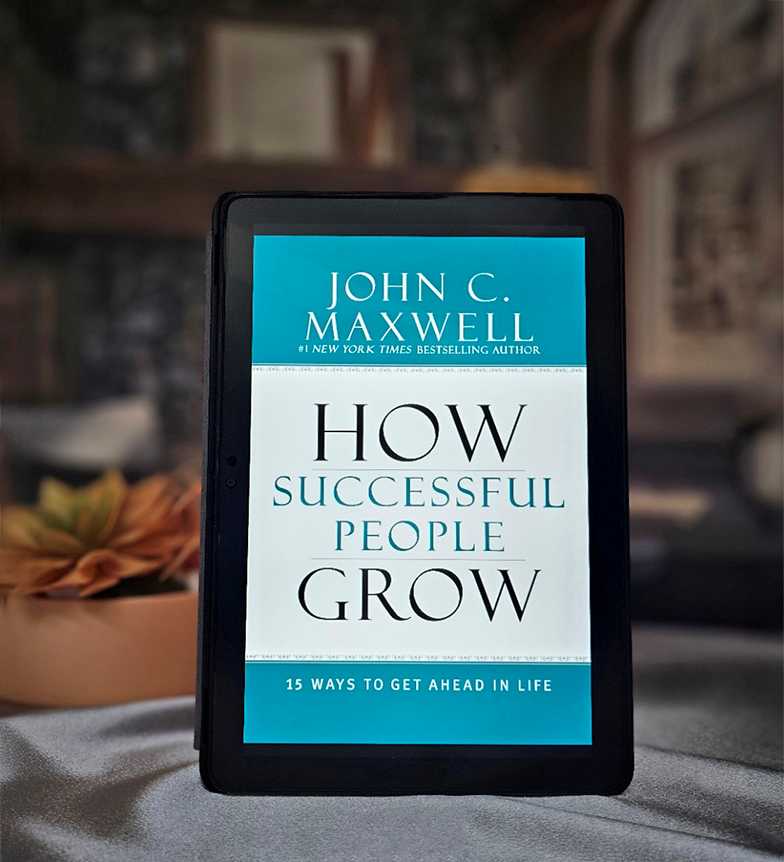
How Successful People Grow
by John C. Maxwell
A practical guide to personal and professional development from leadership expert John C. Maxwell, exploring the habits and mindset that drive continuous growth.
Spoiler Warning
This review may contain spoilers. Read at your own discretion if you haven't finished the book yet.
Growth Doesn't Happen by Accident
Here's a truth that might sting a little: hoping to improve isn't the same as improving. Wanting to grow isn't the same as growing. If you've been waiting for personal development to just sort of... happen, John C. Maxwell has some news for you. In How Successful People Grow, the longtime leadership author lays out fifteen principles he argues separate people who actually develop from people who stay stuck in the same place year after year. His central thesis hits hard precisely because it's so simple - growth is always intentional, never accidental, and the gap between "I want to be better" and "I am actively getting better" is entirely a matter of whether you've built a system for it.
Maxwell has written dozens of books on leadership and personal development, and this one reads like a distillation - the core ideas he keeps coming back to, organized into a framework you can actually use. It's not going to shock anyone who's already spent time in this space. But Maxwell's particular gift has always been making familiar concepts feel urgent enough to act on, and for a book this short - 224 pages, easily finished in a weekend - it packs a surprising amount of practical value alongside its inevitable limitations.
Fifteen Principles, and the Ones That Actually Land
The book's structure is straightforward: fifteen chapters, each built around a single growth principle. Some of these will feel obvious. The Principle of Intentionality - that you need a deliberate plan for growth rather than assuming it'll happen on its own - is table stakes for anyone who's picked up a personal development book before. But Maxwell pushes past the obvious by getting specific about what intentionality actually looks like in practice. He argues that most people mistake activity for growth, confusing busyness with progress. You can work hard for twenty years and never actually develop if you're just repeating the same skills rather than stretching into new ones. That distinction between doing more and doing differently is one of the book's sharpest insights.
The Principle of the Ladder is where Maxwell gets into territory that's genuinely useful for anyone managing their career. He breaks down a hierarchy of growth areas - from areas where you're naturally strong and should invest heavily, down to areas where you're weak and should stop pretending you'll magically improve. His advice to focus your growth energy on your strengths rather than trying to shore up weaknesses runs counter to a lot of conventional workplace wisdom, and he makes a compelling case for why organizations that force people to "round out" their skill sets end up with mediocre generalists instead of exceptional specialists.
The Principle of Contribution - the argument that growth should be oriented toward adding value to others, not just self-improvement for its own sake - is the chapter where Maxwell's background as a pastor and leadership coach shows most clearly. He frames personal development not as self-focused ambition but as a responsibility, arguing that the more you grow, the more you owe to the people around you. Whether that framing resonates will depend on your own orientation toward service versus individual achievement, but it's a useful corrective to the more self-centered strain of personal development writing.
His chapters on the Principle of Reflection and the Principle of Pain are where the book gets most practical. Maxwell argues that experience alone teaches nothing - it's evaluated experience that produces growth. He advocates for building deliberate reflection into your routine, setting aside time to analyze what worked, what didn't, and why, rather than just barreling forward into the next project. The pain chapter takes this further, making the case that the moments you most want to skip over - failure, embarrassment, loss - are precisely the moments with the highest growth potential. His framework for extracting lessons from painful experiences is one of the more actionable takeaways in the book.
The Maxwell Formula, For Better and Worse
If you've read any of Maxwell's other books - The 21 Irrefutable Laws of Leadership, Developing the Leader Within You, The 15 Invaluable Laws of Growth - you'll recognize both the ideas and the delivery method here. Maxwell teaches through anecdotes, usually drawn from his own career or from the lives of leaders he's coached, and he has a habit of circling back to the same core themes across books. The compounding effect of small daily improvements. The importance of surrounding yourself with people who are ahead of you. The idea that your growth ceiling is determined more by your mindset than your circumstances. These are solid principles, and they bear repeating, but readers who are already deep in Maxwell's catalog will find significant overlap.
The book's most noticeable limitation is how heavily it leans on individual agency. Maxwell writes as if growth is almost entirely a function of personal choice and discipline, with relatively little attention paid to the structural factors that make growth easier for some people than others. The Principle of Environment - his chapter on surrounding yourself with growth-oriented people and situations - comes closest to acknowledging that context matters, but even there, the emphasis is on choosing your environment rather than recognizing that not everyone has the same options to choose from. His examples tend to come from the world of corporate leadership, executive coaching, and motivational speaking, which gives the advice a particular flavor that won't resonate equally with every reader.
There's also a sameness to the chapters that becomes noticeable by the book's second half. Several principles overlap enough that you wonder whether fifteen was the right number or whether Maxwell stretched to fill a structure. The Principle of Consistency and the Principle of Intentionality cover related territory. The Principle of Expansion and the Principle of Curiosity are close cousins. Individually, each chapter has something useful to offer, but read straight through, the book develops a repetitive rhythm - principle, anecdote, application - that can feel more like a workbook than a book you'd read for pleasure. This is a minor complaint for something designed to be practical, but it does mean the reading experience plateaus before the content runs out.
A Framework Worth Having
Here's what it comes down to: How Successful People Grow isn't going to revolutionize your thinking if you're already well-read in personal development. It doesn't have the paradigm-shifting ambition of a Covey or the psychological depth of a Carol Dweck. What it does offer is a clear, organized, genuinely practical framework for thinking about your own development - one that you can pick up, flip to the chapter that's most relevant to where you're stuck right now, and walk away with something concrete to try. Maxwell's emphasis on consistent, intentional effort over hacks and shortcuts feels increasingly countercultural in a world that wants every self-improvement strategy to be a life hack, and that alone makes it worth the read.
If you're early in your personal development journey, this is an excellent starting point - organized enough to follow, substantive enough to actually move the needle. If you're further along, it works as a gut check on whether you're still being intentional about your growth or whether you've let the fundamentals slide while chasing more advanced strategies. Just know going in that it's more workbook than revelation, more pastoral than provocative, and more useful in small doses than consumed cover to cover.
Rating: 4.0/5 ⭐
Perfect for: Career-focused readers, aspiring leaders, anyone looking for a systematic and practical approach to personal development without the fluff.
Skip if: You've already read extensively in Maxwell's catalog, or you're looking for something with more psychological depth and less motivational framework.
My Notes & Takeaways
Key Quotes
"You cannot change your life until you change something you do every day."
"If you focus on goals, you may hit goals - but that doesn't guarantee growth. If you focus on growth, you will grow and always hit goals."
"If you want your life to improve, you must improve yourself. You must make that a conscious goal."
"The reality is that you will never get much done unless you go ahead and do it before you are ready."
"To become intentional about growing, expect to make mistakes every day and welcome them as a sign that you are moving in the right direction."
"The best you can hope to do in life is to make the most out of whatever you've been given."
"If you want to change and grow, then you must know yourself and accept who you are before you can start building. The way to start is to pay attention to your passions."
"You cannot change direction if you aren't aware that you're not headed where you want to go."
"People say there are two great days in a person's life: the day you were born and the day you discover why."
"If we want to change our lives, we have to change the way we think of ourselves. If we want to change the way we think of ourselves, we need to change the way we talk to ourselves."
"One of the best ways to build self-esteem is to do what's right. It gives a strong sense of satisfaction."
"If there is an area of your life that seems overwhelming to you - health, work, family, or something else - try chipping away at it a little bit every day instead of trying to tackle it all at once."
"If you pause to allow growth to catch up with you, it makes your life better, because you can not only better understand the significance of what you've experienced but also implement changes and course corrections as a result. You are also better equipped to teach others from the wisdom you have gained."
"Motivation gets you going, but discipline keeps you growing."
"The secret to building motivational momentum is to start small with the simple stuff."
"It is not always comfortable, but it is always profitable to associate with people larger than ourselves. People with integrity. People who are positive. People who are ahead of us professionally. People who lift us up instead of knocking us down. People who take the high road, never the low. And above all, people who are growing."
"Being organized gives a sense of power. When you know your purpose and priorities and you have ordered your day, week, or year according to them, you have a clarity of thought that strengthens everything you do."
"If you do the things you need to do when you need to do them, then someday you can do the things you want when you want to do them. In other words, before you can do, you must be."
"Significance can be birthed within each of us. If we are willing to stretch, that seed can grow until it begins to bear fruit in our lives."
"Life has many intersections, opportunities to go up or down. At these intersections we make choices. We can add something to our life, subtract from it, or exchange something we have for something we don't. The most successful people know when to do which one of those three."
"Perhaps the greatest way to remain curious and keep growing is to enjoy life. That means taking risks - sometimes failing, sometimes succeeding, but always learning. When you enjoy your life, the lines between work and play begin to blur. We do what we love and love what we do. Everything becomes a learning experience."
You Might Also Like
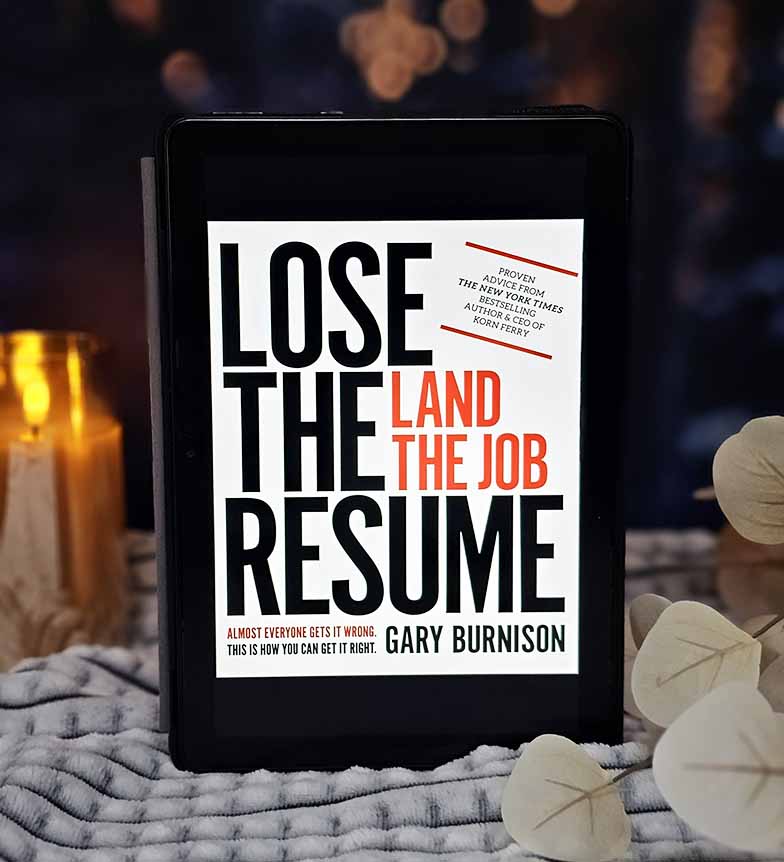
Lose the Resume, Land the Job
by Gary Burnison
A modern approach to job searching that emphasizes relationship-building and personal storytelling over traditional resume-focused strategies.

Playing Big
by Tara Mohr
A practical guide for women looking to step into their power and pursue their ambitions. Tara Mohr offers tools to quiet your inner critic, recognize your unique calling, and take bold action.

The Underdog Advantage
by Dean Graziosi
Dean Graziosi argues that being an underdog is actually an advantage in achieving success, providing strategies for leveraging disadvantages and turning obstacles into opportunities.