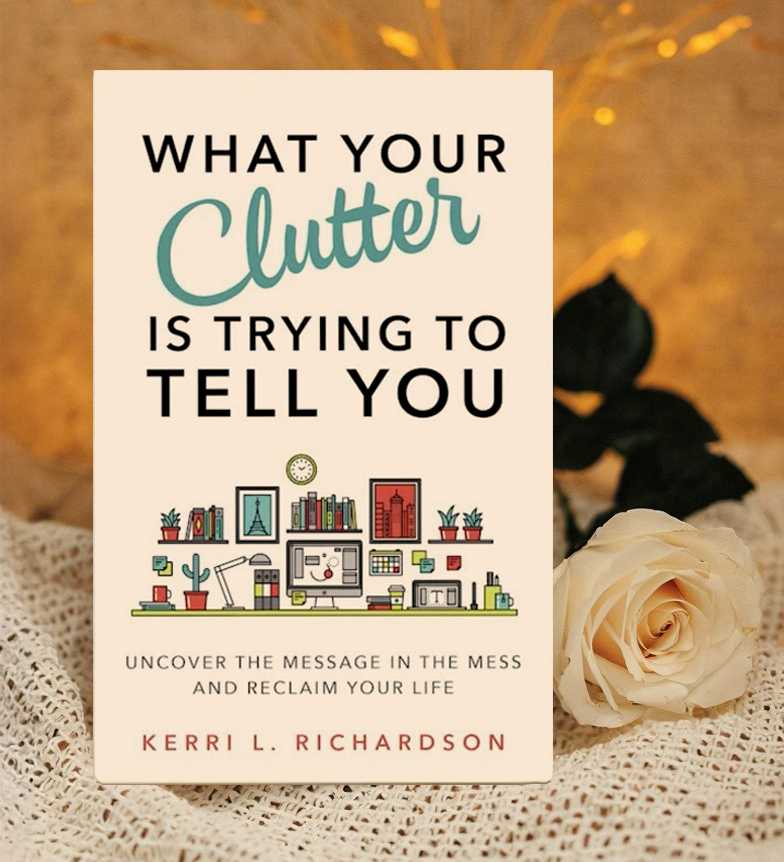
What Your Clutter is Trying to Tell You
by Kerri L. Richardson
A thoughtful exploration of the emotional and psychological aspects of clutter. Richardson goes beyond simple organizing tips to examine what our possessions reveal about our inner lives and relationships.
Spoiler Warning
This review may contain spoilers. Read at your own discretion if you haven't finished the book yet.
When Your Stuff Is Trying to Tell You Something
Have you ever stood in the middle of a cluttered room and felt something beyond simple frustration? Not the "I need to tidy up" kind of frustration, but the deeper, heavier kind - the sense that this mess is connected to something you're not quite ready to look at? Kerri L. Richardson, a life coach who's spent years helping clients clear both physical and emotional clutter, opens What Your Clutter is Trying to Tell You with a line that stopped me in my tracks: "Clutter is a temper tantrum of the soul, and it's time to listen closely to what it's saying." That framing - your mess isn't a failure of discipline, it's a message from your subconscious - is the foundation for a decluttering book that has almost nothing in common with the bin-and-basket organizing guides crowding the self-help shelves.
Richardson's argument is that clutter isn't the problem. It's the symptom. The piles of clothes you never wear, the kitchen gadgets gathering dust, the boxes in the garage you haven't opened since your last move - they aren't just stuff. They're physical manifestations of emotional patterns: grief you haven't processed, identities you haven't released, boundaries you haven't set, decisions you've been avoiding. Until you understand the feelings driving the accumulation, no organizing system will stick. You'll buy the matching containers, watch the YouTube videos, spend a weekend sorting everything into neat categories, and six months later you'll be right back where you started. Richardson wants to break that cycle, and her approach is to go after the root system rather than trimming the branches.
The Emotional Anatomy of Your Clutter
The book's most useful framework is Richardson's taxonomy of clutter types, which goes far deeper than "things you don't need." She identifies memory clutter - items you keep not because you use them but because they're tethered to a moment, a person, or a version of yourself you're not ready to release. Your grandmother's china that you've never taken out of the box. The concert T-shirts from college that don't fit anymore but represent a time when life felt simpler. Someday clutter is the just-in-case category - the exercise equipment for the workout routine you'll definitely start next month, the craft supplies for the hobby you'll pick up when things calm down, the clothes two sizes too small that you're keeping as motivation. Richardson's point isn't that hope is bad; it's that someday clutter lets you feel productive about a goal without actually doing anything about it, and the pile of unused supplies becomes its own kind of permission to keep postponing.
Then there's identity clutter - possessions tied to who you used to be or who you think you should be. The business suits from the corporate career you left five years ago. The textbooks from the degree you finished but never used. The running gear from the marathon phase that ended when your knees gave out. Richardson argues that keeping these items isn't neutral; they take up psychic space as well as physical space, constantly reminding you of the gap between who you are and who you thought you'd become. And relationship clutter - the gifts you keep out of guilt, the ex's belongings you haven't returned or thrown away, the inherited items you don't want but feel obligated to display - is perhaps the most emotionally loaded category of all. Richardson traces each type back to the feelings underneath: fear, obligation, nostalgia, shame, the desperate hope that keeping the object will somehow preserve what it represents.
What elevates this beyond a simple categorization exercise is the work Richardson asks you to do with it. Each chapter includes journaling prompts and reflection exercises designed to help you identify which emotional patterns are driving your specific clutter. She asks questions like: What would it mean about you if you let this go? What are you afraid will happen? What are you trying to hold onto by keeping this? The questions are deceptively simple, but sitting with them honestly can surface feelings that surprise you. I found myself unexpectedly emotional working through her exercise on identity clutter - realizing that I was holding onto objects not because I wanted them but because releasing them felt like admitting that a chapter of my life was really over.
Your Inner Critic Is a Loving Liar
One of Richardson's sharpest insights is about the role of self-talk in maintaining clutter. She describes the inner voice that says "you might need that someday" or "you paid good money for that" or "a good daughter would keep her mother's things" as what she calls a "loving liar" - a voice that sounds protective but is actually keeping you stuck. The inner critic frames itself as practical, responsible, sentimental. But its real function is to prevent change, because change is uncomfortable and the inner critic's job is to keep you safe inside the familiar, even when the familiar is making you miserable.
Richardson dedicates an entire chapter to decision-making, and her central rule is elegant in its simplicity: "If you don't love it, need it, or use it, it's clutter." The power of that framework isn't in the rule itself - variations of it appear in every organizing book ever written - but in how Richardson applies it to the emotional rationalizations that keep people from using it. You don't love it, but you feel guilty about it. You don't need it, but it cost a lot. You don't use it, but someone you care about gave it to you. Richardson walks through each of these objections with compassion but firmness, helping readers separate what they actually feel from what they think they're supposed to feel. Her mantra - "feelings are to be felt, not fixed" - gives permission to feel the guilt and grief of letting go without letting those feelings make the decision for you.
The chapter on expectations is where Richardson connects clutter to broader life patterns. She argues that the pressure of self-imposed expectations - about what your home should look like, what kind of person you should be, how much you should have accomplished by now - creates a kind of paralysis that feeds clutter. "The pressure of the expectations is enough to keep the clutter on your desk, your dream partner at bay, and the pounds on your body." All-or-nothing thinking, she observes, is one of clutter's best allies: if you can't do a complete overhaul, you do nothing. If you can't get the whole house organized in a weekend, why start at all? Her counter-argument - "with all-or-nothing thinking, nothing always wins" - is the kind of line that sounds obvious written down but lands like a revelation when you realize it describes exactly how you've been approaching every area of your life.
Where the Approach Has Its Limits
Richardson's psychological framework is the book's greatest strength, but it does create some gaps. She spends so much time on the emotional roots of clutter that the practical side - what to actually do once you've had your revelation - gets thinner treatment than it probably deserves. Her action steps tend toward the general: start small, be kind to yourself, take breaks when the emotions get intense, celebrate progress. For readers who've done the emotional work and are ready for a concrete, room-by-room action plan, Richardson points you toward the insight but doesn't always walk you through the execution. Pairing this book with a more logistically focused resource - the Marie Kondo method for physical process, or Dana White's "container concept" for maintaining systems - would give you a more complete toolkit.
The book also leans heavily on Richardson's coaching practice, and while her client stories illustrate the concepts well, they sometimes feel curated toward maximum emotional impact rather than representing the full range of clutter situations. The examples tend toward dramatic breakthroughs - the client who realizes she's been keeping her dead mother's wardrobe because letting it go feels like losing her again, the woman whose cluttered home office mirrors her fear of success. These are powerful stories, but readers whose clutter stems from more mundane causes (moving too often, having small kids, genuinely lacking storage space) may not see themselves reflected as clearly.
None of which diminishes the core value of what Richardson has written. This is a book that changed how I think about possessions - not as neutral objects that need organizing, but as emotional artifacts that carry meaning whether we acknowledge it or not. Her insistence that "success is in the action, not the outcome" reframes decluttering from a project with a finish line into an ongoing practice of self-awareness, and that shift in perspective is worth more than any organizational hack. If you've tried to declutter and found yourself unable to let go, or if you've successfully purged only to accumulate again, Richardson's message is that you're not failing at organizing. You're avoiding a conversation with yourself that your clutter has been trying to start for years.
Rating: 4.5/5 ⭐
Perfect for: Readers interested in the psychology of possessions, anyone who's tried traditional organizing methods and ended up right back in the mess, people going through life transitions that stir up complicated feelings about their stuff.
Skip if: You want a practical room-by-room decluttering system rather than emotional exploration, or your clutter is genuinely more logistical than psychological.
My Notes & Takeaways
Key Insights by Chapter
Chapter 1: Understanding Clutter
"We think the problem is not having enough space for our stuff, when in fact it's that we have too much stuff for our space."
"Clutter is a temper tantrum of the soul, and it's time to listen closely to what it's saying."
"With all-or-nothing thinking, nothing always wins."
Chapter 2: The Inner Voice
"Your inner critic is a loving liar."
Chapter 3: Decision Making
"If you don't love it, need it, or use it, it's clutter."
Chapter 4: Taking Action
"Success is in the action, not the outcome."
"Feelings are to be felt, not fixed."
"Make sure your actions support your words. That's the key to having people respect and adhere to your boundaries."
Chapter 5: Expectations and Reality
"The pressure of the expectations is enough to keep the clutter on your desk, your dream partner at bay, and the pounds on your body."
What Makes This Book Valuable
Richardson's approach is psychological rather than purely practical. She helps readers understand the emotional reasons behind clutter, making it easier to address the root causes rather than just rearranging possessions.
You Might Also Like
The Year of Less
by Cait Flanders
A deeply personal memoir about one woman's year-long shopping ban and her journey toward mindful consumption and intentional living.
Playing Big
by Tara Mohr
A practical guide for women looking to step into their power and pursue their ambitions. Tara Mohr offers tools to quiet your inner critic, recognize your unique calling, and take bold action.
Digital Minimalism
by Cal Newport
A compelling philosophy for technology use in the modern age, arguing for a minimalist approach to digital tools. Cal Newport makes the case for being highly intentional about which technologies you allow into your life and how you use them.