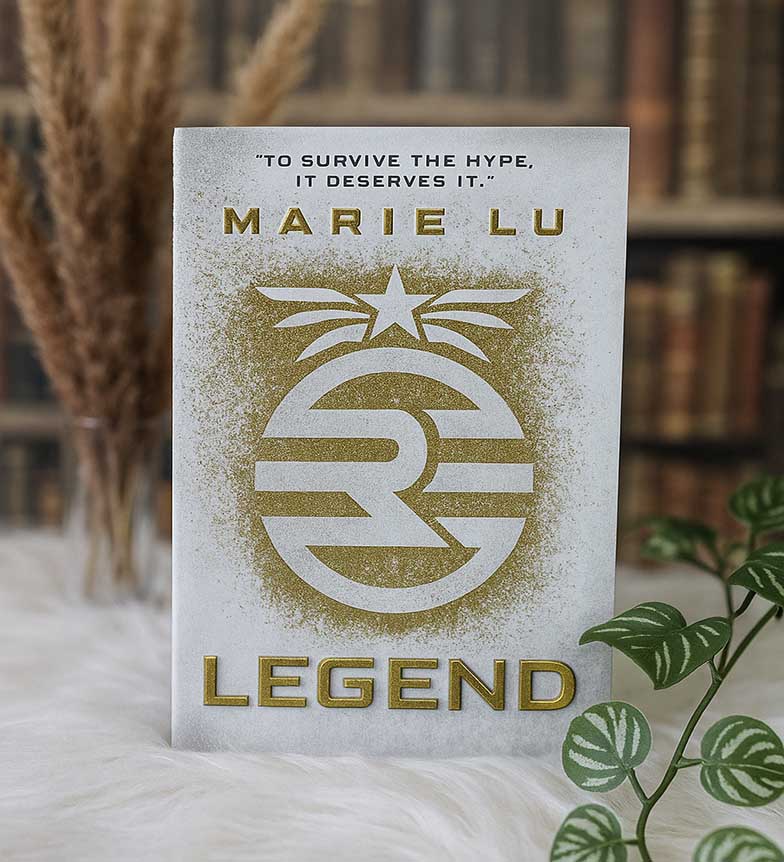
Legend
by Marie Lu
The first book in Marie Lu's dystopian trilogy about Day, the Republic's most wanted criminal, and June, the prodigy tasked with hunting him down.
Spoiler Warning
This review may contain spoilers. Read at your own discretion if you haven't finished the book yet.
When the Perfect Soldier Meets the Perfect Criminal
Picture a future Los Angeles - not the sprawling freeway maze we know, but a flooded, militarized landscape where the western United States has become the Republic, a nation perpetually at war with its eastern neighbor, the Colonies. In this world, every child's future is determined at age ten by a single standardized exam called the Trial. Score well and you're fast-tracked into the best universities and military positions. Score poorly and you're shipped off to labor camps - or worse. Now drop two teenagers on opposite sides of that brutal system and watch what happens when they collide. Legend by Marie Lu is the book that launched one of YA dystopia's best trilogies, and it earns that reputation with a sharp premise, morally complex leads, and a pace that never lets up.
We meet Day first - a fifteen-year-old from the slum sectors of Lake who is the Republic's most wanted criminal. He failed his Trial, watched his family get torn apart by the consequences, and now lives on the streets pulling off acts of sabotage against the military. He destroys fighter jets, steals medical supplies, and spray-paints anti-government slogans across buildings. Then there's June, the Republic's golden child - the only person in its history to score a perfect 1500 on the Trial. She's been groomed for military leadership since childhood, is studying at the prestigious Drake University at just fifteen, and believes completely in the system that made her. When June's beloved older brother Metias, a captain in the Republic's army, is murdered, the evidence points straight to Day. June is deployed to do what the entire military hasn't managed: find and capture the Republic's most elusive fugitive.
The Hunt That Changes Everything
The genius of Legend's structure is how Lu uses the alternating perspectives of Day and June to show us two completely different versions of the same country. June's chapters are precise and analytical - she catalogues details, runs probabilities, and approaches her mission with the calculated focus of someone who's been trained to see the world as a series of problems to solve. Day's chapters are rawer, more desperate, driven by loyalty to his younger brother Eden and his best friend Tess. When June goes undercover in the poor sectors to track Day down, disguising herself as a street kid, we watch her assumptions about how the Republic works start to crack in real time. She sees plague victims left to die, children dragged away after failed Trials, and a level of poverty and suffering that doesn't match the Republic's official narrative.
Lu handles June's unraveling brilliantly. She doesn't flip from loyal soldier to rebel overnight. Instead, she accumulates evidence - the way the plague outbreaks seem targeted at specific poor neighborhoods, the military's willingness to experiment on its own citizens, the growing realization that Metias may have discovered something about the Republic that got him killed. When she finally pieces together the truth about her brother's death, it's not Day she should be hunting at all. The conspiracy runs far deeper and higher than a teenage street criminal, straight to Commander Jameson and the Republic's inner circle.
Day, meanwhile, is dealing with his own ticking clock. Eden has contracted the plague that sweeps through Lake sector, and Day's increasingly desperate attempts to steal plague medicine lead him into a trap. His capture, and the Republic's willingness to use his family as leverage - including the moment soldiers shoot his mother in the street - is the book's emotional turning point. It's the scene where Lu makes clear that this isn't a government that's merely flawed; it's one that views entire populations as expendable.
A Dystopia Built on Familiar Bones
The Republic's world-building is one of Legend's real strengths, though it's not without its shortcuts. Lu constructs a system of oppression that works because it's built on mechanisms we recognize - standardized testing used as social sorting, propaganda that wraps authoritarianism in patriotism, a military that demands loyalty through manufactured fear of an external enemy. The Trials aren't just plot devices; they're a chillingly efficient way to convince an entire population that the class system is fair, that the people on top deserve to be there, and that those who fail were simply lacking. June believed it herself until the evidence became impossible to ignore.
Where the world-building gets thinner is around the edges. The Colonies, the Republic's great enemy, remain almost entirely abstract - we know the two nations are at war and that's about it. The political structure of the Republic itself is sketched in broad strokes rather than detailed specifics. For a first book in a trilogy, that's forgivable - there are two more books to fill in the gaps - but it does mean that the dystopia sometimes functions more as atmosphere than as a fully realized political system. Lu is more interested in what oppression feels like from the ground level than in the structural mechanics of how it operates at the top, and that's a valid choice, but readers who want their dystopias granular may find themselves wanting more.
The romance between Day and June develops naturally from their collision - two prodigies isolated by their exceptional abilities, both starved for genuine connection, drawn to each other before either one understands who the other really is. Their attraction is complicated by the fact that June was hunting Day, that the Republic killed Day's mother, and that trust between them has to be rebuilt from rubble. It works because Lu doesn't rush it, and because neither character loses their personality to the relationship. Day stays reckless and fiercely protective; June stays analytical and driven. They complement each other without completing each other, which is a balance a lot of YA romance doesn't manage.
A Series Opener That Stands on Its Own
Legend does everything a first book needs to do: it establishes a world you want to explore, introduces characters with room to grow, plants seeds for revelations that will pay off in Prodigy and Champion, and delivers a self-contained story that satisfies on its own terms. The pacing rarely slows down - Lu keeps the chapters short and the stakes escalating, cutting between perspectives at exactly the right moments to maintain tension. If anything, the relentless pace is occasionally a limitation; there are moments where the story could benefit from breathing room, from letting Day or June sit with their grief or confusion before the next crisis arrives. But for a debut novel aimed at a YA audience, the momentum is a feature, not a bug.
The book also shows its age in small ways - it was published in 2011, during peak Hunger Games fever, and some of the dystopian trappings feel more of-the-moment than timeless. The love triangle that begins forming here (Tess's feelings for Day adding a quiet complication) is a very 2011 YA convention. But Lu's willingness to engage with class, propaganda, and the morality of rebellion with real intelligence sets Legend apart from the wave of dystopian copycats that followed The Hunger Games. This is a book that takes its teenage characters seriously, that trusts them - and its readers - with moral ambiguity, and that builds toward a conclusion that earns its emotional impact without cheating.
Rating: 4.0/5 ⭐
Perfect for: YA dystopian fans, readers who enjoy dual-perspective narratives and morally complex leads, anyone looking for a fast-paced series opener with political intelligence and heart.
Skip if: You're burned out on dystopian YA from the 2010s era, or you need your world-building fully fleshed out in book one.
You Might Also Like

Champion
by Marie Lu
The epic conclusion to the Legend trilogy, where Day and June face impossible sacrifices as a deadly plague threatens to plunge the Republic and the Colonies back into war.

Prodigy
by Marie Lu
The second book in the Legend trilogy, where Day and June join the rebellion against the Republic, only to discover that the Patriots may be just as dangerous as their enemies.

Forever in Blue: The Fourth Summer of the Sisterhood
by Ann Brashares
The summer after freshman year of college - the friends are scattered, changed, and struggling. The pants bring them together as they navigate who they're becoming.