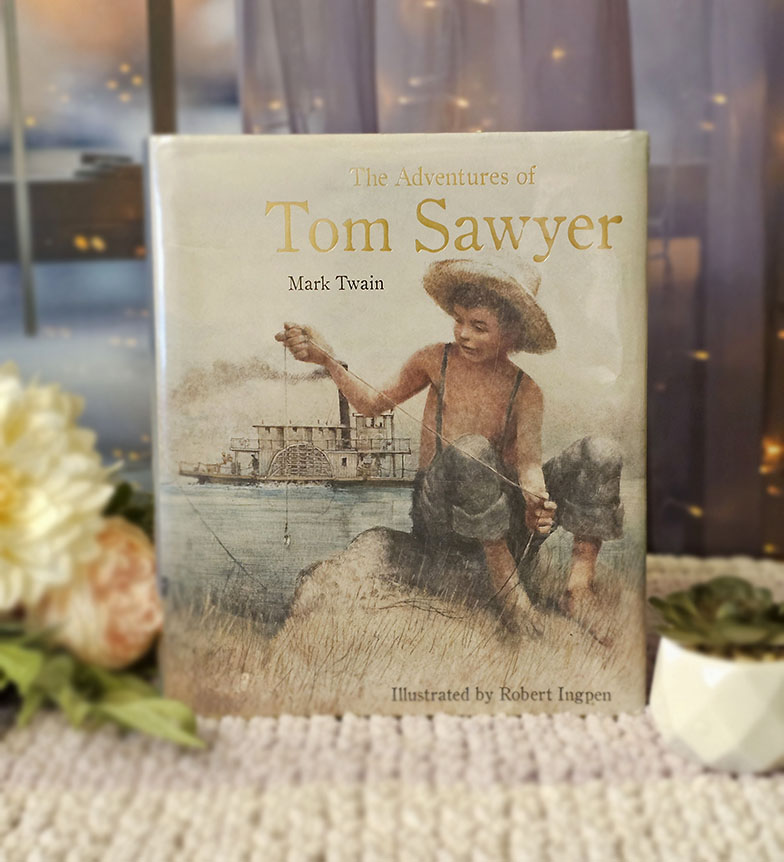
The Adventures of Tom Sawyer
by Mark Twain
Mark Twain's beloved classic about a mischievous boy growing up in a Mississippi River town. Tom Sawyer's adventures—from whitewashing fences to witnessing murder to getting lost in caves—capture the essence of American boyhood and remain timelessly entertaining.
Buy this book:
Spoiler Warning
This review may contain spoilers. Read at your own discretion if you haven't finished the book yet.
My Thoughts
Mark Twain's The Adventures of Tom Sawyer is one of those rare classics that lives up to its reputation—still funny, charming, and surprisingly subversive nearly 150 years after publication. While often relegated to children's literature, this is a sophisticated work that rewards adult reading with its satire, social commentary, and deep understanding of human nature dressed up as boyish adventures.
The story follows Tom Sawyer, a clever, mischievous boy living with his Aunt Polly in the fictional town of St. Petersburg, Missouri (based on Twain's hometown of Hannibal). Tom's world consists of playing pirates with his friends, falling in love with Becky Thatcher, skipping school, and generally driving his aunt to distraction. But the novel takes a darker turn when Tom and his friend Huck Finn witness a murder, leading to adventures that are genuinely suspenseful and morally complex.
What makes this book work is Twain's absolute mastery of voice and perspective. He captures the psychology of boyhood with perfect pitch—the way children's imaginations transform ordinary experiences into grand adventures, how social hierarchies and rituals matter intensely in the moment, the genuine terror and excitement of childhood escapades. Tom isn't idealized or condescended to; he's a real kid with selfishness, creativity, courage, and capacity for growth all mixed together.
The famous whitewashing scene, where Tom tricks other boys into doing his chore by making it seem desirable, is a perfect encapsulation of both Tom's cleverness and Twain's satirical genius. It's funny as a childhood prank, but it's also sharp social commentary about human nature, desire, and manipulation. Twain regularly operates on these multiple levels—entertaining children while offering adults biting observations about human behavior.
Twain's humor is distinctive and still lands. His deadpan delivery, absurd exaggerations, and keen eye for human foolishness create comedy that feels fresh rather than dated. The descriptions of Tom's theatrical displays of suffering, the Sunday school scenes satirizing performative piety, and the various schemes and adventures are genuinely funny. Twain had deep affection for his characters while also seeing them clearly, creating humor that's warm rather than mean.
The book's treatment of childhood is more realistic than most literature of its era. Tom and his friends aren't little angels or demons but recognizable kids with complex motivations. They can be selfish and thoughtless, genuinely frightened, surprisingly brave, deeply loyal, and capable of real moral reasoning. The way Tom struggles with his conscience about letting an innocent man be accused of murder feels authentic to how children process complex moral situations.
The adventure plot—the murder, the trial, the search for treasure, getting lost in the cave—is genuinely suspenseful and well-constructed. Twain doesn't talk down to his audience; the stakes feel real, and the danger is sometimes quite dark. Injun Joe is a genuinely threatening villain, and the cave sequence is claustrophobic and frightening. The book earns its happy ending through real peril.
However, the book also has significant problems that modern readers must reckon with. The depiction of Native Americans, particularly the character Injun Joe, relies on racist stereotypes of the "savage Indian" as villain. The use of racial slurs and casually racist language toward Black characters is pervasive. While Twain would later write more progressive work (Huckleberry Finn, despite its own complications, is deeply anti-racist), Tom Sawyer largely accepts the racial hierarchies of its time.
The treatment of Black characters as background figures or comic relief is particularly uncomfortable. While Twain satirizes white society's hypocrisy, he doesn't extend the same critical lens to racial issues in this book. For modern readers, especially reading with children, these elements require discussion and context about the era's racism and how even progressive writers of the time had significant blind spots.
The female characters are also quite limited. Becky Thatcher exists primarily as Tom's love interest, defined by her prettiness and her relationship to Tom rather than having much interior life or agency of her own. Aunt Polly is more developed—Twain clearly based her on real women he knew and loved—but still operates within narrow domestic sphere. This reflects the era's gender conventions but still feels limiting.
The structure is somewhat episodic, which works for capturing the meandering nature of childhood but can feel loose compared to more tightly plotted novels. Some chapters feel like semi-independent sketches, and not every element contributes to the main narrative arc. This isn't necessarily a weakness—it captures how childhood actually feels—but modern readers accustomed to tighter plotting might find it occasionally meandering.
Twain's prose is wonderful—clear, vivid, and distinctively American. He helped establish American vernacular as legitimate literary language, writing in rhythms and vocabulary that felt authentically American rather than imitating British literary models. The descriptions of the Mississippi River, the town, and the surrounding countryside are beautiful and evocative.
The book's influence on American literature cannot be overstated. Twain's validation of American settings, speech, and experience as worthy literary material helped create space for distinctively American literature. His treatment of childhood influenced everything from To Kill a Mockingbird to Stand By Me. The character of Tom Sawyer became archetypal, embodying a certain kind of American boyhood.
Why You'll Love It
- Mark Twain's Humor: Still genuinely funny
- Childhood Captured: Authentic boy psychology
- Classic Adventures: Whitewashing, pirates, treasure, caves
- Multiple Levels: Works for children and adults
- Beautiful Prose: Twain's distinctive American voice
- Suspenseful Plot: Real stakes and danger
- Cultural Touchstone: Essential American literature
- Timeless Appeal: Remains entertaining and relevant
Perfect For
Readers of any age interested in American classics, those who appreciate humor mixed with adventure, anyone wanting to understand influential American literature, parents reading with children (with discussion of racial elements), and readers who enjoy coming-of-age stories that don't sentimentalize childhood. Great for revisiting if you first read it young.
Final Verdict
The Adventures of Tom Sawyer is a genuine classic that largely earns its status. Twain created an enduring character, captured childhood with authenticity and humor, and wrote a book that works on multiple levels. The adventures remain engaging, the humor fresh, and the social satire sharp. However, modern readers must also reckon with the book's racial stereotypes and limited treatment of non-white characters—elements that reflect the era's pervasive racism even in work by relatively progressive authors. These problems don't erase the book's considerable achievements but require acknowledgment and discussion. Read it for Twain's genius, for its influence on American literature, and for adventures that remain entertaining. Just read it critically, recognizing both its brilliance and its blind spots.
You Might Also Like
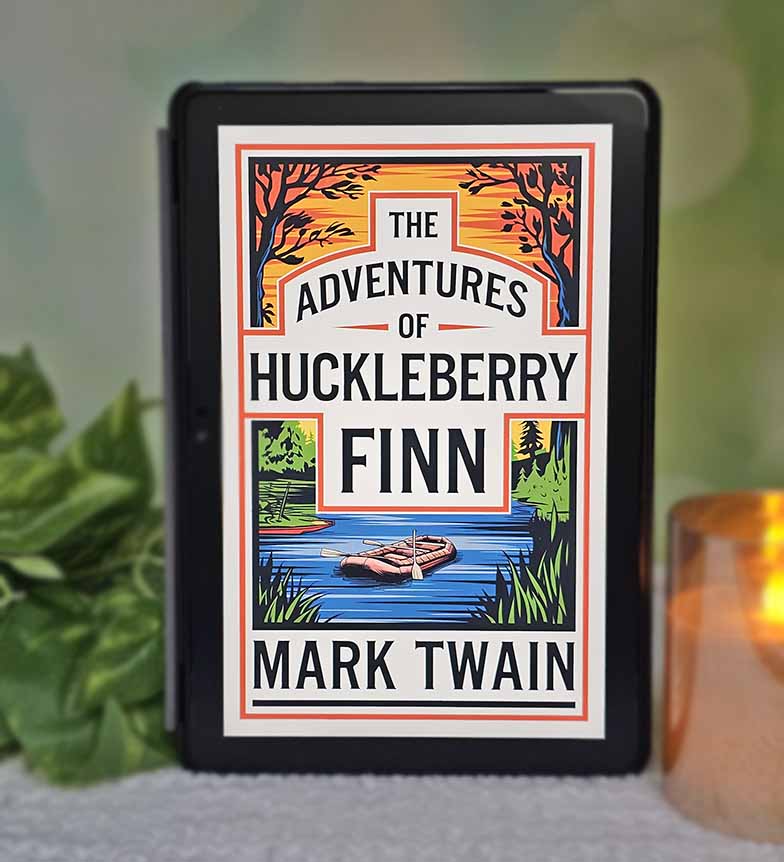
The Adventures of Huckleberry Finn
by Mark Twain
The great American novel follows Huck Finn and escaped slave Jim as they travel down the Mississippi River, exploring themes of race, freedom, and morality in antebellum America.

The Call of the Wild
by Jack London
Jack London's classic adventure novel about Buck, a domesticated dog thrust into the harsh realities of the Yukon during the Gold Rush. A powerful story of survival, transformation, and the wild nature lurking beneath civilization.

The Outsiders
by S.E. Hinton
S.E. Hinton's groundbreaking YA classic about teenage gang rivalry, social class divisions, and the universal struggles of adolescence. Written when Hinton was just 16, this remains one of the most influential young adult novels ever published.