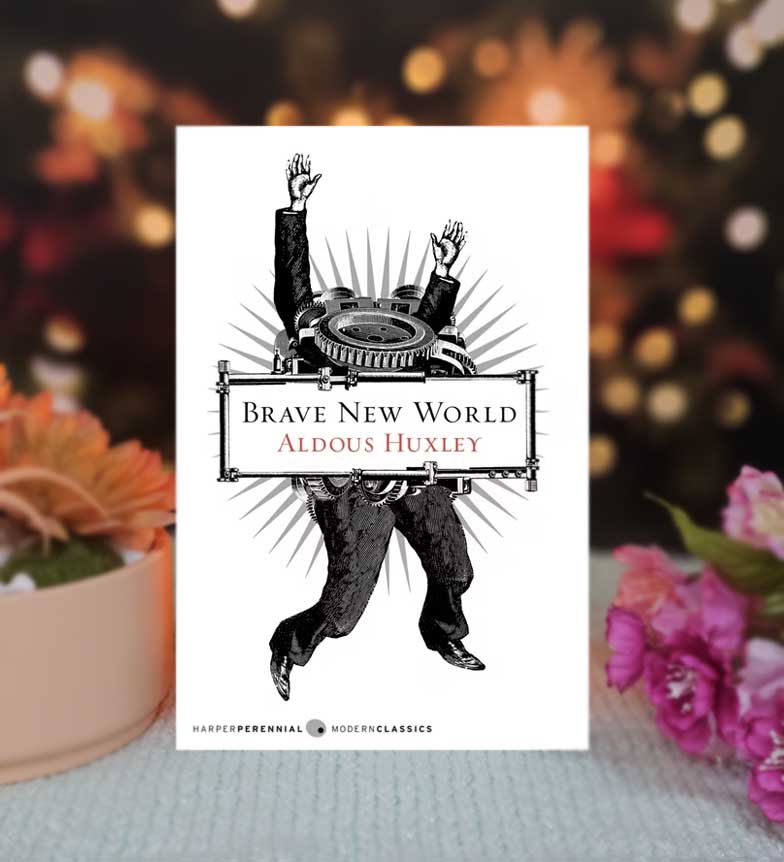
Brave New World
by Aldous Huxley
Aldous Huxley's 1932 dystopia of the World State - five castes grown in bottles, a population conditioned in its sleep to love its predetermined role, soma to manage anything that conditioning didn't reach - tested against an outsider named John, raised on a Reservation by a London Beta named Linda and brought back to a London where the freedom to suffer is the only freedom left to demand.
Buy this book:
Spoiler Warning
This review may contain spoilers. Read at your own discretion if you haven't finished the book yet.
A Dystopia of Comfort, the Outsider Brought to Look At It, and a Closing Image That the Twentieth Century Has Not Stopped Borrowing
Orwell, sixteen years later, would imagine a totalitarianism that worked by terror - a boot stamping on a human face forever. Brave New World, published in 1932, imagined a totalitarianism that worked by comfort. The World State of Huxley's near-future has eliminated war, disease, poverty, family, art, religion, and the entire architecture of unhappiness, and has done so by eliminating the kinds of human beings who would notice the cost. Babies are grown in bottles by something called Bokanovsky's Process and conditioned, before and after "birth," to love the predetermined caste they are being grown for - Alphas and Betas at the top, Gammas and Deltas and Epsilons descending into the menial labor that high-caste citizens never have to think about. Everyone is happy because everyone has been engineered to be happy with what they are getting. When even that fails - and it occasionally does - there is soma, the official drug, available everywhere, on the State.
Aldous Huxley's vision is the dystopia the twenty-first century mostly noticed it had built. The opening hatchery-tour chapter, with the Director walking a group of students through how a society makes its citizens, is one of the most efficient pieces of speculative-fiction worldbuilding in the language. A 2.5 reflects: the ideas are some of the strongest of the century; the novel that surrounds them, for me, is the thinner half of the package.
The World State, Bernard, and the Trip to the Reservation
The book's actual plot, when it gets to one, follows Bernard Marx - an Alpha-Plus psychologist who has, by some accident of bottle chemistry, ended up shorter and physically inferior to the Alphas around him, a discrepancy that has produced in him the closest thing the World State permits to alienation. Bernard takes Lenina Crowne, an attractive Beta who works in the Hatchery and embodies World State ideals so cleanly that her serial casual relationships are praised by her superiors, on a vacation to one of the few places World State citizens still find exotic: a Savage Reservation in New Mexico, a fenced-off zone where the un-conditioned still live in the way humans always lived - with families, religion, illness, suffering, and Shakespeare. There Bernard and Lenina find Linda, a former Beta from London who got separated from her vacation party twenty years ago and was left behind, and her son John, born and raised on the Reservation, raised on a battered copy of the complete Shakespeare. The reader, by this point, has figured out who John's father is, although neither John nor Bernard fully understand the calculus yet.
Bernard brings Linda and John back to London. Linda's reappearance humiliates the Director - John is his son, a fact the World State considers obscene because the very concept of "son" is obscene there - and the Director resigns. Bernard, basking in his status as the man who brought back the Savage, becomes briefly the most fashionable figure in London.
John in London, and the Argument the Book Has Been Building To
John is the book's heart, and the chapters in which he is paraded through London society as the Savage are the place where Huxley's argument lives most clearly on the page. John is appalled. He is appalled by the soma, by the casual sex, by the absence of anything resembling the inner life Shakespeare gave him a vocabulary for. Lenina, whom he has fallen in love with on Reservation terms, propositions him on London terms, and the encounter goes badly in a way that exposes the gap between the two cultural registers as completely unbridgeable. Bernard's friend Helmholtz Watson, an Alpha-Plus emotional engineer who has been quietly suspecting that there is something missing from his life, recognizes Shakespeare and recognizes himself in John's revolt.
The book's central confrontation is between John and Mustapha Mond, the World Controller for Western Europe, in one of the more famous dialogue scenes in twentieth-century English fiction. Mond is not a fool. Mond knows exactly what the World State has traded away. Mond explains, calmly, why he made the trade - and the argument he makes for stability over truth, comfort over meaning, conditioning over choice is, on its own terms, harder to refute than a contemporary reader might want to admit. John's eventual answer - that he is claiming "the right to be unhappy," to age, to suffer, to feel real things - is the only argument the book offers in return.
The Lighthouse, the Whips, and the Closing Image
Skip the rest of this paragraph if you somehow haven't been spoiled on the ending of a 1932 novel. Linda, who has spent her London return drugged into a permanent soma stupor, dies. Mond exiles Bernard and Helmholtz to islands - a punishment that the book quietly notes is also a freedom, because the islands are full of intelligent people who didn't fit in the World State and have been allowed to think there. Mond refuses to let John leave. John retreats instead to an abandoned lighthouse outside of London, where he tries to purify himself with sleeplessness, fasting, and self-flagellation. Reporters find him. Tourists find him. A woman implied to be Lenina steps off a helicopter; John, who has been unable to articulate his feelings about her any other way, attacks her with a whip. The crowd, soma-flushed and laughing, joins in - the assault becomes a flagellant orgy, the kind of mass-hysteria release the World State citizens have been chemically managed away from. John wakes the next morning, remembers what he has done, and hangs himself in the lighthouse.
It is one of the bleaker closing images of the dystopian century, and Huxley refuses to soften it. The book's argument, spelled out in the closing pages, is that the only escapes available from the World State are exile, suicide, or assimilation, and that John has not been permitted any of them on his own terms.
Why a 2.5
The strengths are the ideas, the worldbuilding, the Mond conversation, and the prophetic accuracy that makes the book read like reportage in 2026. Huxley saw it coming - the entertainment infrastructure, the pharmaceutical management of mood, the constant low-grade distraction calibrated to the size of a thought, the casual sexual ecosystem in which intimacy is the one thing that never quite arrives. The book is one of the texts the rest of the twentieth century kept reaching for, and not without reason.
The reservations are about the novel as a novel. Bernard is a vehicle more than a person. Lenina is, mostly deliberately, a programmed surface. John is a symbol the book cannot quite let breathe as a character. The pacing is uneven; the Reservation chapters drag in the middle; the Mond debate, brilliant as it is, is mostly philosophical exposition wearing a dialogue costume. Huxley was a thinker who chose the novel form, and the fit is imperfect. A 2.5 reflects: an essential book of ideas, an unsatisfying book of characters, and a foundational text I'm glad to have read once and unlikely to revisit.
Rating: 2.5/5 ⭐
Perfect for: Readers interested in foundational dystopian fiction, anyone who has read Orwell and wants the Huxley counterpart, students of mid-century speculative fiction, readers who can sit with a novel that prioritizes argument over character.
Skip if: You need character-driven fiction with people who feel fully inhabited, you find didactic philosophical novels (the Mond chapter is essentially a position paper) frustrating, or you've already absorbed the book's central argument from cultural osmosis and don't need the source.
You Might Also Like

Catching Fire
by Suzanne Collins
President Snow visits Katniss at home, tells her the threat she didn't know she'd become, and watches her try to perform her way out of it on a Victory Tour that only spreads what she's accused of - and then announces the 75th Hunger Games will be a Quarter Quell drawn from the existing pool of victors, sending Katniss back into an arena designed as a clock with twelve hourly terrors and a force field at its edge.

The Hunger Games
by Suzanne Collins
On Reaping Day in the coal-mining poverty of District 12, sixteen-year-old Katniss Everdeen volunteers to take her younger sister Prim's place in the 74th annual Hunger Games - the televised arena battle in which the Capitol forces twenty-four teenage tributes from twelve districts to kill each other on live broadcast - and the book that follows became, fairly, the YA dystopian novel by which all subsequent YA dystopian novels would be measured.

Randomize
by Andy Weir
Edwin Rutledge, owner of the Babylon Hotel and Casino in Las Vegas, has shut down his keno lounge because his IT lead Nick Chen has discovered that consumer-grade quantum computers have made the casino's pseudo-random-number generator retroactively crackable; the fix is a quantum random-number generator, which a sales rep named Prashant Singh is in town to install; what Prashant does not know is that his wife Sumi - a polymath who is the actual story of this story - has at home a second quantum unit entangled with the one her husband is installing, has used it to choose her winning keno numbers in advance, and is using a single trip to the Babylon to set up a long con on Las Vegas itself. Andy Weir's contribution to the Amazon Original Stories Forward Collection (2019), narrated in audio by Janina Gavankar.