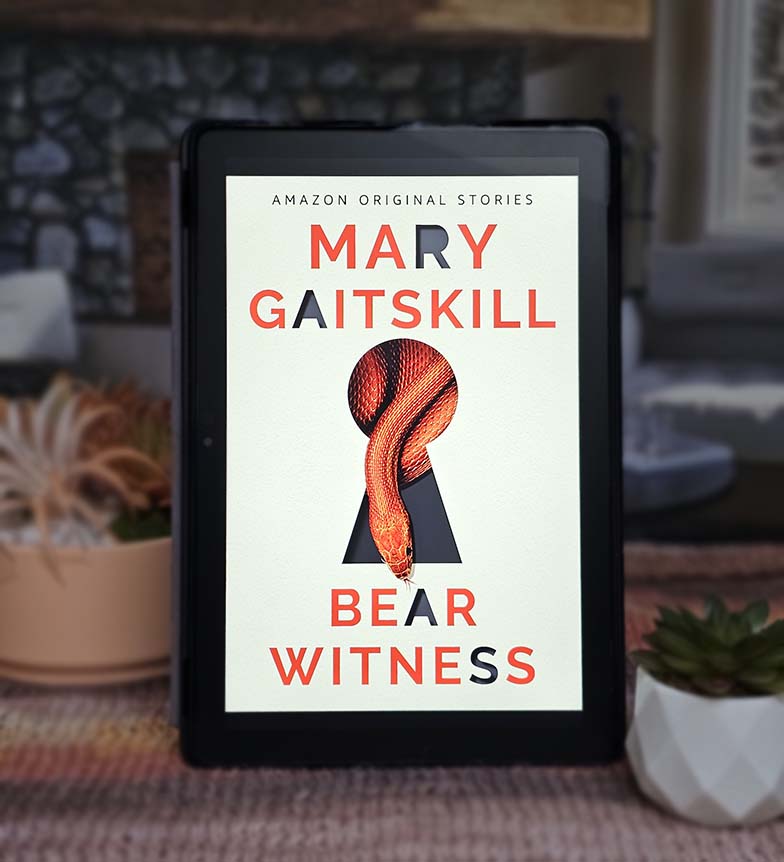
Bear Witness
by Mary Gaitskill
Mary Gaitskill's contribution to Amazon's Out of Line collection braids three voices around a single rape trial - the seventy-year-old retired schoolteacher who was assaulted, the fifty-year-old former student of hers who is accused, and the apathetic grand juror whose unwanted seat in the box is going to ask more of her than she came in prepared to give.
Buy this book:
Spoiler Warning
This review may contain spoilers. Read at your own discretion if you haven't finished the book yet.
Three Voices Around One Trial, and Mary Gaitskill at Her Most Demanding
The premise is brutal and Mary Gaitskill, who has spent her career writing about sex and power and the dark interiors of ordinary people, does not soften it. A seventy-year-old retired schoolteacher has been raped in her apartment above her father's maintenance store. The accused is one of her own former students - a fifty-year-old man who was in her elementary special-education classroom decades ago, then again later at a different school in a different town, and who eventually came to work at her father's store. He broke into the apartment above. The story is told from three rotating perspectives: the teacher (a woman this review will keep calling that, since the sources disagree on her name and Gaitskill is working in the register where what people are called and how they are addressed is itself an instrument); Mark, the accused; and Moira, the grand juror who is dreading the jury duty and dreading even more what she is about to be asked to think about.
This is the sixth of seven entries in Amazon's Out of Line short-story collection, which has by this point given us Strayed's This Telling, Gay's Graceful Burdens, Ko's The Contractors, Donoghue's Halfway to Free, and Kepnes's Sweet Virginia. Bear Witness is, by some distance, the hardest of the seven. A 2.5 reflects: respect for what Gaitskill is doing, an honest accounting of how much the reading experience cost me, and a note that some readers will find this the most lasting piece in the set and others will close the file before page twenty.
The Teacher, the Student, and the Years Between Them
What sets Gaitskill's version of this material apart from the easier moral arithmetic a different writer would settle for is the specificity of the prior history. Mark was in the teacher's special-education classroom as a child. He was, by the descriptions, a difficult student - troubled, struggling, the kind of kid who absorbed the worst of how schools treated children like him. There is a moment in the back-story chapters - and it is the kind of detail that explains a lot of what comes later without excusing any of it - in which the teacher disciplined him with a corporal punishment that became sexually charged for him in a way the situation did not warrant. He encountered her again, years later, in another classroom in another town. He worked, eventually, at her father's maintenance store. When her father's apartment is the apartment she has been renting above the store, Mark, fifty years old, has known where she lives and how to reach her for as long as he has had the obsession to.
Gaitskill renders this prior history in the teacher's chapters and in Mark's. She does not, importantly, present the corporal-punishment scene as a justification for what he later does. She presents it as a hinge - one of those moments in a person's emotional life that they will not stop returning to and that the rest of their behavior will be organized around without their being able to admit it. The story is doing in 2020 what Gaitskill has done since Bad Behavior and Veronica: writing about the psychological architecture of damage with a specificity most writers will not commit to.
Mark, the Apartment, and the Tenderness in His Voice
The crime itself is rendered without sensational detail and without softening. The teacher's apartment, the break-in, the assault - Gaitskill is precise about what happened and refuses to either spectacularize it or look away. What unsettles most, in Mark's chapters, is that the obsession he has been carrying since girlhood-classroom days is not, in his interior register, a story about violence. It is a story about love. When Mark testifies at the trial, there is - in one of the more disturbing details several reviewers have flagged - a tenderness in his voice when he says the teacher's name. That tenderness is not redemptive. It is the precise thing that makes Mark's particular kind of damage so difficult to look at: he has organized his entire emotional life around the idea that what he did was not what it was.
Moira and What "Bearing Witness" Means
Moira is the story's third voice and, structurally, the reader's. She is on the grand jury without wanting to be. She has been going through the motions of her life with the kind of low-grade detachment Gaitskill is good at writing in middle-aged American women whose interior lives have been mostly outsourced to managing. The case forces her to reckon with what witnessing actually is - what gets asked of you when you sit in a jury box and listen to a victim describe what happened, and listen to an accused describe a different version of what happened, and have to make some judgment about whose account you trust and what to do with it. The title, deliberately, runs across all three characters: the teacher who has to bear witness on the stand, Mark who is being witnessed, Moira who is being asked to do the witnessing.
What Gaitskill is interested in, in Moira's chapters, is the moral fatigue of an ordinary person being handed a moral question this size. Moira is not an obvious heroic figure; she is a person whose own life is a partial mess and who is being asked to render judgment on a worse one.
Why a 2.5
The strengths: Gaitskill at full force, three voices that genuinely sound different and refuse the easy reading positions, a refusal of the catharsis sexual-assault fiction usually owes its readers, the specificity of the prior history that lifts the case out of generic horror and into a particular ruined human shape. The reservations are honest. The story is hard. The audio (narrated by Margo Martindale of Mrs. America, with R.C. Bray on Mark's chapters) has been criticized for not differentiating the two women's voices clearly enough, and on print the rotating perspectives ask more of the reader than forty pages can quite hold. The ambiguity Gaitskill works in - what Moira will decide, what the teacher feels by the end, what Mark believes - is not the kind of ambiguity that resolves on the way to bed; it sits with you. Some readers will say that's exactly the point. I respected the project. I came out of it more depleted than illuminated, and a 2.5 is the honest number that registers both.
Rating: 2.5/5 ⭐
Perfect for: Mary Gaitskill readers prepared for her at her most uncompromising, fans of literary fiction that treats sexual violence with full seriousness and no easy resolution, readers who want challenging multi-perspective short fiction.
Skip if: You need narrative resolution, sexual assault on the page is a hard limit (this story does not pull back), or you want fiction that gives you something to hold onto by the closing line.
You Might Also Like

Shine, Pamela! Shine!
by Kate Atkinson
Kate Atkinson's contribution to Amazon's Out of Line collection follows Pamela - newly retired teacher, thoroughly divorced, mother to a thirty-year-old son who has refused to leave the house, devotee of the exclamation mark as a coping mechanism - through a stretch of disastrous online dating and into the tub for a bath that ends with the discovery that she is, somehow, post-menopausally and inexplicably, pregnant.
Halfway to Free
by Emma Donoghue
Emma Donoghue's contribution to Amazon's Out of Line collection imagines a 2060 in which the climate crisis has been answered by a society that strongly disincentivizes having children - and Miriam, who has accepted the rules her whole life, finds at a work retreat that she and a coworker named Ned both want what almost no one is allowed to want anymore.

The Contractors
by Lisa Ko
A tech reporter's misdirected email connects two women eight thousand miles apart - both named Sandra Guzman, both contract content moderators for the same mega social media platform, one in New Jersey and one in the Philippines - and the friendship that grows between them across the inbox starts to look, by the end, like the beginning of a campaign.