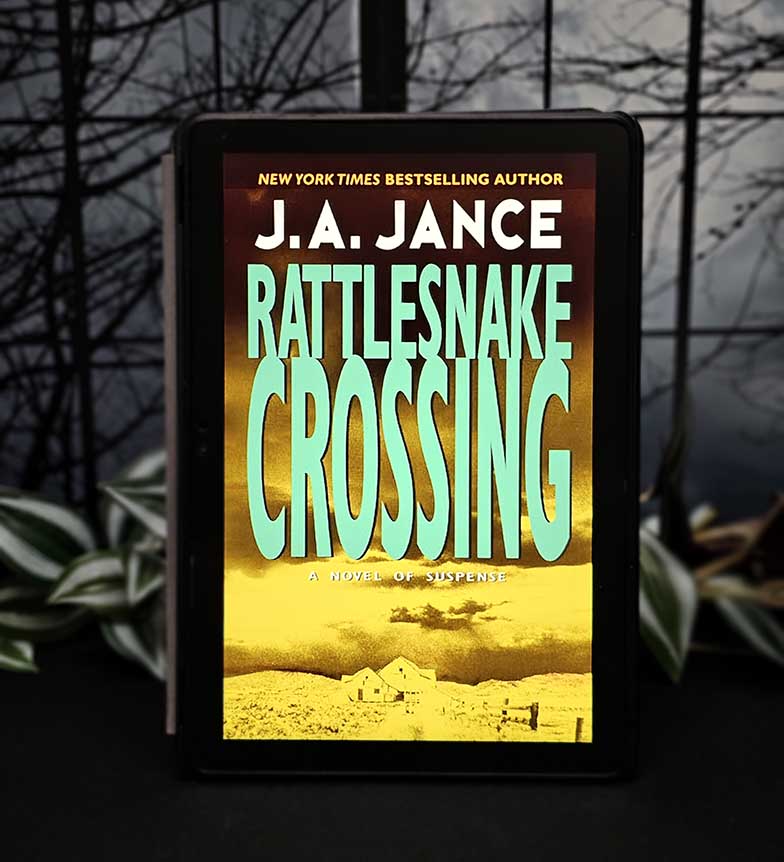
Rattlesnake Crossing
by J.A. Jance
When a gun dealer is murdered and his assault weapons stolen, Sheriff Joanna Brady follows a trail of sniper killings and scalped victims to a New Age dude ranch - while her best friend's adopted baby daughter faces a life-or-death heart transplant.
Spoiler Warning
This review may contain spoilers. Read at your own discretion if you haven't finished the book yet.
Stolen Guns, Scalped Victims, and a Dude Ranch Full of Secrets
The trouble starts with Clyde Philips, a gun dealer in Pomerene, Arizona, found beaten and smothered in his home. His entire stock of high-powered assault weapons has been stolen. Then the stolen guns start being used - first for sniper attacks on livestock, then on people. Two women are found shot and scalped: Ashley Brittany, described in the local reporting as an anti-oleander activist, and Katrina Berridge, an administrative worker at a nearby dude ranch. The scalping is the detail that changes the investigation. It's a signature, deliberate and theatrical, and when an FBI profiler tells Joanna the killer is probably a white male teenager, the case shifts from what-happened to who-among-us.
Rattlesnake Crossing is the sixth Joanna Brady mystery, and it's the one where Jance's ambitions for the series - balancing complex mysteries with deepening personal storylines and a richly specific Arizona setting - are most visible in both their strengths and their strains. The mystery is layered, the personal subplots are emotionally powerful, and the setting is as vivid as anything in the series. But the number of threads Jance juggles means not all of them carry equal weight, and some unravel rather than resolve.
The Rattlesnake Crossing Resort
The title refers to a fictional dude ranch - Jance invented both the location and an Apache legend to accompany it - that blends New Age spiritualism, Native American pantheism, and cold-blooded materialism into a resort experience for wealthy European visitors. The guests dress in Native American garb and live outdoors, playing at a version of indigenous life that's equal parts cultural tourism and expensive fantasy. Jance originally planned to call the book "Cascabel Crossing" (cascabel being Spanish for rattlesnake), but her editor preferred the English name.
The resort is the hub of the murder investigation. Katrina Berridge worked there. The killer's profile points to someone living on or near the property. And the resort's atmosphere - isolated, performative, built on a romanticized fiction of the desert - mirrors the book's broader theme: things in Cochise County are not what they present themselves to be. The ranchers hiding behind patriotism have their own agendas. The resort selling spiritual authenticity is a commercial operation. The family that looks stable is disintegrating. Jance uses the setting not just as backdrop but as commentary on the gap between appearance and reality in the Arizona borderlands.
Red Herrings and Range Wars
Jance loads the book with suspects and subplots that keep the investigation from settling into a single track. Alton Hosfield is a fifty-three-year-old rancher waging war against environmentalists and the federal government - an armed separatist whose anger and rhetoric make him an obvious suspect for the kind of violence unfolding in the area. His nearest neighbor, Martin Scorsby, is a transplanted California insurance executive who bought prime river-bottom pastureland that Hosfield had coveted and planted a forty-acre pecan orchard on it. Hosfield's cattle keep breaching the fence into Scorsby's orchard, and the range dispute between them is drawn with the specificity of someone who understands how land conflicts work in rural Arizona.
The Hosfield/Scorsby feud is vivid and well-drawn, but Kirkus noted that it "goes nowhere" in terms of the murder resolution - Hosfield is a red herring, and the range war subplot, while interesting on its own terms, doesn't connect to the central mystery. The same criticism applies to the conflict with Dr. Fran Daly, a substitute medical examiner who clashes with Joanna over professional territory. Daly creates friction that adds to Joanna's workload but doesn't advance the case. Jance is building a world - showing the texture of a county sheriff's daily reality, where not every conflict is connected to the crime you're investigating - but the effect is that the book sometimes feels like it's serving two masters: the mystery and the community portrait.
Baby Esther
The book's most emotionally devastating thread has nothing to do with the murders. Joanna's best friend, Reverend Marianne Maculyea, and her husband Jeff Daniels had adopted twin daughters from China - Ruth, who is healthy, and Esther, who needs a heart transplant. In Rattlesnake Crossing, a donor heart becomes available, and baby Esther is taken to a Tucson hospital for the surgery. Esther dies after the transplant.
It's a subplot that would be powerful in any novel, but it's especially effective here because Jance has spent five books building the friendship between Joanna and Marianne. When Marianne, a pastor whose faith has sustained her through every crisis the series has presented, asks Joanna to give the funeral service for her daughter, the scene carries a weight that the murder investigation can't match. Esther's death tests Marianne's faith in ways the book doesn't resolve neatly, and Joanna's grief for her friend - helpless, inadequate, the wrong kind of strong for this particular loss - adds a dimension to the series that the procedural elements alone would never provide.
Joanna and Butch
The romance with Butch Dixon deepens in this installment. Butch delivers "some rather unexpected news" to Joanna - the specific nature of which is kept as a reveal - and their relationship moves past the flirtation stage that characterized the previous books. Butch is warm, direct, and secure enough in himself not to be threatened by a woman whose job involves chasing killers and managing a department of men who didn't vote for her. Their scenes together add warmth without derailing the mystery, and readers who've been following the slow-burn romance since Shoot Don't Shoot will appreciate the forward movement.
Marliss Shackleford, the gossip columnist for the Bisbee Bee whose "Bisbee Buzzings" column has been a thorn in Joanna's side since early in the series, continues to make spiteful comments and stir up trouble - a small-town antagonist whose weapon is public opinion rather than violence.
Where the Sixth Book Strains
The mystery's resolution is the book's weakest element. The FBI's profile - a white male teenager - narrows the suspect pool so dramatically that several reviewers noted the killer's identity became obvious once the profile was delivered. As one reader put it: "When the FBI profiler tells the detective that the killer is probably a white male teen, and there's only one white male teen in the story, and he happens to live on the site of the murders, that should sort of be a clue." The climax involves a dangerous confrontation - the FBI warns the killer will stage a dramatic exit, and Joanna is nearly killed - but the journey to get there is more interesting than the destination.
Kirkus was particularly sharp: "The longer Joanna Brady's cases get, the less there seems to be to them." The criticism stings because it identifies a real pattern - Jance fills the book with subplots and character work that, while individually engaging, dilute the mystery's tension. The Hosfield range war, the Dr. Daly conflict, Eleanor's impossibly high standards, the professional friction with deputies - all of it creates a realistic portrait of a county sheriff's life, but the murder investigation sometimes feels like it's competing for space rather than commanding it.
The killer's motive also leaves some readers unsatisfied. The scalping is theatrical enough to demand a psychological explanation, and the one the book provides doesn't fully account for the specificity and brutality of the signature. Too much is left unexplained, and too many coincidences prop up the final act.
But the book's emotional core - Esther's death, Marianne's shattered faith, Joanna's deepening relationship with Butch, the ongoing evolution of a woman growing into a job she never trained for - justifies the four-star rating. Jance has always been more interested in who her characters are becoming than in the mechanics of who killed whom, and by book six, that interest has produced a community of fictional people worth caring about across the inevitable weaknesses of any individual mystery.
Rating: 4.0/5 ⭐
Perfect for: Fans of the Joanna Brady series, readers who value character development and community-building across a long series, anyone who appreciates mysteries where the personal stakes match the professional ones.
Skip if: You need your mystery plots airtight, predictable killer reveals frustrate you, or subplots that "go nowhere" for the central case test your patience.
You Might Also Like

Devil's Claw
by J.A. Jance
A week before her wedding to Butch Dixon, Sheriff Joanna Brady is hit with two cases at once - her octogenarian neighbor Clayton Rhodes is found dead in his garage, and a woman freshly paroled for killing her husband is murdered, leaving her half-Apache fifteen-year-old daughter Lucy Ridder on the run with a red-tailed hawk and the diskette her father left her.

Outlaw Mountain
by J.A. Jance
When free-spirited elderly widow Alice Rogers is found dead in the desert clutching an insulin vial - despite not being diabetic - Sheriff Joanna Brady investigates her greedy children, her mysterious younger boyfriend, and a web of land development corruption.
Skeleton Canyon
by J.A. Jance
When high school valedictorian Brianna O'Brien is found murdered in remote Skeleton Canyon, her wealthy parents blame her forbidden Hispanic boyfriend - but Sheriff Joanna Brady suspects the family racism masks darker secrets involving smugglers using their land.