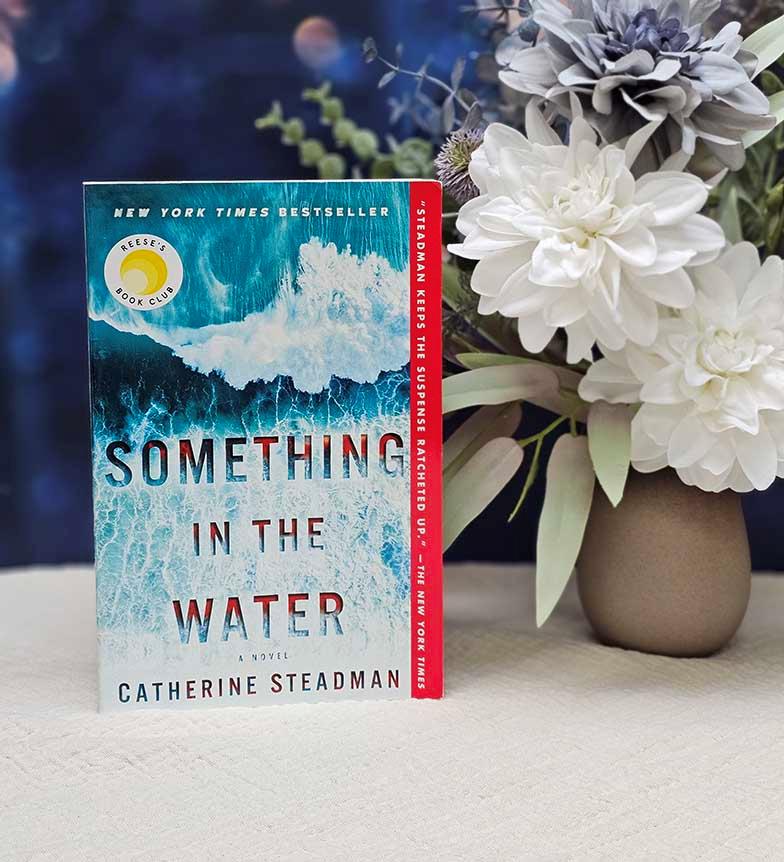
Something in the Water
by Catherine Steadman
Catherine Steadman's 2018 debut psychological thriller opens with London documentary filmmaker Erin Roberts digging a grave alone in the woods, then flashes back to the Bora Bora honeymoon - already trimmed from three weeks to two after her banker husband Mark lost his job - where a sealed duffle bag the couple pulls from the water turns out to contain a great deal more than they were prepared to be in possession of.
Spoiler Warning
This review may contain spoilers. Read at your own discretion if you haven't finished the book yet.
A Bora Bora Honeymoon, a Duffle Bag on the Lagoon Floor, and the London Documentary Filmmaker Whose Last Extravagance Becomes Her First Federal-Felony Decision
Catherine Steadman's 2018 debut starts with the ending. The first sentence of the book is a question - "Have you ever wondered how long it takes to dig a grave?" - and the woman asking it, alone in a stretch of English woods with a body and a shovel, is the same documentary filmmaker the reader is going to spend the next three hundred and fifty pages following backward and forward to understand how she came to be the person standing there. The narrator is Erin Roberts. The body is her husband Mark's. The novel is the journey from a London life that was meant to be the start of the rest of their life together, to that morning in the woods.
The setup is the high-concept thriller premise the cover promised. Erin is a documentary filmmaker on the edge of a professional breakthrough; she has been working on a project about how recently paroled inmates reimagine themselves on the outside, building her three primary subjects - Alexa, Holli, and a charming, dangerous figure named Eddie Bishop - into the spine of a film she believes will land her career. Mark is an investment banker who, a few weeks before the wedding, lost his job. They have economized everything they can economize. The honeymoon at the Four Seasons in Bora Bora is the one extravagance they have only partially cut - from three weeks to two. On the boat ride back from a scuba dive, they spot a sealed black duffle bag floating in the water and pull it aboard. They turn it in to the hotel staff when they get back to shore; whoever it is meant to be returned to, presumably someone will come looking for it. The next morning the bag has been left back inside their room, padlocked, at the foot of the bed. They eventually open it, on the rationalization, which the rest of the book is going to be the slow corrosion of, that seeing what is inside it will help them figure out who it belongs to so they can return it. The contents are not what they expected - a million dollars in cash, a pouch of uncut diamonds, a Glock handgun, a cell phone, and a USB drive of documents the people the bag belongs to would prefer remained underwater. The bag is, they piece together, the wreckage of a corporate plane that went down nearby. The corporation in question is the kind that, in Erin's reasoning, cannot afford to come openly looking for what they lost, because doing so would acknowledge what they were carrying. So Erin and Mark keep it.
A 4.0 reflects: a debut psychological thriller with a high-concept premise that lands; a first-person voice (Erin's, throughout) that does the work of a Steadman performance - controlled, conversational, increasingly unreliable in the way the genre needs - because Steadman is an actress and is writing what she knows about how to inhabit a person; an opening that sets up the grave on page one and earns the grave by the end; and a set of reservations about a middle stretch where the financial-laundering procedural slows down and a last-act twist that some readers loved and some found over-engineered.
Erin, Mark, and the Decision They Are Going to Spend the Rest of the Book Inside Of
The pleasure of the front half of the book is the moral and procedural specificity of the choice. Erin and Mark do not make a single dramatic decision; they make a slow series of small ones, each of which forecloses the option of backing out. Once the items are back in London, Mark - drawing on years inside an industry whose edges he has clearly skirted before - proposes opening an untraceable foreign bank account to absorb the cash and converting the uncut diamonds through a contact he says he knows how to find. Erin watches the plan come together with the dawning, half-acknowledged awareness that her banker husband has a fluency in this kind of work the version of him she had married had not given her any reason to expect.
That awareness is the thread Steadman pulls on for the rest of the book. Because the novel is in Erin's first person throughout, the reader only ever gets Mark through Erin's filter, and the small inconsistencies start to accumulate - what he says about his job hunt, how he handles the laundering steps, where he insists on going alone. The Mark of the early chapters is still the steady, charming, slightly-too-controlled banker husband Erin had chosen to marry. The Mark of the middle chapters is harder to pin down, and Steadman is patient about letting the reader's certainty about what kind of marriage Erin is inside of erode at the same pace Erin's does, until the moment in the woods makes the picture clear.
The London Procedural, the Documentary Subjects, and Eddie Bishop
Where the book pulls away from the standard honeymoon-thriller cover is in the London chapters. Steadman is uninterested in writing a thriller in which the dangerous thing is the foreign location; the dangerous thing here is the city Erin and Mark already live in, the bank they already use, the colleagues they already work with, and the documentary subjects Erin had been carefully maintaining professional distance from until the day she could no longer afford to. Eddie Bishop is the figure the book uses to do its hardest work. Erin has been filming him as a research subject. The longer she has the bag's contents, the more she finds herself wanting to consult him as an expert. The line between the documentarian and the participant - the line whose blurring is the whole point of the kind of true-crime adjacent work she does - is a line she stops being able to see. Steadman writes Eddie with the kind of restraint that lets him be both genuinely dangerous and genuinely useful to Erin without resolving which of those is the more important fact about him.
The other documentary subjects - Alexa and Holli - are quieter presences for most of the book but pay out in the back third in ways the front half has been quietly setting up. Steadman is patient about the way the research relationship Erin had been building gives her an unfamiliar set of options at the moment she needs unfamiliar options. The novel is honest that the version of Erin who finishes the book is not the version of Erin who started it, and that the difference between the two is largely the work of the time she spent in a room with people who had already lived inside the choices she is now making for the first time.
The Twist, the Burial, and the Ending That Earns the Grave
The last quarter of the book is where Steadman delivers the structural payoff the opening pages promised. Without spoiling the specifics: the question of what Mark has actually been doing while he and Erin have been moving the money together is not the question the reader thinks it is, and the reveal recontextualizes both the marriage and the laundering arc that has been the book's main plot. The woman on page one digging the grave is the version of Erin who has worked out what the reader has only just worked out, and the last fifty pages of the book - including a reveal about Erin's pregnancy, and a final negotiation in which she draws on every piece of what her documentary subjects have taught her - land with the kind of moral coldness the cold open had been promising. Reviewers split on the twist itself: some found it the most satisfying part of the book; others found it over-engineered, with the marital betrayal arriving later and on a tighter timeline than the rest of the book's patience had earned. Both responses are visible in the reception.
What Works, and Where the Middle Slows
The strengths: the in-medias-res opening that pays out by the end; Erin's first-person voice; the moral patience of the front-half decisions; Eddie Bishop and the documentary-subject scaffolding; the London procedural specificity; and the fact that Steadman, as an actress writing her debut novel, knows how to inhabit a narrator whose performance to the reader is part of what the book is doing.
The reservations: the middle stretch where the laundering work becomes its own slow procedural can sag for readers who came for thriller pacing rather than the moral-corrosion close-up the book is more interested in. A few of the back-half twists land tighter than the book's first two hundred pages had set up. The Mark character is, by structural necessity, less drawn than Erin; readers who wanted more interior into the marriage will feel the asymmetry. None of this breaks the book, but a reader expecting the standard exotic-honeymoon-thriller-with-twist will find that Steadman is writing a slightly different and more interesting book than the cover suggests.
Why a 4
A 4.0 means: a confident, structurally ambitious debut psychological thriller that knows what kind of book it is and trusts the reader to follow it; a Reese's Book Club pick that earned the pick; an Erin Roberts whose voice carries a book whose other characters are deliberately held at arm's length; and a closing chapter that earns the opening sentence. The half-star off is for the middle-stretch laundering procedural and a couple of back-half plot mechanics that move faster than the book's first half had set their pace.
Rating: 4.0/5 ⭐
Perfect for: Psychological-thriller readers, fans of in-medias-res structures that pay out, anyone who liked the moral-corrosion arc of The Talented Mr. Ripley or the moneyed-deception arc of The Couple Next Door, Reese's Book Club readers, anyone interested in how an actress's instincts translate into first-person prose.
Skip if: You want fast thriller pacing all the way through, you need a marriage rendered with both spouses' interiors equally, you find financial-laundering procedural detail tedious, or you have hit your limit on twisty honeymoon-thrillers in the post-Gone-Girl shelf.
You Might Also Like

Into The Water
by Paula Hawkins
A psychological thriller exploring the dark secrets of a small English town where women have been drowning for centuries. When Nel Abbott dies in the same river, her sister Jules returns to uncover the truth.

All Dressed in White
by Mary Higgins Clark & Alafair Burke
The third Under Suspicion novel: five years after bride-to-be Amanda Pierce vanished the night of her pre-wedding celebration at a luxury Palm Beach resort, television producer Laurie Moran reopens the cold case for her cold-case show - reuniting the wedding party, including the fiance who has since married one of Amanda's own bridesmaids, to find out whether the runaway bride ran or was made to disappear.

The Cinderella Murder
by Mary Higgins Clark & Alafair Burke
The second Under Suspicion novel and the first Mary Higgins Clark / Alafair Burke collaboration: Laurie Moran, producer of a cold-case television show, reopens the twenty-year-old murder of UCLA student Susan Dempsey - found strangled in Laurel Canyon Park missing a single shoe, the 'Cinderella Murder' of the tabloids - by reuniting the suspects on camera, from Susan's grieving mother and womanizing boyfriend to the now-famous director she was auditioning for, her former roommates, a tech billionaire who was her classmate, and the computer-science professor who taught them both.