
Into The Water
by Paula Hawkins
A psychological thriller exploring the dark secrets of a small English town where women have been drowning for centuries. When Nel Abbott dies in the same river, her sister Jules returns to uncover the truth.
Spoiler Warning
This review may contain spoilers. Read at your own discretion if you haven't finished the book yet.
The River Remembers What Towns Want to Forget
There's a stretch of river in the small English town of Beckford that has been swallowing women for centuries. "The Drowning Pool has been calling to women for hundreds of years," Nel Abbott wrote in her research notes. "They come here to jump, to slip, to tumble into the water and sink beneath its surface." Nel was a photographer and amateur historian who had spent years documenting the deaths at the Drowning Pool - building a project she called her "book of the dead," tracing the women who had drowned there across centuries and investigating whether the official stories matched the truth. Then Nel herself became the latest entry. Found dead in the Drowning Pool one summer morning, her body broken on the rocks below the cliff. Suicide, the police suggest. But Nel's teenage daughter Lena doesn't believe it. And when Nel's estranged sister Jules arrives in Beckford to take custody of Lena, she walks into a town full of people who have excellent reasons to want Nel's research - and Nel herself - silenced.
Into The Water is Paula Hawkins's follow-up to The Girl on the Train, and it's a more ambitious, more complicated, and more uneven book than its predecessor. Where The Girl on the Train built its tension through a tight three-narrator structure and a single escalating mystery, Into The Water fragments its story across nearly a dozen perspectives - Jules, Lena, the lead detective, various townspeople, and Nel herself through her research notes and memories. The result is a novel that functions less like a traditional thriller and more like a literary excavation, digging through layers of personal and collective history to uncover how a community perpetuates the very patterns it claims to mourn.
The Sisters, the Daughter, and the Dead
The emotional core of the novel is the triangle between Nel, Jules, and Lena - two of whom are still alive and one of whom persists through her writing, her photographs, and the questions she left behind. Jules and Nel were estranged for years before Nel's death, and the reason for that estrangement is one of the book's slow-burning revelations. Jules arrives in Beckford carrying a weight of guilt and fear that goes back to their childhood, to something that happened at the Drowning Pool when they were young - something that she's spent her adult life trying to forget and that Nel, characteristically, kept returning to and picking at. Jules is terrified of the water, terrified of Beckford, and now suddenly responsible for a grieving, furious fifteen-year-old who blames her for not being around when her mother needed her.
Lena is one of Hawkins's strongest character creations. She's not the passive, sympathetic orphan of genre convention - she's angry, reckless, manipulative when she needs to be, and deeply protective of her mother's memory and work. Lena was involved in a scandal before Nel's death: her best friend Katie Whittaker drowned in the same pool just months earlier, and the circumstances around Katie's death - her relationship with her teacher, Mark Henderson, and the question of whether she jumped or was pushed - had already thrown Beckford into turmoil. Lena believes the two deaths are connected. She believes her mother was killed because of what she'd uncovered about Katie's death and about the deeper history of the Drowning Pool. And she is willing to destroy anyone she thinks is responsible, regardless of the collateral damage.
The detective investigating Nel's death, DS Sean Calvert, brings his own complications. He grew up in Beckford, he has a personal history with the town's secrets, and his wife Erin - who works with him on the investigation - begins to notice that Sean's reactions to the case aren't entirely professional. There are things he knows about the town, about the people involved, about the river itself, that he isn't sharing with her. Calvert's chapters are where Hawkins explores how the men in Beckford have related to the Drowning Pool across generations - sometimes as protectors, sometimes as perpetrators, sometimes as witnesses who chose not to see.
Centuries of Women and Water
What sets Into The Water apart from standard domestic thrillers is its historical dimension. Nel's research into the Drowning Pool spans centuries, and Hawkins weaves fragments of that research throughout the contemporary narrative. In the 1600s, women were thrown into the pool as a witch trial - if they floated, they were guilty; if they drowned, they were innocent. Either way, the pool won. In later centuries, women who were inconvenient - adulteresses, troublemakers, women who knew too much or spoke too loudly - ended up in the water under circumstances that were politely labeled as suicide or accident. The pattern Nel traced isn't just about individual tragedies; it's about how a community has systematically disposed of women who threatened its comfort, and how each death was absorbed into a narrative that blamed the victim rather than examining the system.
Hawkins handles this historical thread with more subtlety than the premise might suggest. She's not drawing a straight line from witch trials to modern misogyny - the connections are atmospheric rather than literal, building a sense that the river itself has become a repository for the town's darkest impulses. The parallel between Katie Whittaker's death and the historical drownings isn't that the same thing is happening; it's that the same reflexes - silence the woman, protect the man, rewrite the story - persist in recognizable forms. When the town responds to Katie's death by questioning her judgment rather than her teacher's behavior, when it responds to Nel's death by calling her obsessive and unstable rather than investigating who she'd angered, the echoes of the historical pattern are unmistakable.
The Fragmented Structure and Its Cost
The multi-narrator approach is the book's most divisive element, and I understand both sides. On the one hand, it serves the themes perfectly. Community secrets persist precisely because no single person has the whole picture - everyone holds a fragment, and the fragments don't get assembled because that would require conversations that nobody wants to have. By giving us a dozen different perspectives, Hawkins forces the reader into the position of detective, piecing together contradictions and evasions to find the truth underneath. When different narrators describe the same event with crucial variations, the gaps between their accounts become the story's most important information.
On the other hand, the sheer number of voices means that some inevitably get less development than they deserve. Mark Henderson, Katie's teacher, gets chapters that sketch his perspective but never fully commit to exploring his psychology - he hovers between sympathetic and sinister without landing firmly enough in either direction. Louise Whittaker, Katie's mother, has powerful scenes driven by grief and rage but repeats emotional beats that could have been consolidated. Nickie Sage, the town psychic who claims to communicate with the dead, adds an atmospheric layer but her chapters occasionally feel like they're working harder on mood than on narrative purpose. Hawkins manages the kaleidoscope impressively given its complexity, but there are moments - particularly in the book's middle section - where flipping between so many perspectives diffuses the tension rather than building it.
The pacing is the other place where the ambition creates friction. The Girl on the Train was a propulsive read, every chapter ending on a note that demanded you turn the page. Into The Water is more deliberately paced, more willing to linger in atmosphere and historical texture, more interested in the weight of the past than the urgency of the present. This is the right choice for the story Hawkins is telling - rushing through centuries of complicit silence would undermine the point - but readers expecting the same taut momentum will feel the slower sections, particularly when a narrator's chapter circles back over emotional ground the book has already covered.
What the River Reveals
The resolution brings the various threads together in a way that's more emotionally satisfying than mechanically surprising. The truth about Nel's death, when it arrives, recontextualizes several earlier scenes in ways that reward careful reading, and the connection between Nel's investigation and her own fate has the kind of grim inevitability that suits the book's themes. The truth about Jules and Nel's childhood at the Drowning Pool is the reveal that carries the most emotional weight - it's the piece that explains the estrangement, explains Jules's terror of the water, and forces both sisters' stories into painful new alignment.
What lingers after you close the book isn't the mystery's solution but the larger pattern it illuminates. Hawkins has written a thriller that's also an argument about how communities handle women's pain - how they aestheticize it (the Drowning Pool as tourist attraction), mythologize it (the historical drownings as ghost stories), and ultimately refuse to reckon with it (each new death absorbed into the same comfortable narrative of individual tragedy). "Sometimes the truth isn't good enough," one character observes. "Sometimes people deserve more." That line captures the book's moral core: the insistence that the truth, however uncomfortable, is owed to the women the river has swallowed - and that the town's refusal to face it is its own form of violence.
Rating: 4.5/5 ⭐
Perfect for: Fans of multi-perspective literary thrillers, readers who loved The Girl on the Train but want something more ambitious and historically layered, anyone interested in stories about community complicity and women's silencing.
Skip if: Multiple narrators frustrate you, you prefer tightly paced thrillers without atmospheric detours, or you need your mystery structures streamlined.
You Might Also Like
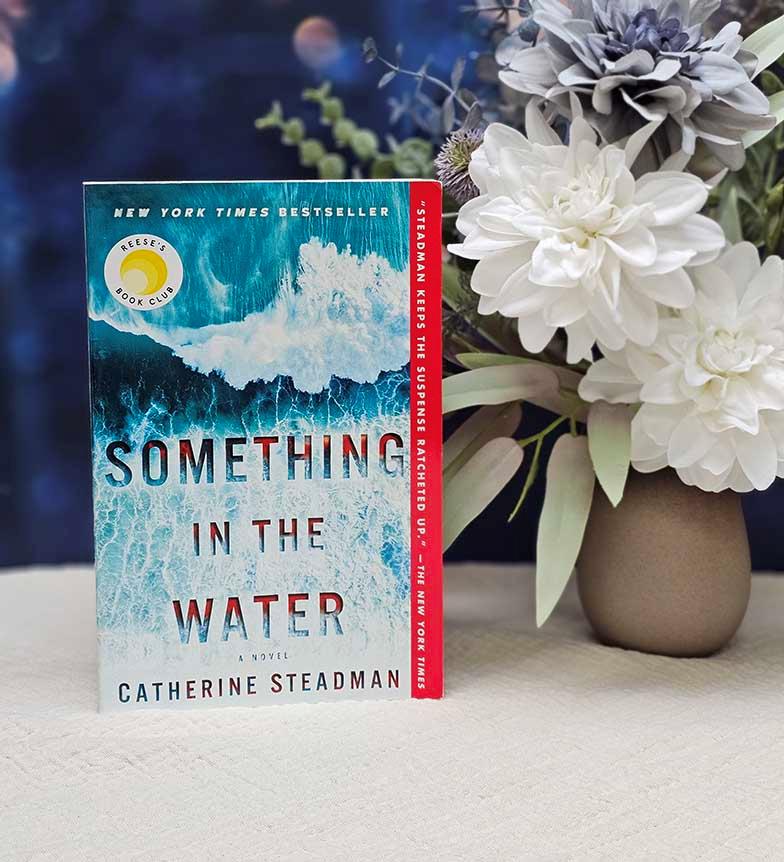
Something in the Water
by Catherine Steadman
Catherine Steadman's 2018 debut psychological thriller opens with London documentary filmmaker Erin Roberts digging a grave alone in the woods, then flashes back to the Bora Bora honeymoon - already trimmed from three weeks to two after her banker husband Mark lost his job - where a sealed duffle bag the couple pulls from the water turns out to contain a great deal more than they were prepared to be in possession of.

My Sister's Grave
by Robert Dugoni
Twenty years ago, Tracy Crosswhite's younger sister Sarah vanished one summer night on a county road outside the small Cascade-mountain town of Cedar Grove, Washington; a recently paroled rapist named Edmund House was convicted on circumstantial and partly planted evidence and given a life sentence, Tracy and Sarah's grief-shattered father took his own life, and Tracy left Cedar Grove to become a Seattle homicide detective. When Sarah's remains are uncovered in the dam-flooded land outside town, Tracy comes home to reopen the case alongside her childhood friend Dan O'Leary - now a small-town lawyer - against the sheriff and prosecutor she has known her whole life.

Vanishing Girls
by Lisa Regan
The first Detective Josie Quinn novel: a seventeen-year-old named Isabelle Coleman vanishes from the small Pennsylvania town of Denton, and the suspended detective who shouldn't be working the case finds a second girl - mute, traumatized, and able to give up only one name, Ramona - whose neon tongue piercing matches Isabelle's, pulling Josie into a cold case the department had filed away as a hoax.