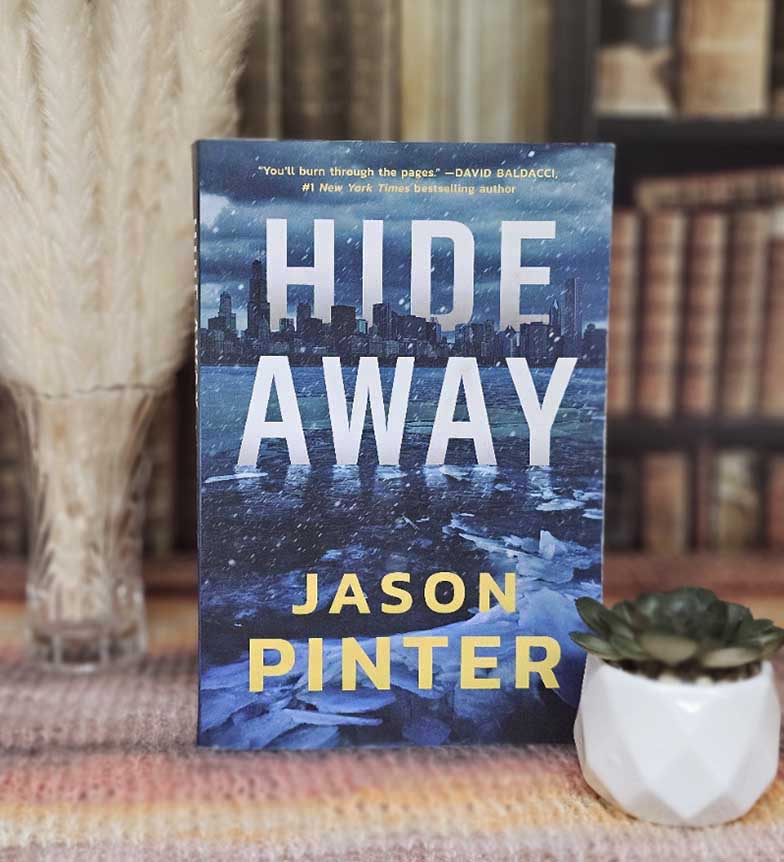
Hide Away
by Jason Pinter
A gripping thriller about a woman who changed her identity to protect her children after her husband's murder. When her carefully constructed new life begins to unravel, Rachel Marin must confront the past she's been hiding from.
Spoiler Warning
This review may contain spoilers. Read at your own discretion if you haven't finished the book yet.
The Perfect Suburban Lie
Rachel Marin has the kind of life that looks perfect from the outside: two kids - thirteen-year-old Eric and seven-year-old Megan - a tidy house in Ashby, a small town outside Chicago, a routine of school drop-offs and grocery runs and neighborly waves that blends seamlessly into the suburban background. She's quiet, pleasant, forgettable in exactly the way she needs to be. Because Rachel Marin doesn't exist. Her real name is Olivia Powell. Seven years ago, her husband was murdered - his body left on the front porch for young Eric to find - and Rachel did something most people in her situation wouldn't: instead of waiting for the system to protect her, she changed her name, changed her appearance, and disappeared with her children. No witness protection program. No government handlers. Just a woman who decided that the only person she could trust to keep her kids safe was herself. And now, seven years into the most convincing performance of normalcy she can manage, something is going wrong. Someone is watching. And Rachel has to decide whether the danger is real or whether years of hiding have made her unable to tell the difference.
Jason Pinter's Hide Away opens with that uncertainty and never lets it go. The book is built on the specific paranoia of someone who can't afford to dismiss her instincts but also can't afford to act on them without risking exposure. Rachel notices a car idling on her street for too long. She notices a man at the coffee shop who seems to appear every time she does. She notices her neighbor, a friendly woman named Evelyn, asking questions that might be ordinary small talk or might be probing for information Rachel can't give. Each of these observations could mean everything or nothing, and the tension comes from the fact that Rachel's survival has depended on her ability to read threats accurately - but her judgment has been warped by five years of constant vigilance. She can't tell if she's seeing real danger or if the machinery of self-protection she's built has become its own kind of prison.
The Cost of Disappearing
What Pinter understands - and what elevates Hide Away above standard witness-protection thrillers - is that disappearing doesn't just protect you. It hollows you out. Rachel hasn't had a real conversation with another adult in five years. She can't tell anyone her real name, can't share her actual history, can't explain why she flinches at certain sounds or why she checks the locks three times before bed. Every relationship she has in Ashby is built on a lie, which means every relationship she has is, at some fundamental level, loneliness wearing a social costume. She goes to neighborhood barbecues and smiles and makes small talk and goes home and sits in silence, because the person her neighbors think they know doesn't exist and the person who does exist can't be known by anyone.
The toll on her children is handled with equal honesty. Eric, the older one, is starting to ask questions. Why don't they have photographs from before they moved to Ashby? Why doesn't anyone from their old life ever visit? Why does his mom tense up every time the doorbell rings unexpectedly? Rachel has been telling versions of the truth - we moved for a fresh start, our old life was complicated, sometimes families need to begin again - but Eric is getting old enough that the deflections are starting to sound like what they are. Megan, younger and more adaptable, has accepted Ashby as her whole world, which creates its own kind of grief for Rachel: her daughter's normalcy is real, built on a foundation that could collapse at any moment.
Pinter renders these domestic details with a precision that makes the thriller elements hit harder. The scene where Rachel volunteers at Megan's school and has to fill out a background check form - writing down her fabricated Social Security number, her fictional employment history, her invented references - captures the exhausting meta-cognition of living under cover. Every mundane interaction is a test she has to pass. Every form is a potential exposure. Every new person is a possible threat. The surveillance anxiety isn't just a thriller device; it's the realistic psychological consequence of living a lie that you can never stop maintaining.
When the Past Breaks Through
The plot accelerates when Constance Wright, the disgraced former mayor of Ashby, is found dead - an apparent suicide that Rachel suspects is actually murder. The investigation begins to circle uncomfortably close to Rachel's carefully constructed world. The police start asking questions in the neighborhood. A detective - John Serrano, sharp and persistent, partnered with Detective Leslie Tally - takes an interest in Rachel that might be professional suspicion or might be personal attraction, and Rachel can't afford either. Constance Wright's death may or may not be connected to the threat Rachel senses closing in, and Pinter keeps the reader - and Rachel - uncertain about whether the two storylines are converging or running in parallel.
Meanwhile, the flashbacks begin to fill in what Rachel is running from. Pinter structures the backstory as a series of gradually expanding revelations, each one adding context that reframes what we thought we understood. Rachel's previous identity as Olivia Powell, her husband's murder, the conspiracy she's been running from - these emerge not as info-dumps but as memories triggered by present-day events, so the past and present feel like they're accelerating toward each other. By the time the full picture comes into focus, the stakes have escalated from "is someone watching Rachel?" to something much larger and more dangerous, involving people with resources and motivation that the witness protection program may not be equipped to handle.
Rachel's response to the escalating threat is where Pinter's character work pays off most impressively. She doesn't call for help - she can't, not without blowing her cover and potentially putting her children in worse danger than they're already in. She doesn't freeze - seven years of hypervigilance have made her observant, resourceful, and physically capable. Rachel has spent those years deliberately training herself, transforming from the soft, passive woman her husband knew into someone harder, stronger, and selectively aggressive. And she doesn't run - because she's been running for seven years and she's reached the point where the cost of continuing to run exceeds the cost of turning around and fighting. The shift from defensive to offensive, from hiding to confronting, is the book's emotional climax, and it works because Pinter has spent the first two-thirds of the novel making us feel every ounce of what Rachel has lost and sacrificed. When she finally decides to fight, it's not a thriller-heroine power moment. It's a mother who has run out of acceptable options and is terrified but done hiding.
The Action and Its Honest Limits
The final act delivers the confrontation the book has been building toward, and Pinter handles it with admirable restraint. Rachel is capable and smart, but she's not a trained operative or an action hero. She makes mistakes under pressure. She misjudges a situation and pays for it. A plan that should have worked goes sideways because real confrontations don't follow scripts. The violence, when it comes, is messy and frightening rather than choreographed and cool, which makes Rachel's survival feel earned rather than predetermined. Pinter clearly respects his protagonist enough to put her in genuine danger rather than wrapping her in plot armor.
Detective Serrano's role in the resolution adds a complication that the book handles better than expected. His involvement forces Rachel into a position where she has to decide how much truth to reveal and to whom, and the negotiation between her need for help and her instinct to trust no one produces some of the book's tensest scenes. Their dynamic avoids the worst tendencies of the detective-meets-mysterious-woman thriller trope - Serrano is neither the white knight who saves her nor the bumbling cop who gets in her way, but a professional with his own competence and his own blind spots who has to earn Rachel's trust one careful step at a time.
The book's one notable weakness is that some of the secondary characters in Ashby don't develop beyond their functional roles. Evelyn, the inquisitive neighbor, and a few other townspeople serve the plot efficiently but never fully emerge as people with lives independent of Rachel's story. In a book this tightly focused on its protagonist, that's a reasonable trade-off - the intimacy of Rachel's perspective is part of what makes the paranoia feel so immersive - but a slightly wider lens on the community would have added texture to the world she's built and increased the emotional cost of its potential destruction.
What I keep coming back to is how the book redefines what a witness-protection story can be. Most thrillers in this subgenre focus on the external threat - the bad guys finding the witness, the climactic confrontation, the escape. Pinter is equally interested in the internal cost - what it does to a person to erase themselves, to watch their children grow up inside a fiction, to be surrounded by people and fundamentally alone. Rachel's fight isn't just against the people hunting her. It's against the erasure of her own identity, and her decision to stop hiding is as much about reclaiming who she is as it is about physical survival. That emotional dimension is what earns the five stars and what makes Hide Away linger long after the plot's been resolved.
Rating: 5.0/5 ⭐
Perfect for: Thriller readers who want emotional depth with their suspense, anyone who appreciates capable female protagonists navigating impossible situations, readers who enjoy witness-protection stories that go deeper than the genre usually allows.
Skip if: You prefer slower literary fiction, or you need your supporting casts fully developed alongside the protagonist.
You Might Also Like

The Black Book
by James Patterson & David Ellis
Detective Billy Harney's life is turned upside down when he's framed for a murder he didn't commit, forcing him to navigate a web of corruption within his own police department.

Rapid Falls
by Amber Cowie
A psychological thriller about a woman who returns to her hometown to face dark secrets from her past that threaten to destroy everything she's built.

All Dressed in White
by Mary Higgins Clark & Alafair Burke
The third Under Suspicion novel: five years after bride-to-be Amanda Pierce vanished the night of her pre-wedding celebration at a luxury Palm Beach resort, television producer Laurie Moran reopens the cold case for her cold-case show - reuniting the wedding party, including the fiance who has since married one of Amanda's own bridesmaids, to find out whether the runaway bride ran or was made to disappear.