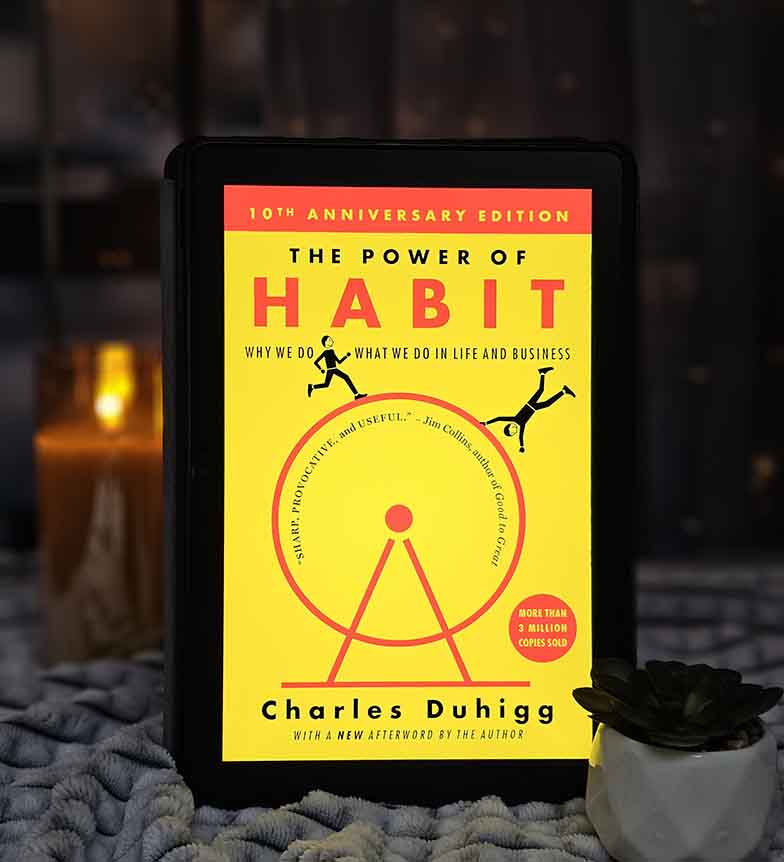
The Power of Habit
by Charles Duhigg
An exploration of the science behind habit formation and change, examining how habits work in individual lives, organizations, and societies. Duhigg combines neuroscience research with compelling case studies.
Spoiler Warning
This review may contain spoilers. Read at your own discretion if you haven't finished the book yet.
The Loop That Runs Your Life
Here's an uncomfortable truth: most of what you do each day isn't decided consciously. You're running on automatic, following loops your brain established weeks, months, or years ago to conserve mental energy. Charles Duhigg, a Pulitzer Prize-winning reporter for the New York Times, built The Power of Habit around a single framework that explains how those loops work: "First, there is a cue, a trigger that tells your brain to go into automatic mode and which habit to use. Then there is the routine, which can be physical or mental or emotional. Finally, there is a reward, which helps your brain figure out if this particular loop is worth remembering for the future." Cue, routine, reward. That's the habit loop, and Duhigg argues it's the invisible architecture behind everything from your morning coffee ritual to corporate culture to the civil rights movement.
It's a genuinely useful framework. And the book is a genuinely engaging read, because Duhigg is a talented journalist who knows how to turn behavioral science into narrative. But here's the thing I kept bumping into: knowing how habits work isn't the same as knowing how to change them, and Duhigg's book is considerably stronger on the former than the latter. By the time I finished, I understood the mechanism perfectly and had almost no concrete tools for applying it to my own life. That gap between intellectual satisfaction and practical utility is what lands this at three stars for me - a fascinating book that stops just short of being a truly useful one.
The Case Studies That Carry the Book
Duhigg structures the book in three parts - the habits of individuals, the habits of organizations, and the habits of societies - and each section is driven by case studies that are, genuinely, excellent storytelling. The individual section opens with a man named Eugene Pauly, who suffered a devastating case of viral encephalitis that destroyed his medial temporal lobe - the part of the brain responsible for forming new memories. Eugene couldn't remember what he'd eaten five minutes ago, couldn't draw a map of his own house, couldn't tell you what year it was. And yet he could walk to the end of his block and back without getting lost, because his habits - the cue-routine-reward loops encoded in a different part of his brain - still functioned perfectly. Duhigg uses Eugene's case to make the neuroscience tangible: habits aren't just behaviors, they're neurological patterns stored in the basal ganglia, and they operate independently of conscious memory or decision-making.
The organizational section tells the story of Paul O'Neill taking over as CEO of Alcoa in 1987 and announcing that his number one priority wasn't profits or efficiency but worker safety. Wall Street thought he was insane. But O'Neill understood something about what Duhigg calls "keystone habits" - habits that, when changed, trigger cascading changes in other behaviors. By obsessing over safety, O'Neill forced every level of the organization to rethink communication, accountability, and process design. Within a year, Alcoa's profits hit a record high. Duhigg uses this to argue that "some habits matter more than others in remaking businesses and lives," and that identifying your keystone habits - the ones with the biggest ripple effects - is more strategic than trying to change everything at once.
The most talked-about case study is the Target pregnancy prediction story, and it's worth lingering on because it illustrates both Duhigg's strengths and his weaknesses as an author. Target's data analysts discovered that they could identify pregnant customers - and predict their due dates - based on purchasing patterns: unscented lotion, certain vitamin supplements, extra-large bags of cotton balls. They used this to send targeted coupons, and in one infamous case, a father complained to a Target manager that his teenage daughter was receiving baby-product promotions, only to later apologize when he discovered she was, in fact, pregnant. It's a terrific story. Duhigg tells it with perfect pacing. But it's also doing a lot of heavy lifting in a chapter that's ostensibly about the habits of companies, and by the time you step back, you realize the connection between Target's data mining and the habit loop framework is thinner than the narrative makes it feel. The story works because it's surprising and a little creepy, not because it deepens your understanding of how to change your own habits.
The Golden Rule and Its Missing Manual
The book's most practically relevant idea is what Duhigg calls the Golden Rule of Habit Change: "You can't extinguish a bad habit, you can only change it. How it works: Use the same cue. Provide the same reward. Change the routine." The logic is clean - if you eat a cookie every afternoon at 3 PM because you're bored and the walk to the break room provides social interaction, you don't need to eliminate the craving. You need to find a different routine that gives you the same reward (socializing, a break from your desk) without the cookie. Duhigg illustrates this with the story of Tony Dungy coaching the Tampa Bay Buccaneers and later the Indianapolis Colts, drilling his players to respond to the same on-field cues with new, faster routines until the new behaviors became automatic.
The problem is that the Golden Rule sounds much more straightforward than it actually is in practice. Duhigg tells you to identify your cue and your reward, then experiment with different routines - but the process of correctly identifying what you're actually craving is far harder than he acknowledges. Is your 3 PM cookie habit driven by hunger, boredom, the need for a walk, social contact, or a sugar crash from lunch? Each diagnosis suggests a different replacement routine, and Duhigg's advice for figuring out which one applies to you amounts to roughly a page of "try different things and see what sticks." For simple habits, that might be enough. For the kinds of entrenched behaviors that actually send people looking for self-help books - stress eating, phone addiction, procrastination patterns tied to anxiety - the framework starts to feel like a skeleton without enough muscle on it.
The section on willpower, anchored by a Starbucks case study about how the company trains baristas to handle stressful customer interactions through pre-planned routines, is one of the book's better practical chapters. Duhigg describes Starbucks' LATTE method - Listen, Acknowledge, Take action, Thank, Explain - as an example of how organizations can build willpower by giving people specific scripts for difficult moments. It's a genuinely useful concept: willpower isn't a fixed trait but a skill that can be developed through structured practice. But even here, the insight feels like it belongs in a different, more focused book about organizational training rather than a chapter that's supposed to help individual readers strengthen their own self-control.
A Journalist's Book, Not a Self-Help Book
The societal habits section - covering the Montgomery Bus Boycott, Rick Warren's Saddleback Church, and the neuroscience of sleepwalking - is where the book most clearly reveals itself as a journalist's exploration rather than a practical guide. These are fascinating stories. Duhigg's analysis of how Rosa Parks's social ties turned an individual act of defiance into a mass movement through the mechanics of "weak ties" and "peer pressure" is compelling social science writing. But by this point, the book has drifted so far from its initial promise - help me understand and change my habits - that it feels like a different project entirely. The connection between societal habit formation and your afternoon cookie craving is, at best, thematic.
This is the core tension of The Power of Habit. Duhigg is a gifted storyteller and a thorough researcher, and the book is genuinely enjoyable to read. The habit loop framework is useful and well-explained. The case studies are memorable. But the gap between "here's how habits work" and "here's how to change yours" never gets adequately bridged. When James Clear published Atomic Habits six years later, he essentially took Duhigg's framework, stripped out the tangential case studies, and replaced them with specific, implementable strategies - habit stacking, environment design, the two-minute rule, identity-based habit formation. Clear's book isn't better written, but it's dramatically more useful, and reading the two back-to-back makes Duhigg's practical deficit feel more pronounced.
If you've never thought systematically about why you do what you do, The Power of Habit is a solid and engaging introduction to the science. The habit loop will change how you think about your own behavior, and some of the case studies will stick with you for years. But if you're picking it up because you have specific habits you want to change and you're looking for a roadmap, you'll finish the book smarter than when you started and not much closer to actually doing anything differently. It's a book that explains the lock without quite handing you the key.
Rating: 3.0/5 ⭐
Perfect for: Readers new to behavioral science, anyone who enjoys narrative-driven non-fiction with strong case studies, people who want to understand the psychology of automatic behavior.
Skip if: You've already read Atomic Habits, you want step-by-step implementation strategies, or you prefer your non-fiction tightly focused rather than expansive.
My Notes & Takeaways
Key Quotes
"This process within our brains is a three-step loop. First, there is a cue, a trigger that tells your brain to go into automatic mode and which habit to use. Then there is the routine, which can be physical or mental or emotional. Finally, there is a reward, which helps your brain figure out if this particular loop is worth remembering for the future."
"When a habit emerges, the brain stops fully participating in decision making. It stops working so hard, or diverts focus to other tasks. So unless you deliberately fight a habit - unless you find new routines - the pattern will unfold automatically."
"Habits are powerful, but delicate. They can emerge outside our consciousness, or can be deliberately designed. They often occur without our permission, but can be reshaped by fiddling with their parts. They shape our lives far more than we realize - they are so strong, in fact, that they cause our brains to cling to them at the exclusion of all else, including common sense."
"He created a craving. And that craving, it turns out, is what makes cues and rewards work. That craving is what powers the habit loop."
"Cravings are what drive habits. And figuring out how to spark a craving makes creating a new habit easier."
"... to change a habit, you must keep the old cue, and deliver the old reward, but insert a new routine."
"For a habit to stay changed, people must believe change is possible. And most often, that belief only emerges with the help of a group."
"If you focus on changing or cultivating keystone habits, you can cause widespread shifts."
"Willpower isn't just a skill. It's a muscle, like the muscles in your arms or legs, and it gets tired as it works harder, so there's less power left over for other things."
"This is how willpower becomes a habit: by choosing a certain behavior ahead of time, and then following that routine when an inflection point arrives."
You Might Also Like
Rising Strong
by Brené Brown
Brené Brown explores the process of getting back up after failure, heartbreak, and disappointment, providing a research-based approach to resilience and emotional recovery.

Playing Big
by Tara Mohr
A practical guide for women looking to step into their power and pursue their ambitions. Tara Mohr offers tools to quiet your inner critic, recognize your unique calling, and take bold action.
Digital Minimalism
by Cal Newport
A compelling philosophy for technology use in the modern age, arguing for a minimalist approach to digital tools. Cal Newport makes the case for being highly intentional about which technologies you allow into your life and how you use them.