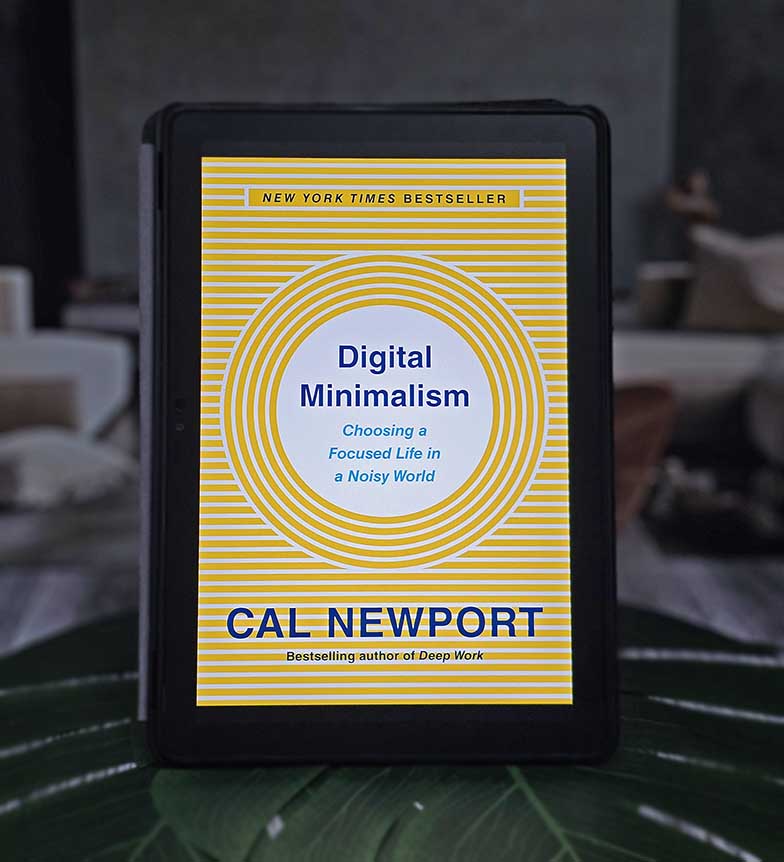
Digital Minimalism
by Cal Newport
A compelling philosophy for technology use in the modern age, arguing for a minimalist approach to digital tools. Cal Newport makes the case for being highly intentional about which technologies you allow into your life and how you use them.
Spoiler Warning
This review may contain spoilers. Read at your own discretion if you haven't finished the book yet.
Your Attention Is Being Stolen (And Sold)
Here's the uncomfortable truth Cal Newport lays out in Digital Minimalism: the apps on your phone aren't neutral tools. They're products engineered by teams of brilliant people whose explicit goal is capturing and keeping your attention, because your attention is what they sell. Newport draws a direct parallel between social media platforms and Las Vegas slot machines - both use intermittent, unpredictable rewards to keep you compulsively pulling the lever. The like that might be there when you check. The feed that's been refreshed since you last looked. These aren't design accidents; they're borrowed casino techniques, fueling an attention economy that is, as Newport notes, more lucrative than extracting oil.
Newport isn't a technophobe ranting from the margins. He's a computer science professor at Georgetown, the author of Deep Work, and someone who has never had a social media account - not out of ignorance but out of a researched conviction that the costs outweigh the benefits. Digital Minimalism is his attempt to build a complete philosophy for engaging with digital technology, starting from first principles rather than tips and tricks. "Digital minimalism is a philosophy of technology use in which you focus your online time on a small number of carefully selected and optimized activities that strongly support things you value," he writes, "and then happily miss out on everything else." That last phrase - "happily miss out" - is the key. This isn't about deprivation. It's the realization that what you're missing out on wasn't making you happy in the first place.
The Three Principles and the Amish Model
Newport builds his philosophy on three principles: clutter is costly, optimization is important, and intentionality is satisfying. The first argues that even if each individual app provides some small value, the cumulative cost of dozens of low-value digital tools - in attention, time, and cognitive overhead - outweighs their benefits. The second pushes past "should I use this?" to the better question of "how should I use this?" - a tool that's valuable for twenty deliberate minutes a day might be actively harmful when it's open in a background tab for eight hours. The third is the most surprising: the act of consciously choosing rather than passively accepting generates its own satisfaction, independent of which specific tools you keep or discard.
His model for this approach is, unexpectedly, the Amish. Newport dismantles the popular misconception that they reject all technology. What they actually do is evaluate each new technology against their core values - family, community, faith - before allowing it in: a community "alpha geek" trials it, the community observes its impact on daily life and social bonds, and a collective decision is made to allow, restrict, or prohibit it. The Amish rejected car ownership not because cars are inherently evil but because they observed that cars drew members away from local social life, weakening the bonds that sustain their way of living. Newport argues the rest of us should apply the same logic - not rejecting technology wholesale, but accepting only what passes the test of our actual values.
He also draws on Thoreau's "new economics" from Walden - the idea that the true cost of a thing is the amount of life you must exchange for it. The question isn't "does Twitter provide value?" It's "does that value justify the hours of life I exchange for it?" For most people, Newport argues, the honest answer is no.
The 1,600-Person Experiment
The practical heart of the book is the digital declutter, and Newport didn't just theorize about it - he tested it. In late 2017, he put out a call for volunteers expecting 40 to 50 responses. Over 1,600 people signed up. During January 2018, participants removed all optional technology from their lives for 30 days - not as a detox (which implies returning to the original behavior afterward) but as a reset, clearing the slate to rediscover what they actually valued versus what they'd been using purely out of habit.
The first week was uncomfortable for most - phantom phone-checking, empty moments that used to be filled with scrolling. By the second week, most participants had begun filling the reclaimed time with activities they'd abandoned: reading, walking, building things, having actual conversations. By the end of the month, the question had flipped: instead of "why would I give this up?" they were asking "why would I add this back?"
Newport structures reintroduction around the three principles: each tool has to earn its way back by providing substantial value aligned with your core values. Not "is Facebook useful?" but "does this specific way of using it, at this frequency, for this purpose, justify the cost in attention and time?" Most tools, evaluated that honestly, don't make the cut - and the recurring finding among his volunteers was surprise at how little they missed, and how much better the replacement activities felt.
Solitude, Lincoln, and the Cost of Never Being Alone
One of the book's most powerful concepts is "solitude deprivation" - Newport's term for the state of never being alone with your own thoughts. He defines solitude precisely: not physical isolation, but freedom from input from other minds. You're not in solitude if you're alone in a room with a podcast on; you are in solitude walking through a crowded park without your phone. The smartphone, Newport argues, has created the first generation in history that can go from waking to sleeping without a single moment of genuine solitude - every potential gap filled with someone else's words, images, or ideas.
He illustrates the cost through Abraham Lincoln, who spent the summers of 1862 through 1864 at the Soldiers' Home cottage in North DC, commuting roughly three miles each way alone on horseback - about 45 minutes of solitude in each direction, on a route dangerous enough that the military uncovered a Confederate assassination plot along it, and Lincoln was shot at on at least one occasion. He kept making the ride, because the solitude was where he processed the impossible decisions of the war. Newport's point isn't that we face Lincoln-scale pressures. It's that solitude serves a cognitive function - processing, self-knowledge, emotional regulation - that no other activity replicates, and eliminating it entirely produces the anxiety and restlessness so many people now treat as normal.
His prescriptions are simple - long walks without your phone, regular time alone with your thoughts, earbuds left at home sometimes - and harder than they sound, because we've become so habituated to constant stimulation that silence now feels like a problem to be solved rather than a resource to be cultivated.
Conversation Over Connection
Newport's chapter on relationships draws a distinction that felt genuinely clarifying. Connection - likes, comments, emoji reactions, quick texts - feels social but doesn't provide what humans actually need from relationships. "Conversation is the only form of interaction that in some sense counts toward maintaining a relationship," he writes. You can have thousands of digital connections and still be lonely, because none of them involve the sustained attention and genuine presence that real conversation requires; social media's low-friction interactions are junk food that tastes like social nourishment and leaves you hungry.
His practical fix is "conversation office hours" - regular, predictable times when you're available for real conversation, like the businessman he describes who tells friends and family to call during his 5 PM commute. The practice dissolves the social obstacle that keeps most people trapped in text-message relationships - the worry that calling someone unsolicited is intrusive. If your friends know when you're reachable, the barrier to real conversation drops dramatically.
Where the Philosophy Has Edges
I gave this five stars because the core framework - evaluate your technology against your values, keep only what passes the test, replace passive consumption with active engagement - genuinely changed my relationship with my phone. The 30-day declutter is one of the most useful practical strategies in any self-help book I've read, and the three principles are flexible enough to adapt to different lives without being so vague they're useless.
That said, Newport's perspective has blind spots worth noting. His framework assumes a degree of control over your digital life that not everyone has - if your job requires you to be on Slack eight hours a day, or your family coordinates entirely through a group text, "just remove optional technology" gets complicated fast. He writes as a tenured professor with significant autonomy over his schedule, and some suggestions - solitary walks, conversation office hours, evenings spent on crafts - assume a life structure that isn't available to everyone.
The book also doesn't fully grapple with the ways social media serves genuine community-building for marginalized groups. For people who can't find their communities locally - queer teenagers in rural areas, people with rare diseases connecting with others who share their condition, activists coordinating across distances - these platforms aren't just attention traps. They're lifelines, and Newport's framework would benefit from engaging with those use cases rather than treating social media as a uniformly extractive force.
These are limitations of perspective, not failures of the core argument. The central insight - that technology should serve your values rather than your values being shaped by whatever happens to capture your attention - is powerful, practical, and genuinely countercultural in an era that treats constant connectivity as a moral good. Newport makes a compelling case that the opposite might be true, and he gives you the tools to find out for yourself.
Rating: 5.0/5 ⭐
Perfect for: Anyone feeling overwhelmed by their phone habits, people who sense their relationship with technology isn't healthy but don't know where to start, readers who want a philosophy rather than just tips.
Skip if: Your digital life genuinely serves your values already, or the idea of a 30-day technology reset sounds impossible given your work and life circumstances.
My Notes & Takeaways
Core Principles & Key Ideas
Digital Minimalism Defined:
"Digital minimalism is a philosophy of technology use in which you focus your online time on a small number of carefully selected and optimized activities that strongly support things you value, and then happily miss out on everything else."
The Three Principles:
-
Clutter is costly: Keeping around a bunch of small tools, even if each provides a little bit of value, has costs that add up.
-
Optimization is important: Deciding which technology to use is only the first step. To truly extract value, you must think carefully about how you use it.
-
Intentionality is satisfying: Digital minimalists derive significant satisfaction from their general commitment to being highly intentional about how they engage with new technologies.
On Solitude:
"Solitude is the state in which you're alone with your own thoughts, free from input from other minds."
On Conversation-Centric Communication:
"Conversation is the only form of interaction that in some sense counts toward maintaining a relationship."
You Might Also Like
The Year of Less
by Cait Flanders
A deeply personal memoir about one woman's year-long shopping ban and her journey toward mindful consumption and intentional living.

Everything is Figureoutable
by Marie Forleo
A revolutionary mindset and practical action plan for when you feel stuck, overwhelmed, or lost. Marie Forleo shares her philosophy that any problem, challenge, or dream is figureoutable.

Playing Big
by Tara Mohr
A practical guide for women looking to step into their power and pursue their ambitions. Tara Mohr offers tools to quiet your inner critic, recognize your unique calling, and take bold action.