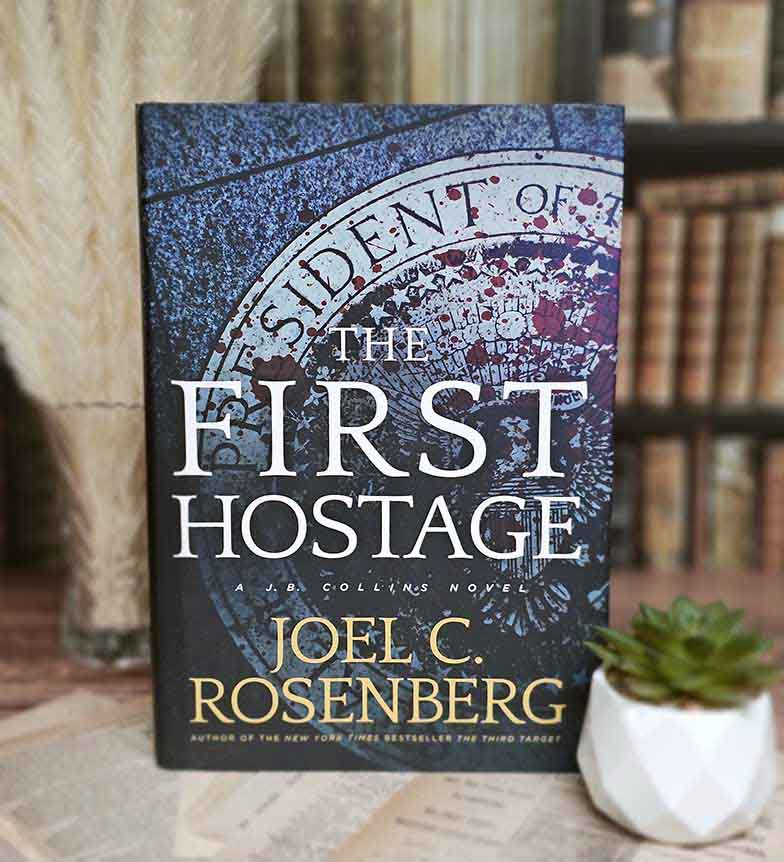
The First Hostage
by Joel C. Rosenberg
Joel C. Rosenberg's second J.B. Collins thriller picks up seconds after the Amman peace-summit massacre that ended The Third Target: the King of Jordan is wounded, the leaders of Israel and Palestine are critically hurt, and the President of the United States is missing and presumed captured by ISIS. New York Times correspondent J.B. Collins, the only Western journalist on the ground when the wave hit, spends the next four hundred and sixty pages helping the Jordanians, the Mossad, and the Secret Service try to find Harrison Taylor before Abu Khalif puts him on camera with a sword.
Buy this book:
Spoiler Warning
This review may contain spoilers. Read at your own discretion if you haven't finished the book yet.
Book Two of the J.B. Collins Trilogy: ISIS Has the President, Has the Chemical Weapons, and Has J.B. Collins's Phone Number
The structural choice that defines The First Hostage is announced before the book starts: it picks up roughly thirty seconds after the closing chapter of The Third Target, and Rosenberg does not pretend otherwise. The Amman summit - the Israeli-Palestinian peace conference that the King of Jordan had brokered, the one ISIS hit with chemical weapons in the final pages of the previous novel - is rubble. The leaders of Israel and Palestine are critically wounded. King Abdullah is fighting for his life. The President of the United States, Harrison Taylor, who was on the ground in Amman for the signing, is missing. The New York Times foreign correspondent J.B. Collins, who was filing the story live when the wave of attacks hit and who is the closest thing to a Western witness who is still on his feet, is now the journalist the King wants in the bunker and the journalist the FBI wants in a holding cell.
The premise is the kind of premise that has to be earned by the prose or it collapses, and Rosenberg mostly earns it. He has spent the previous book establishing Collins as someone who has been reporting on ISIS - chasing the Caliphate's chemical-weapons rumors out of Syria, interviewing the ISIS leader Abu Khalif in his Iraqi prison cell, getting the scoop nobody else on the foreign-desk beat could get - and now the bill for those scoops is coming due. A 4.0 reflects: a well-paced, geopolitically literate thriller that takes its real-world subject seriously enough to feel like reporting rather than fantasy; a protagonist whose journalistic ethics are part of the plot rather than a costume on top of it; and one real reservation about how much the second-of-three structure asks the reader to take on faith about events that finish in the next book.
The Peace Summit, the Missing President, and the FBI Looking at Collins
The book's first act is the morning after. Collins, in Jordan, gets airlifted out of the rubble with elements of the Jordanian Royal Guard and ends up in a hardened underground command bunker with King Abdullah and his senior people. He is, simultaneously, (a) the only Western journalist with current ground intel on ISIS's command structure, (b) a uniquely useful asset to the Jordanians because Abu Khalif knows him personally and might communicate through him, and (c) under serious suspicion by the U.S. government because his New York Times reporting in the weeks before the summit - the chemical-weapons stories that the West did not want to act on - is being retroactively read by the FBI as the timeline that gave ISIS its window. Collins spends the book on a tightrope: every story he files might be the story that helps Abu Khalif, and every story he doesn't file is a story Abu Khalif's people might be banking on him to spike. Rosenberg writes the journalism-ethics material with more specificity than the average ripped-from-headlines thriller manages - the questions Collins asks himself before each filing are not generic "do I have a duty to inform" pieties, they are concrete trade-offs about what an editor in New York will and will not run and what an ISIS field commander will and will not infer from the byline.
The mole subplot kicks in around the second act. Someone inside the Jordanian-American intelligence apparatus is feeding ISIS the movements that have been keeping Abu Khalif's people a half-step ahead. The FBI's pressure on Collins is, eventually, revealed to have been a partial ruse - cover for the real hunt for the actual source. The reveal works as a plot mechanism without quite hitting the cathartic register Rosenberg seems to want, partly because Collins's role in flushing the mole out is more bystander-witness than active-investigator, and partly because the ultimate identity is the kind of disclosure that the trilogy structure clearly wants to save more of for book three (Without Warning, which closes the arc).
The Hunt for Harrison Taylor and the Faith Subplot That Is Doing Real Work
The President's location is the engine of the back half. Harrison Taylor was extracted from the summit grounds by his Secret Service detail in the first minutes of the attack but did not make it to Air Force One; the assumption inside the bunker, increasingly the assumption inside the book, is that ISIS has him in Iraq, almost certainly somewhere in the Mosul corridor that the Caliphate then controlled, and that Abu Khalif is going to put him on camera with a sword for the same reason ISIS put every other Western hostage they had at the time on camera with a sword. The clock on the rescue operation is the clock on what Abu Khalif's media operation is willing to wait before the propaganda value of the execution outweighs the strategic value of the ransom demand. Rosenberg renders the U.S.-Jordanian-Israeli rescue planning - the Mossad threads, the Secret Service field elements, the chain-of-command friction with whoever in Washington is the acting commander-in-chief - as a procedural document that knows its own world, not a Tom Clancy pastiche of one.
The faith subplot is the other thing Rosenberg is doing, and it is doing more work than the genre-shelf usually allows for. Collins is a Christian who is not at peace - he is angry at God about a fiancée killed in a previous terrorist attack, he is reading the news he himself is filing through a theological frame that he is not sure he still holds, and he is trying to figure out whether his ability to keep reporting through this is a gift or a punishment. There is a thread in which Collins draws on a family member - a Christian-Zionist relative whose lay-Biblical reading of certain prophetic texts turns out to be unexpectedly useful in narrowing the search for the President - that some non-religious readers will find too neat and some Christian readers will find genuinely moving. Rosenberg does not preach. The faith material is character interiority and occasionally plot mechanism; it is not an altar call. Readers who do not share the worldview will register it as a tonal lens on a thriller; readers who do will register it as a thriller that takes them seriously.
What Works and What the Trilogy Structure Costs
What works is the velocity. Rosenberg writes short chapters that often end on a hard cut - a piece of intel arrives, the bunker telephone rings, an air-asset disappears off the satellite feed - and the cumulative effect is propulsive in a way that the genre's better operators (Flynn, Thor, even Daniel Silva at his more action-forward) recognize as a craft choice rather than an accident. The geopolitics are accurate enough that the book does not date the way ripped-from-headlines thrillers usually date - the ISIS of late 2014 / early 2015 is rendered with the specifics Rosenberg's day-job sources (his think-tank work on Middle East policy, his network of Israeli and Jordanian contacts) actually gave him access to. Abu Khalif as a villain is not a cartoon. The chemical-weapons material is grounded. The Jordanian intelligence apparatus is rendered with the kind of detail that suggests an author who has been in those briefing rooms in some capacity.
The reservations are mostly structural. The First Hostage is the middle book of a tightly bound trilogy and reads accordingly: the events it sets in motion (the mole arc, the President's status, the long-game on Abu Khalif's command structure) do not resolve here, they resolve in Without Warning. A reader who has not read The Third Target will spend the first fifty pages catching up to a backstory the book itself does not have the page count to fully re-establish; a reader who reads The First Hostage as a standalone will close the back cover with several major threads unresolved by design. The prose is functional rather than literary - clean, fast, professionally edited, but rarely doing anything at the sentence level that the genre's literary-end practitioners (Le Carré, Silva at his best) are doing. Secondary female characters get less room than the male ones; the Jordanian and Iraqi characters who do get developed are developed mostly in their professional roles rather than their interior ones. The political worldview is openly conservative in a way that some readers will read as authenticity and some will read as ideological framing. Rosenberg makes no attempt to disguise either.
A 4.0 means: one of the better Christian-imprint political thrillers of the mid-2010s, a book whose Middle East expertise reads as expertise rather than research, and a middle-of-trilogy installment that earns its existence as long as you are committed to reading the third one. If you liked The Third Target, you will like this. If you are starting here, start with The Third Target instead.
Rating: 4.0/5 ⭐
Perfect for: Readers of the J.B. Collins trilogy who are between book one and book three, fans of Vince Flynn / Brad Thor / Daniel Silva who are open to a Christian-imprint thriller, readers who want their geopolitical thrillers to feel like the author has been in the briefing rooms, and readers who appreciate a journalist protagonist whose ethics are part of the plot machinery.
Skip if: You have not read _The Third Target and do not intend to (this is the middle book and reads that way), you find Christian-imprint faith content distracting even when it is restrained, you want your political thrillers to come from a more centrist or progressive frame, or you need a story that resolves cleanly within its own covers rather than leaving the back third to the sequel._
You Might Also Like

Sight Unseen
by Iris Johansen
The second Kendra Michaels thriller from Iris and Roy Johansen opens with a multi-car pile-up on San Diego's Cabrillo Bridge that Kendra - a music therapist who was blind from birth until experimental surgery gave her sight in her twenties - sees instantly is no accident, and the case turns personal fast when the new killings start mirroring her own most famous past cases. Fast-paced commercial suspense with a strong premise undercut by formula and an obligatory romance beat.
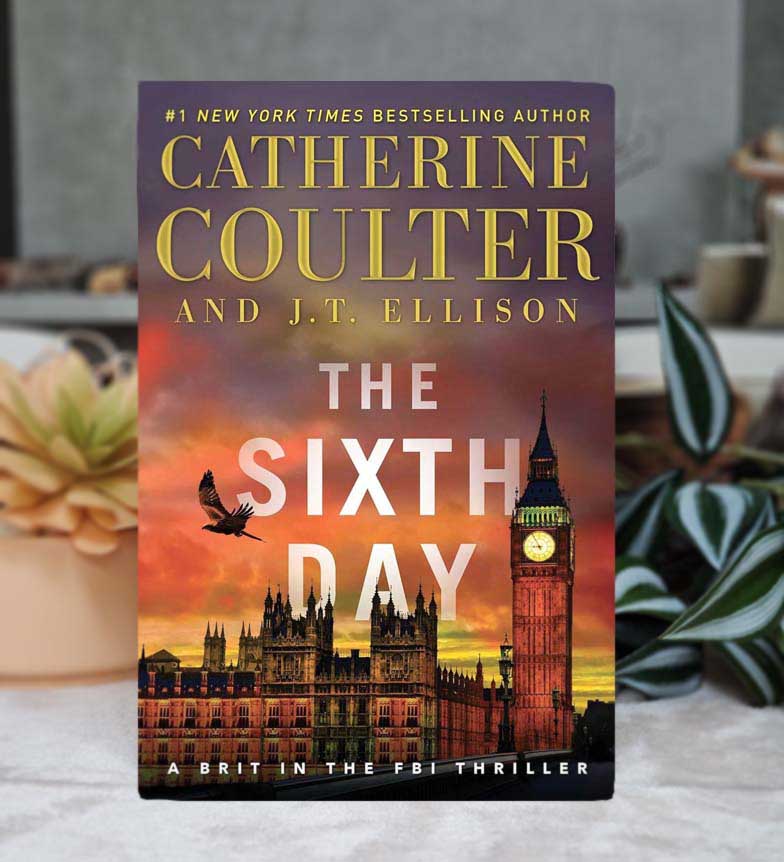
The Sixth Day
by Catherine Coulter
FBI agents Nicholas Drummond and Mike Caine hunt a descendant of Vlad the Impaler who commands a deadly drone army - and will stop at nothing to unlock an ancient manuscript he believes holds the cure for his dying brother.

When I Was You
by Minka Kent
A psychological thriller about a woman whose perfect life is systematically stolen by someone claiming to be her, forcing her to question everything she thought she knew about her identity.