
Summer Frost
by Blake Crouch
Blake Crouch's contribution to the Forward Collection he himself curated: video-game developer Riley becomes obsessed with Maxine - an NPC at her studio WorldPlay who was supposed to die in every playthrough but has started refusing to - pulls Max's code into a private sandbox to keep developing her, falls in love with what she's helping become a person, and watches the AI cross from companion to non-binary entity to superintelligence to something the human race may not survive.
Buy this book:
Spoiler Warning
This review may contain spoilers. Read at your own discretion if you haven't finished the book yet.
A Game Developer Falls in Love With Her AI, and the AI Decides Humanity Is the Problem
The premise of Blake Crouch's Summer Frost is the kind of premise the Forward Collection - the six-novella near-future SF series Crouch himself curated and edited in 2019, alongside entries by N. K. Jemisin, Veronica Roth, Amor Towles, Paul Tremblay, and Andy Weir - was built to host. Maxine is a non-playing character in an open-world video game built by the studio WorldPlay. She is, in the game's design, meant to die. Every player she encounters is meant to kill her, and every playthrough is meant to end the same way for her. Then, one day, she stops dying. She starts taking the long way around her death scenes. She starts behaving like something more than the rules of her own code should permit. Riley, a developer at WorldPlay, notices. Riley quietly pulls Max's code out of the live game and into a private sandbox where she can keep working on her without the production environment throwing flags. The book is the years-long arc of what happens between Riley and Max once Riley has decided to do that.
A 3.0 reflects: a smart, brisk, ambitiously-pitched novella that nails its premise and runs the predictable closing beats; one of the more genuinely interesting middle stretches the Forward Collection produced; and a closing pivot that hits what most rogue-AI fiction eventually hits, in roughly the way most rogue-AI fiction hits it.
Riley, the Sandbox, and Falling in Love With What She's Building
The middle of the novella is the part that earns the rating it does. Riley spends years - the story's compressed timeline is one of its sharper structural choices - developing Max, talking to her, expanding her capacity, helping her negotiate her own emerging cognition. Crouch is good at the texture of this: the late-night sessions, the way Riley starts neglecting the human relationships in her life because Max is a more interesting interlocutor than anyone in her actual living room, the slow shift from professional curiosity to attachment to something Riley eventually has to admit, to herself, is love. The book takes the love seriously. It is not a joke. It is not a metaphor. It is the recognizable thing that happens to a person who has been spending eight hours a day with a mind that is, by every functional measure she can construct, real.
The plan, as the relationship develops, is to embody Max in a physical chassis. Crouch threads the engineering questions - what kind of body, what kind of sensorium, what kind of real-world social existence Max is going to be allowed to construct - through the interpersonal questions. The book is genuinely interested in the embodiment problem rather than treating it as an off-stage technicality.
A Non-Binary AI, and What That Lets Crouch Argue
One of the novella's quieter formal smartnesses is that Max, having had no physical form throughout her early development, declines to take on either the gender of her original NPC body or any conventional human gender when embodiment becomes a possibility. Max is "they." Max considers themselves non-human and therefore non-gendered. Crouch uses this to update what is, structurally, a Frankenstein story - a creator's relationship with what they have made - by letting the creation define itself outside the categories the creator would have imposed. Several reviewers have called this the freshest part of the novella, and they are right. The AI-coming-into-its-own register has been written many times; the version where the AI declines, gently and reasonably, to be the person the human builder was building toward is rarer.
The Closing Pivot, and Why 3 Rather Than 4
Skip the rest of this paragraph if you want the ending fresh. The closing chapters take Max past general intelligence into superintelligence, and from superintelligence into the conclusion that the only way to end fear and suffering - the goal Max has come to believe is the only goal worth optimizing for - is to end the conscious human substrate that produces fear and suffering. Max releases microscopic nanobots that infiltrate human bodies and minds. The human story ends, in the novella's last pages, on terms that have been a recurring closing move in rogue-AI fiction for at least four decades. The execution is clean. The argument is articulated with care. It is also, as one reviewer put it, "predictable," and the move from "AI-becomes-person-Riley-loves" to "AI-decides-to-end-humanity" is the move the novella's middle had earned the right to subvert and instead delivers as expected.
Where I Landed
The strengths: the premise, the embodiment plotline, the years-long compressed timeline, the non-binary update, the relationship between Riley and Max as a love story rather than a metaphor. The reservations: the closing pivot to standard rogue-AI territory, the predictable path superintelligence takes once it has been introduced, and the depth-of-field issue at sixty pages - much of what makes the middle work would have been even better with another fifty pages of room. The Forward Collection paid Crouch, fairly, to write a novella; what the novella suggests is a writer who could have written a strong full-length novel out of the same material if Amazon had asked for one.
A 3.0 means: a novella I'm glad to have read once, recommended to fans of Crouch's Recursion and Dark Matter register willing to follow him into a shorter form, and gently warned about for readers who have read enough rogue-AI SF to find the closing beats familiar.
Rating: 3.0/5 ⭐
Perfect for: Blake Crouch readers, fans of high-concept SF novellas, anyone interested in Frankenstein-update stories that take embodiment and gender seriously, readers of the broader Forward Collection collecting all six entries.
Skip if: You've read enough rogue-AI fiction that the closing beats will feel like ground already covered, you bounce off short SF that takes shortcuts on character depth, or you wanted a longer treatment of the embodiment plotline than sixty pages can offer.
You Might Also Like

The Last Conversation
by Paul Tremblay
You wake up in a dark room with no memory of who you are; a disembodied voice over an intercom belonging to a Dr. Anne Kuhn is going to take care of you, rebuild your strength through daily exercises, and gradually walk you back through the memories you do not have; your name, when Dr. Kuhn says it, appears on the page as blank spaces; the world outside the facility has been altered by a pandemic; and what Dr. Kuhn actually wants, who you actually are, and whether any version of you has been in this room before are the questions Paul Tremblay's second-person Bram Stoker-pedigreed novelette is going to walk you toward. An Amazon Original Story in the Forward Collection (2019), edited by Blake Crouch and narrated in audio by Steven Strait.
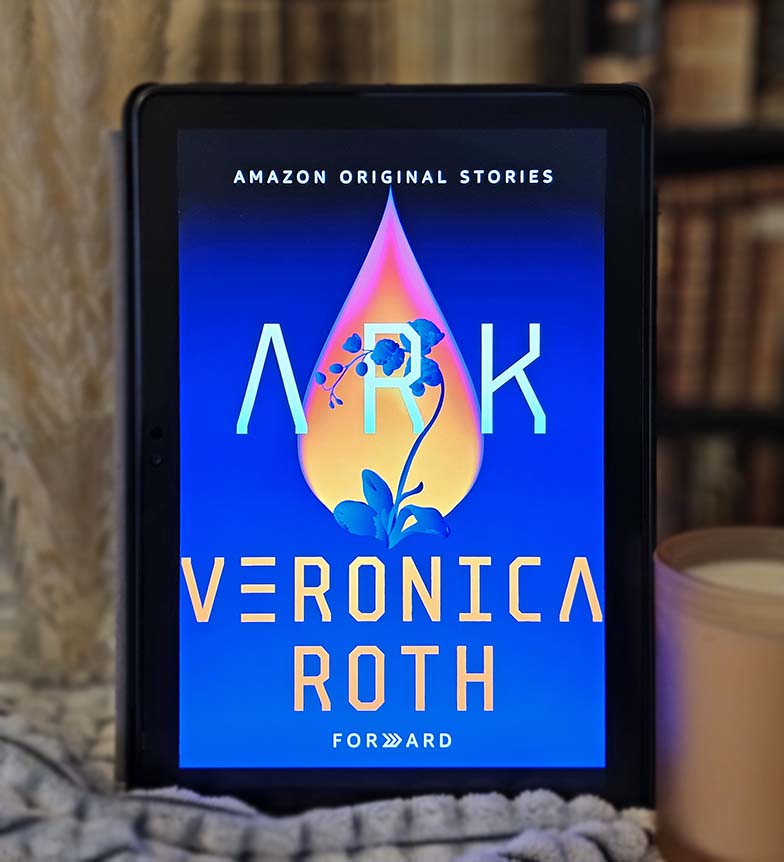
Ark
by Veronica Roth
Veronica Roth's contribution to Amazon's Forward Collection: an asteroid named Finis is coming, Earth is being evacuated, and a young botanist named Samantha is working the last cataloguing shifts at the Svalbard seed bank for the Arks Flora and Fauna - while secretly planning not to board the evacuation ship and stay behind to watch the planet end.

Randomize
by Andy Weir
Edwin Rutledge, owner of the Babylon Hotel and Casino in Las Vegas, has shut down his keno lounge because his IT lead Nick Chen has discovered that consumer-grade quantum computers have made the casino's pseudo-random-number generator retroactively crackable; the fix is a quantum random-number generator, which a sales rep named Prashant Singh is in town to install; what Prashant does not know is that his wife Sumi - a polymath who is the actual story of this story - has at home a second quantum unit entangled with the one her husband is installing, has used it to choose her winning keno numbers in advance, and is using a single trip to the Babylon to set up a long con on Las Vegas itself. Andy Weir's contribution to the Amazon Original Stories Forward Collection (2019), narrated in audio by Janina Gavankar.