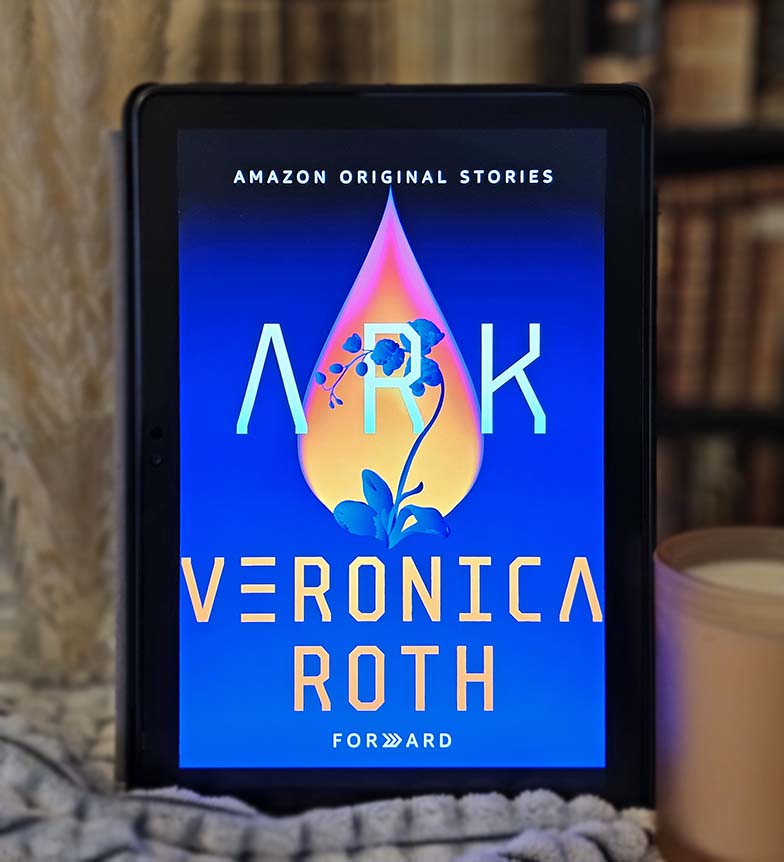
Ark
by Veronica Roth
Veronica Roth's contribution to Amazon's Forward Collection: an asteroid named Finis is coming, Earth is being evacuated, and a young botanist named Samantha is working the last cataloguing shifts at the Svalbard seed bank for the Arks Flora and Fauna - while secretly planning not to board the evacuation ship and stay behind to watch the planet end.
Buy this book:
Spoiler Warning
This review may contain spoilers. Read at your own discretion if you haven't finished the book yet.
A Botanist at the Svalbard Seed Bank, an Asteroid Named Finis, and the Quiet Plan She Hasn't Told Anyone
The premise of Veronica Roth's Ark is the opposite of the spectacle the Divergent author's name might lead you to expect. An asteroid called Finis is on a confirmed path to Earth. The world has known for years. The evacuation has been long-planned. Two Arks - Flora and Fauna, named for what they will carry with them - are docked at the poles, at the global seed banks, where the last skeleton crews of botanists and zoologists are cataloguing every plant and animal the new world (Terra) might want preserved. The novella's protagonist, Samantha, is a young botanist working her last weeks at the Svalbard seed bank, north of the Arctic Circle, processing samples while the clock runs down. What she has not told her colleagues, what she has not told her family, is that when the ships leave she does not plan to be on one. She is going to stay.
Roth's contribution to Amazon's Forward Collection - the six-story near-and-far-future series edited by Blake Crouch and released in 2019 - is the most quietly written entry in the set. The audiobook (about an hour, narrated by Evan Rachel Wood) is one of the more unexpected pleasures in the collection. A 3.0 reflects: a small, well-crafted, deliberately undramatic piece by a writer using the short form to do something other than what her novels are known for, with reservations mostly about how much fifty pages can carry.
Samantha, Hagen, and the Orchid
The story's structure is deceptively simple. Samantha works. The world ends in months. Her colleagues prepare to go. She does not. Among the older scientists at the station is Dr. Nils Hagen - reclusive, devoted to orchids in a way that has organized his entire life, also planning to remain - and the relationship that grows between them across the closing weeks of human Earth is the heart of the piece. They are not, in the conventional sense, falling in love. They are recognizing in each other the specific decision both have made, and finding small daily company in a place where most people have stopped being able to make small daily company because they are leaving.
The orchid is the device. With days left on Earth, Samantha discovers a new species - a plant nobody has catalogued, on the verge of being lost. Hagen, by long Linnaean tradition, names it after her. The naming is the kind of small, tender, useless gesture that, in Roth's reading of human behavior at the end of things, is exactly the thing humans do anyway and exactly the thing the story has been arguing for. The Ark will leave with Earth's catalogued species. One specimen of the orchid will go with it. Samantha, who is staying, will not.
What Roth Is Doing in Fifty Pages
The structural smartness of Ark is its refusal to make the apocalypse the subject. The asteroid is the weather. The story is interested in what people do when the weather is unsurvivable and they have already decided how they are going to face it. Roth is in a register here that her Divergent readers will not necessarily recognize - quiet, observational, melancholic without performing melancholy, willing to spend the few pages it has on a long conversation about flowers between two people who already know they are not going to be alive at the end of the year. The reviewers who have called it grown-up are right. So are the reviewers who have called it slight. Both are looking at the same fifty pages.
What the story is best at is the specific emotional register of having decided. Samantha is not depressed. She is not in despair. She has, the reader understands gradually, made a clear-eyed choice not to participate in the next chapter of human existence, and the story takes that choice seriously rather than trying to argue her out of it. Hagen has made the same choice for his own reasons. The two of them keeping each other company without trying to change each other's minds is the most adult thing the piece does.
Why a 3
The strengths are the tonal control, the orchid as a working metaphor that doesn't strain, the specificity of the Svalbard setting, and Roth working in a register her novels do not try for. The reservations are mostly the reservations short stories of this length have to bear: the supporting cast is necessarily thin, the long-form character work Roth does well in her novels is impossible at fifty pages, and the closing pages leave the reader with a feeling rather than a resolution - which some readers will find honest and others will find too small for what the premise was carrying. The Evan Rachel Wood audio narration smooths a lot of those concerns; the print read is closer to what readers expecting plot will find frustrating.
A 3.0 means: a careful, quiet piece that I respected, recommended for readers who want short SF with emotional weight rather than thriller mechanics, and gently warned about for readers expecting Roth in the register her Divergent trilogy and Carve the Mark operate in.
Rating: 3.0/5 ⭐
Perfect for: Veronica Roth readers willing to follow her into a quieter register, fans of literary SF that uses apocalypse as setting rather than subject, anyone with an hour and a tolerance for endings that are deliberately small.
Skip if: You came for the high-concept thriller-SF the* Forward Collection *also contains in other entries, you bounce off short stories that decline to resolve, or you want the species-survival ethics interrogated in detail rather than gestured at.
You Might Also Like

Summer Frost
by Blake Crouch
Blake Crouch's contribution to the Forward Collection he himself curated: video-game developer Riley becomes obsessed with Maxine - an NPC at her studio WorldPlay who was supposed to die in every playthrough but has started refusing to - pulls Max's code into a private sandbox to keep developing her, falls in love with what she's helping become a person, and watches the AI cross from companion to non-binary entity to superintelligence to something the human race may not survive.

Randomize
by Andy Weir
Edwin Rutledge, owner of the Babylon Hotel and Casino in Las Vegas, has shut down his keno lounge because his IT lead Nick Chen has discovered that consumer-grade quantum computers have made the casino's pseudo-random-number generator retroactively crackable; the fix is a quantum random-number generator, which a sales rep named Prashant Singh is in town to install; what Prashant does not know is that his wife Sumi - a polymath who is the actual story of this story - has at home a second quantum unit entangled with the one her husband is installing, has used it to choose her winning keno numbers in advance, and is using a single trip to the Babylon to set up a long con on Las Vegas itself. Andy Weir's contribution to the Amazon Original Stories Forward Collection (2019), narrated in audio by Janina Gavankar.

The Last Conversation
by Paul Tremblay
You wake up in a dark room with no memory of who you are; a disembodied voice over an intercom belonging to a Dr. Anne Kuhn is going to take care of you, rebuild your strength through daily exercises, and gradually walk you back through the memories you do not have; your name, when Dr. Kuhn says it, appears on the page as blank spaces; the world outside the facility has been altered by a pandemic; and what Dr. Kuhn actually wants, who you actually are, and whether any version of you has been in this room before are the questions Paul Tremblay's second-person Bram Stoker-pedigreed novelette is going to walk you toward. An Amazon Original Story in the Forward Collection (2019), edited by Blake Crouch and narrated in audio by Steven Strait.