
Stories of Your Life and Others
by Ted Chiang
A collection of eight brilliant science fiction short stories that explore the nature of consciousness, free will, language, and what it means to be human. Includes "Story of Your Life," the basis for the film Arrival.
Spoiler Warning
This review may contain spoilers. Read at your own discretion if you haven't finished the book yet.
Science Fiction as Philosophy Seminar
Reading Ted Chiang feels less like entertainment and more like having your assumptions about reality systematically dismantled by someone who is smarter than you and also, somehow, kind about it. Stories of Your Life and Others collects eight science fiction stories - just eight, published over a decade, because Chiang writes with the speed of someone who won't release a story until it's airtight - and each one takes a single speculative premise and follows it with the rigor of a philosopher and the craft of a literary writer. What if you could learn an alien language that changed how you perceived time? What if you could build a tower tall enough to reach the vault of heaven? What if the angels of the Bible were real, visible, and terrifying? Chiang doesn't use these premises as backdrops for adventure. He uses them as laboratory conditions for investigating questions about free will, consciousness, language, and what it means to be human. The result is a collection that left me staring at the ceiling at 2 AM more than once, not because of cliffhangers but because of ideas I couldn't stop turning over.
Chiang's method is distinctive and consistent across the collection. He identifies a philosophical or scientific concept - the Sapir-Whorf hypothesis in linguistics, variational principles in physics, Gödel's incompleteness theorems in mathematics - and builds a story that makes the concept experiential rather than abstract. You don't just understand the idea after reading a Chiang story. You've felt what it would be like to live inside it. That's an extraordinary trick for a writer whose prose style is closer to a research paper than a thriller, and it's why Chiang has won more Hugo and Nebula Awards relative to his output than any other science fiction writer alive.
Story of Your Life: The One That Destroys You
"Story of Your Life" is the story that became Denis Villeneuve's film Arrival, and while the movie is excellent, the story it's based on operates at a level the film can only gesture toward. Dr. Louise Banks, a linguist, is brought in to communicate with the heptapods - alien beings who've arrived on Earth in enormous ships. As she learns their written language, Heptapod B, she discovers something shattering: the language doesn't operate sequentially the way human languages do. It's simultaneous. A heptapod sentence isn't written word by word, beginning to end. The entire sentence - including its conclusion - is present from the first stroke. The heptapods don't experience time linearly. They perceive past, present, and future as a single unified field, and their language reflects and enables that perception.
As Louise becomes fluent in Heptapod B, her own perception begins to shift. She starts experiencing her life non-linearly - remembering her future, including the birth, life, and death of her daughter, a child she hasn't yet had. The story is told in second person, addressed to this future daughter, and the effect is devastating because Chiang has structured the narrative so that the reader experiences the temporal shift alongside Louise. The beginning of the story is also the end. The daughter's death, revealed early, frames every joyful moment that follows - or precedes, depending on how you're counting.
The question at the heart of the story is: if you knew everything that would happen - including the loss, the grief, the unbearable parts - would you still choose it? Chiang doesn't answer. He makes you feel the weight of the question instead. The story draws on variational principles in physics - the idea that a ray of light doesn't choose its path moment by moment but rather travels the path that minimizes total travel time, as if it "knows" its destination in advance - and uses this as a metaphor for a life lived in full knowledge of its arc. It's philosophy made visceral, and it's the single best piece of science fiction I've ever read about parenthood, choice, and the nature of time.
The Stories That Think Different Thoughts
"Tower of Babylon" opens the collection and establishes Chiang's method. The premise is beautifully literal: what if the Tower of Babel was real, and ancient Mesopotamian cosmology was physically accurate? What if you could actually build a tower from the Earth to the vault of heaven? Chiang follows a miner named Hillalum who ascends the tower - a structure so enormous that entire communities live on its upper reaches, farming wheat and raising children in the clouds - to break through the ceiling of the sky. The story is a painstaking, patient exploration of the journey itself: the physical reality of climbing for months, the communities that have formed at different altitudes, the theological implications of reaching the boundary between Earth and heaven. What Hillalum finds when he breaks through is a revelation that Chiang sets up with mathematical elegance - the universe's geometry isn't what anyone expected, and the ending reframes the entire story in a way that's simultaneously surprising and inevitable.
"Understand" is the collection's most kinetic story and the one closest to traditional science fiction. Leon Greco, brain-damaged in a near-drowning, is given an experimental hormone treatment that doesn't just repair his cognition but exponentially enhances it. Chiang writes the escalation from the inside - each section of the story is narrated by a version of Leon who is more intelligent than the version in the previous section, and the prose shifts accordingly. Early sections read like a smart person getting smarter. Later sections read like something genuinely alien - a mind operating at such speed and complexity that human concerns become irrelevant, and the only interesting question is what happens when two superintelligences with incompatible goals encounter each other. It's the most thriller-like story in the collection, and while the ideas are the draw, the pacing is genuinely gripping.
"Hell Is the Absence of God" is the collection's most disturbing and most original story. Chiang constructs a world where Judeo-Christian theology is literally, verifiably true. Angels are real and occasionally descend to Earth, causing miracles and catastrophic damage simultaneously - they heal the sick while their presence levels buildings and kills bystanders. Heaven and Hell are confirmed afterlife destinations, and the souls in Hell are occasionally visible through chasms in the earth. In this world, Neil Fisk's wife is killed by an angelic visitation, and Neil - who has never loved God and now has reason to hate Him - must somehow develop genuine devotion in order to be reunited with his wife in Heaven. The story isn't satire. Chiang plays the premise straight, and the result is a genuine philosophical exploration of what faith would mean if God's existence were proven - if the challenge weren't believing but loving a God whose actions are visibly, demonstrably destructive.
Where the Collection Gets Quieter
Not every story in the collection hits with the same force, and Chiang's method - rigorous, precise, idea-driven - occasionally produces stories that feel more like demonstrations than experiences. "Division by Zero" is the story I struggled with most. A mathematician named Renee discovers a proof that arithmetic is inconsistent - that any number can be shown to equal any other number, which means the entire edifice of mathematics is built on a void. Her husband, a non-mathematician, struggles to understand her devastation while simultaneously recognizing that their marriage is collapsing. The concept is fascinating, and Chiang's structural choice - alternating between the mathematical crisis and the marital one, drawing parallels between the two kinds of foundational collapse - is intellectually elegant. But the characters never fully come alive. Renee's devastation reads as described rather than felt, and her husband Carl remains a function of the story's architecture rather than a person you invest in. It's the story where Chiang's weakness - a clinical precision that can keep you at arm's length from his characters - is most visible.
"Seventy-Two Letters" is a longer piece set in an alternate Victorian England where the kabbalistic practice of animating golems through inscribed names actually works, and where a naming scientist named Robert Stratton discovers that humanity faces extinction unless a new method of reproduction can be developed. It's ingenious world-building, and Chiang's integration of kabbalistic mysticism with Victorian science is characteristically thorough. But the story's length exposes the thinness of its characters more than the shorter pieces do - Stratton is a vehicle for exploring the ideas, and you can feel Chiang's interest in the nomenclature system outpacing his interest in the people who use it.
"Liking What You See: A Documentary" closes the collection with a story presented as a series of testimonials about "calliagnosia" - a neurological procedure that eliminates the ability to perceive beauty in human faces. A university is debating whether to require the procedure for all students, and the story gathers arguments from both sides. It's prescient - written in 2002, it anticipates social media's distortion of beauty standards and the debates about algorithmic manipulation that would follow - and structurally inventive. But the documentary format keeps you intellectually engaged rather than emotionally invested, and the story reads more like a brilliant essay than a piece of fiction you carry with you.
These uneven spots are why the collection lands at four stars rather than five. Chiang's mind is extraordinary, and when he connects his ideas to genuine human emotion - as he does in "Story of Your Life" and "Hell Is the Absence of God" - the results are devastating. When the emotional connection doesn't land, you're left admiring the architecture from the outside rather than living inside it. It's the difference between a story that changes how you think and a story that changes how you feel, and Chiang manages both in his best work but only the former in his weaker pieces.
Rating: 4.0/5 ⭐
Perfect for: Readers who love intellectually rigorous science fiction, anyone interested in philosophy, linguistics, and the nature of consciousness, people who want fiction that challenges their assumptions about reality.
Skip if: You need strong emotional connection to characters in every story, prefer plot-driven narratives, or find cerebral fiction more admirable than moving.
You Might Also Like
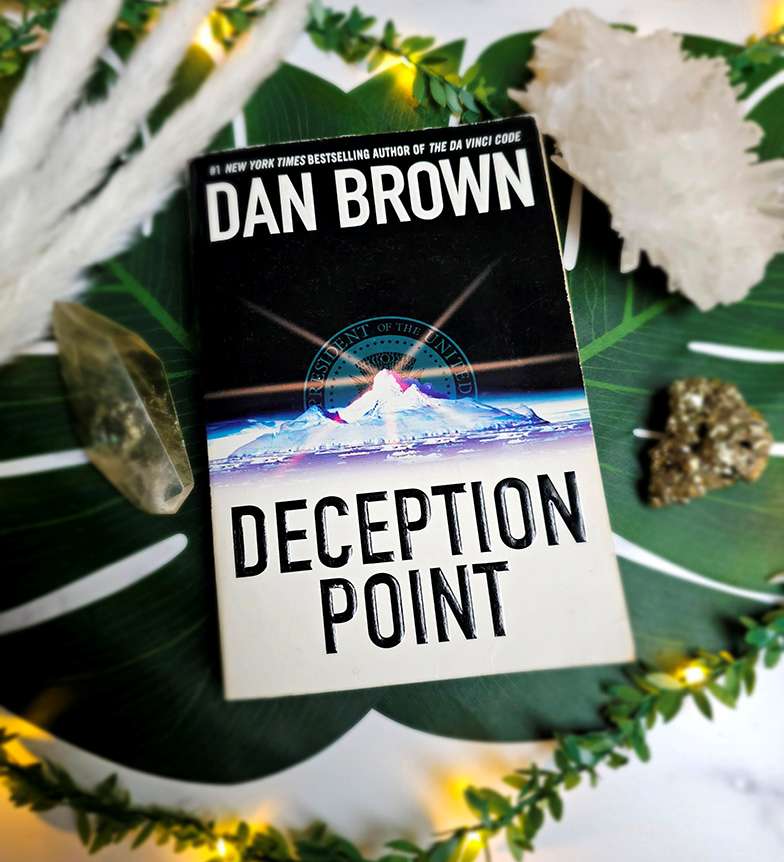
Deception Point
by Dan Brown
A high-stakes thriller involving a NASA discovery in the Arctic that could change everything, if the political conspiracy surrounding it doesn't destroy it first.

All Dressed in White
by Mary Higgins Clark & Alafair Burke
The third Under Suspicion novel: five years after bride-to-be Amanda Pierce vanished the night of her pre-wedding celebration at a luxury Palm Beach resort, television producer Laurie Moran reopens the cold case for her cold-case show - reuniting the wedding party, including the fiance who has since married one of Amanda's own bridesmaids, to find out whether the runaway bride ran or was made to disappear.
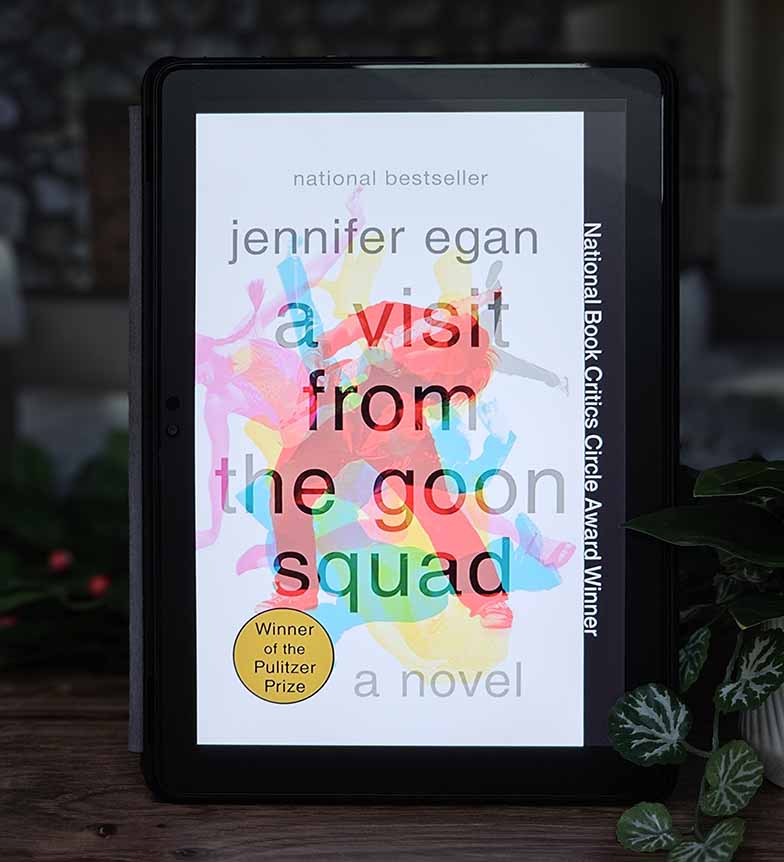
A Visit from the Goon Squad
by Jennifer Egan
A Pulitzer Prize-winning novel that weaves together interconnected stories about a group of characters connected to the music industry, exploring themes of time, memory, and aging through an innovative narrative structure.