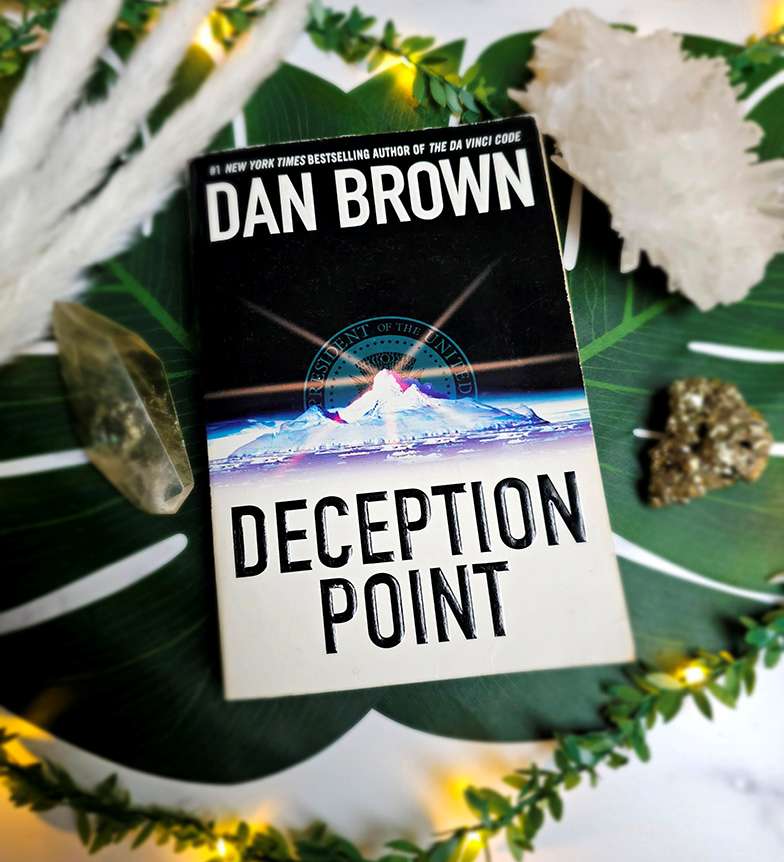
Deception Point
by Dan Brown
A high-stakes thriller involving a NASA discovery in the Arctic that could change everything, if the political conspiracy surrounding it doesn't destroy it first.
Spoiler Warning
This review may contain spoilers. Read at your own discretion if you haven't finished the book yet.
Frozen Secrets and Presidential Stakes
What if NASA announced tomorrow that they'd found proof of extraterrestrial life? Not little green men, but fossils of insect-like creatures embedded in a meteorite buried deep in the Milne Ice Shelf - undeniable, scientific evidence that we are not alone in the universe. Now imagine that discovery happening on the eve of a presidential election, with one candidate promising to abolish NASA entirely and the other staking his political future on space exploration. The timing seems almost too perfect, doesn't it?
That skeptical little voice in your head is exactly where Dan Brown wants you for Deception Point. This is a standalone thriller from Brown, separate from the Robert Langdon series, and honestly? It's some of his tightest, most propulsive work. Brown had already written Angels & Demons, but The Da Vinci Code was still two years away from making him a household name, and there's a hungry energy here that feels like a writer with something to prove. The novel drops us into the frozen Arctic alongside a meteorite that could change human history - if the conspiracy surrounding it doesn't bury everyone who gets too close.
Caught Between Father and Country
Intelligence analyst Rachel Sexton has a complicated life, and Brown wastes no time making it worse. Her father is Senator Sedgewick Sexton, a presidential candidate who's built his entire campaign on attacking NASA as a wasteful, failing agency. He wants to dissolve it completely and redirect the funding to public schools - a position that's made him dangerously popular with voters tired of billion-dollar space flops. Rachel works for the National Reconnaissance Office under director William Pickering, analyzing intelligence for the current administration - her father's political enemy. She and her father haven't spoken in years. Family dinners are not a thing.
When President Zachary Herney personally sends Rachel to the Arctic to independently verify NASA's meteorite discovery before it goes public, she's caught between professional duty, family loyalty, and the growing sense that something about this find isn't quite right. On the ice shelf, she joins a verification team that includes Corky Marlinson, a world-renowned astrophysicist with the social skills of a caffeinated penguin, and Michael Tolland, an oceanographer and celebrity TV scientist who's still quietly grieving his wife's death from cancer. The team is impressive. The evidence seems airtight. The meteorite contains chondrules - metallic spheres found only in space rocks - and fossils of creatures unlike anything on Earth. Case closed, right?
Not even close.
The Cracks in the Ice
The genius of Brown's plotting is how methodically he dismantles the discovery. Glaciologist Norah Mangor is the first to notice something wrong: there's salt water in the extraction shaft, which is impossible for a landlocked glacier. Then the team spots bioluminescent plankton - living, glowing organisms - in a shaft that's supposedly been sealed in ancient ice for centuries. Ground-penetrating radar reveals a perfectly cylindrical tunnel extending from the meteorite chamber straight down to the ocean below. Someone drilled up through the ice shelf from underneath and inserted the meteorite from below.
The deception is elegant and infuriating in equal measure. The "extraterrestrial fossils" are actually mutated marine insects embedded in ocean-floor rock that's been chemically altered to mimic a space meteorite. It's not just a lie - it's an engineering masterpiece, and Brown's scientific detail makes you understand exactly how it was pulled off and why it almost worked. When Rachel and Tolland start pulling at the threads, you follow every step of their logic because Brown has laid the groundwork so carefully.
But someone doesn't want those threads pulled. Delta Force operatives - terrifying, efficient, and operating under orders from someone very high up - begin eliminating anyone who questions the discovery. Norah Mangor is killed on the ice shelf. Paleontologist Wailee Ming drowns. Rachel, Tolland, and Corky are left to die on a drifting ice floe in the Arctic Ocean, saved only by the USS Charlotte, a Navy submarine that happens to be patrolling nearby.
Following the Money, Following the Bodies
Meanwhile, back in Washington, Brown weaves a parallel political thriller through Gabrielle Ashe, Senator Sexton's young aide. Gabrielle discovers that her boss isn't the reformer he claims to be - he's secretly funded by a coalition of private aerospace corporations who would profit enormously from NASA's dissolution. The idealistic crusade against government waste is really about funneling contracts to private industry. It's a neat piece of plotting that complicates the easy assumption that the anti-NASA candidate is the good guy and the pro-NASA president is the villain.
Brown keeps you guessing about who's behind the deception longer than you'd expect. President Herney seems like he has the most to gain, but he's portrayed with enough integrity that framing him feels wrong. Senator Sexton is clearly corrupt, but he's too incompetent to engineer something this sophisticated. The real answer, when it comes, is satisfying precisely because it's rooted in character motivation rather than random twists. The mastermind isn't acting out of greed or political ambition - they're acting out of grief, and a warped conviction that national security justifies any deception. That moral complexity elevates the story beyond simple good-versus-evil dynamics.
A Thriller That Actually Thrills
Let's talk about pacing, because this is where Brown earns his page-turner reputation. The chapters are short, usually ending on cliffhangers that make "just one more chapter" turn into "wait, it's 2 AM." The action sequences - Arctic survival on the ice shelf, a terrifying rescue by submarine, the climactic confrontation on Tolland's research vessel the Goya anchored over an underwater volcanic megaplume swarming with hammerhead sharks - are choreographed with clarity and mounting tension. Brown alternates between the Arctic, Washington D.C., and the Atlantic Ocean, building multiple threads of suspense that converge in a final act that's genuinely breathless.
Is it perfect? No. Some character development takes a backseat to plot mechanics, and the romance between Rachel and Tolland feels slightly obligatory. A few twists might land early if you've read enough thrillers. But these are minor complaints about a book that does exactly what it sets out to do: grab you by the throat and not let go until the final page. The central mystery kept me guessing longer than I expected, and the resolution delivers both intellectual satisfaction and emotional payoff. Brown was poking at real tensions between science, politics, and truth that have only intensified in the years since 2001 - scientific discoveries being politicized, institutional pressure corrupting integrity, media manipulation during elections. This one still has teeth.
Rating: 5.0/5 ⭐
Perfect for: Thriller fans who love a good conspiracy, anyone fascinated by space exploration and Arctic adventure, readers who appreciate scientific detail in their fiction.
Skip if: You prefer character-driven narratives over plot-driven ones, or detailed technical exposition tends to slow you down.
You Might Also Like

The Black Book
by James Patterson & David Ellis
Detective Billy Harney's life is turned upside down when he's framed for a murder he didn't commit, forcing him to navigate a web of corruption within his own police department.

Double Blind
by Iris Johansen
Kendra Michaels, blind for the first twenty years of her life, uses her extraordinary observational skills to hunt a brilliant serial killer in this pulse-pounding thriller.

Your Heart Belongs to Me
by Dean Koontz
Dean Koontz's 2008 standalone thriller: Ryan Perry, a thirty-four-year-old internet tycoon, is diagnosed with incurable cardiomyopathy, receives a heart transplant that saves his life - and a year later begins to be stalked by a mysterious woman whose gifts and messages all carry the same chilling refrain: your heart belongs to me.