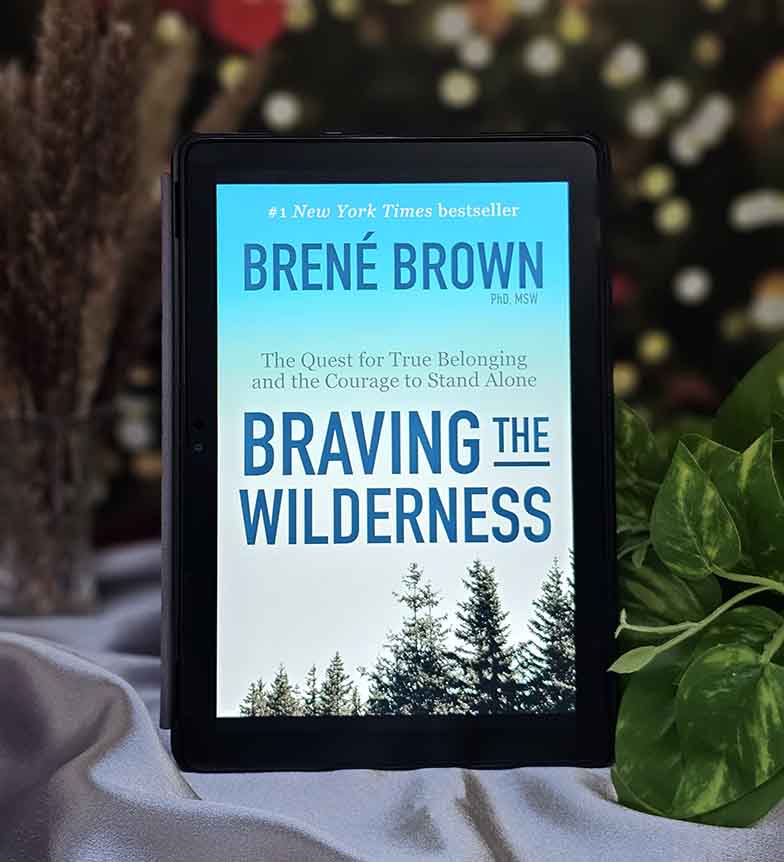
Braving the Wilderness
by Brené Brown
Brené Brown explores true belonging and the courage to stand alone, examining how we can maintain our authenticity and values even when it means standing apart from groups or popular opinion.
Spoiler Warning
This review may contain spoilers. Read at your own discretion if you haven't finished the book yet.
The Belonging Paradox
Here's the counterintuitive thing about belonging: the more desperately you try to fit in, the more alienated you feel. You'd think that conforming to a group's expectations would create connection, but what it actually creates is performance - and the loneliness of knowing that the version of you people accept isn't really you at all. Brené Brown has been circling this idea across several books - Daring Greatly explored vulnerability, Rising Strong explored failure and recovery - but Braving the Wilderness is where she tackles belonging directly, and she arrives at a definition that stopped me cold: "True belonging is the spiritual practice of believing in and belonging to yourself so deeply that you can share your most authentic self with the world and find sacredness in both being a part of something and standing alone in the wilderness."
Read that again. Belonging, in Brown's framework, isn't something you achieve by finding the right group. It's something you practice by finding yourself - and then showing up as that person even when it costs you acceptance, approval, or membership. The wilderness of the title is the space you enter when your authentic beliefs don't align with your tribe's demands, and Brown's argument is that learning to survive there - to stand alone when necessary without losing your connection to others - is the central challenge of living with integrity in an era of escalating polarization.
The Distinction That Changes Everything
Brown grounds the book in a distinction she's been developing across her two decades of research: the difference between fitting in and belonging. Fitting in is assessing a group, figuring out what they want you to be, and becoming that. Belonging is showing up as you are and being accepted - or not - on those terms. Her research consistently shows that people who define their identity primarily through group membership report higher levels of loneliness and disconnection than people who maintain their individual values even when those values conflict with group consensus. The more perfectly you fit in, the more invisible you feel, because the acceptance is conditional on a performance you know isn't sustainable.
Brown defines fitting in as its own kind of trap: assessing a situation and becoming whoever you need to be in order to be accepted. It is the opposite of belonging precisely because it works by hiding - presenting only the parts of yourself likely to be received well. This, Brown argues, is how most adults navigate belonging: scanning the room, calibrating their opinions, offering up the version of themselves most likely to be accepted. It works, in the sense that you get included. It fails, in the sense that the inclusion doesn't actually feed the hunger it was supposed to satisfy, because what gets accepted is the performance rather than the person.
Brown connects this to her broader research on shame and vulnerability. The reason fitting in doesn't satisfy the need for belonging is that belonging requires being seen - really seen, with your contradictions and unpopular opinions and unflattering truths intact. Fitting in requires being hidden, presenting only the parts of yourself that will be received well. You can't simultaneously hide and be seen. The two strategies are fundamentally incompatible, and most of us spend our lives toggling between them without understanding why neither one fully works.
The Four Practices of True Belonging
The book's practical framework is organized around four principles that Brown calls the practices of true belonging. The first - "People are hard to hate close up. Move in." - is her answer to political polarization. Brown describes attending a community meeting where she sat across from people whose political views she found abhorrent, and how the experience of hearing their personal stories - their fears about their children's futures, their grief over lost jobs, their feeling of being dismissed by people like her - didn't change her positions but made it impossible to dehumanize the people holding opposite ones. "It's hard to hate people close up," she writes. "Move in. Speak truth to bullshit. Be civil. Hold hands. With strangers." That last line is the one that sticks, because it captures the tension Brown is navigating: you don't have to agree with people to recognize their humanity, and you don't have to dehumanize them to disagree.
The second principle - "Speak truth to bullshit. Be civil." - is where Brown pushes back against the idea that connection requires avoiding conflict. She argues that you can challenge someone's ideas firmly, even passionately, while still treating them as a human being deserving of dignity. Civility isn't weakness or capitulation; it's the commitment to engaging with people rather than dismissing them. But it also doesn't mean tolerating genuinely harmful speech or behavior in the name of keeping the peace. Brown draws a line: you can be civil and still call out what's wrong. The trick is doing both simultaneously rather than choosing one at the expense of the other.
The third principle - "Hold hands. With strangers." - explores the power of collective experiences to create belonging across difference. Brown writes about attending a concert and experiencing the particular magic of singing with thousands of strangers - the way shared music, shared grief, shared joy creates a temporary community that transcends political identity and tribal affiliation. She connects this to research on what she calls "collective effervescence," a term borrowed from sociologist Émile Durkheim: the heightened sense of connection that comes from physically being with other humans during moments of shared emotion. Her argument is that we've lost many of the communal rituals - church, civic gatherings, shared cultural events - that used to create these moments, and that their absence has contributed to the epidemic of loneliness and polarization.
The fourth principle is the BRAVING framework itself - an acronym for the seven elements Brown identifies as essential for trust: Boundaries, Reliability, Accountability, Vault (keeping confidences), Integrity, Nonjudgment, and Generosity. Each element gets its own treatment, and the framework functions as a kind of checklist for evaluating your relationships. Is this person reliable? Do they keep what I share confidential? Do they hold me accountable without shaming me? Brown applies BRAVING not just to interpersonal relationships but to the relationship you have with yourself - arguing that you can't truly belong to others until you've built trust with yourself by living in alignment with your own values.
Where Brown Reaches and Where She Stops
I gave this five stars because the core insight - that belonging is an internal practice, not an external achievement - genuinely reframed how I think about my own social life, my political engagement, and the moments where I've betrayed my own beliefs to keep group membership. The research is solid, the writing is warm and specific, and the four practices provide a framework that's immediately applicable to the small, daily decisions about when to speak up and when to stay quiet, when to move closer and when to stand apart.
That said, there's a tension in the book that Brown acknowledges but doesn't fully resolve. "Stand alone in the wilderness" is braver advice for some people than for others. For Brown - a tenured professor, bestselling author, white, financially secure - standing alone in her convictions carries social discomfort but not existential threat. For a queer teenager in a conservative community, or a whistleblower facing professional destruction, or a person of color whose "authenticity" is policed by systems with real power, the wilderness isn't just uncomfortable. It's dangerous. Brown's framework is built on the assumption that being authentic will ultimately be worth the cost, but she doesn't spend enough time with the question of what happens when the cost is genuinely devastating - when belonging to yourself means losing your job, your family, or your safety.
The book also leans heavily on individual psychology and interpersonal connection as the antidote to polarization, which is Brown's expertise and where she's strongest, but which can feel insufficient as a response to structural problems. "Move in, speak truth, be civil, hold hands" is powerful advice for Thanksgiving dinner with your politically opposite uncle. It's less clear how it applies to systemic injustice, institutional racism, or power structures that benefit from keeping people divided. Brown isn't wrong that dehumanization is always wrong, but some readers will want her to sit longer with the question of what happens when civility is weaponized by people who use it to avoid accountability.
These are limitations of scope, not failures of insight. What Brown does - connecting research on shame, vulnerability, and belonging into a framework for living with more integrity and less loneliness - she does better than anyone else writing in this space. The wilderness metaphor is powerful precisely because it captures something real: the discomfort of holding your ground when everyone around you wants you to move, and the discovery that the ground under your feet is more solid than you thought. This is the kind of book that doesn't just give you ideas. It gives you permission - to disagree, to stand alone, to define your own belonging rather than waiting for someone else to grant it.
Rating: 5.0/5 ⭐
Perfect for: Anyone struggling with belonging and authenticity, people trying to maintain relationships across political differences, readers who appreciate research-backed personal development with emotional honesty.
Skip if: Brown's vulnerability-based approach doesn't resonate with you, or you're looking for something that engages more deeply with structural barriers to belonging.
My Notes & Takeaways
"Belonging is the innate human desire to be part of something larger than us. Because this yearning is so primal, we often try to acquire it by fitting in and by seeking approval, which are not only hollow substitutes for belonging, but often barriers to it. Because true belonging only happens when we present our authentic, imperfect selves to the world, our sense of belonging can never be greater than our level of self-acceptance."
"Belonging so fully to yourself that you're willing to stand alone is a wilderness - an untamed, unpredictable place of solitude and searching. It is a place as dangerous as it is breathtaking, a place as sought after as it is feared. The wilderness can often feel unholy because we can't control it, or what people think about our choice of whether to venture into that vastness or not. But it turns out to be the place of true belonging, and it's the bravest and most sacred place you will ever stand."
"True belonging is the spiritual practice of believing in and belonging to yourself so deeply that you can share your most authentic self with the world and find sacredness in both being a part of something and standing alone in the wilderness. True belonging doesn't require you to change who you are; it requires you to be who you are."
You Might Also Like
Rising Strong
by Brené Brown
Brené Brown explores the process of getting back up after failure, heartbreak, and disappointment, providing a research-based approach to resilience and emotional recovery.

Everything is Figureoutable
by Marie Forleo
A revolutionary mindset and practical action plan for when you feel stuck, overwhelmed, or lost. Marie Forleo shares her philosophy that any problem, challenge, or dream is figureoutable.

Playing Big
by Tara Mohr
A practical guide for women looking to step into their power and pursue their ambitions. Tara Mohr offers tools to quiet your inner critic, recognize your unique calling, and take bold action.