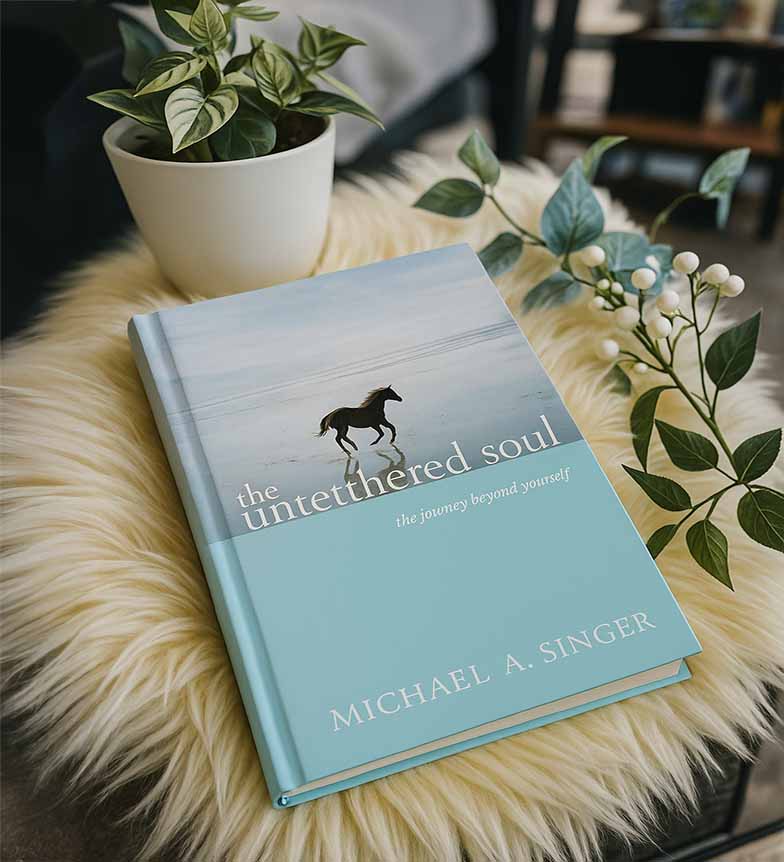
The Untethered Soul
by Michael A. Singer
A profound exploration of consciousness and spiritual awakening that guides readers toward inner freedom through understanding the nature of self, thoughts, and awareness itself.
Spoiler Warning
This review may contain spoilers. Read at your own discretion if you haven't finished the book yet.
You Are Not the Voice in Your Head
Let's start with a simple exercise. Right now, you probably have a stream of mental commentary running: thoughts about this review, what you'll do next, something that happened earlier today, a worry about something tomorrow. Now notice - who is listening to that commentary? The fact that you can observe your thoughts means you can't be your thoughts. You are something else. You are the awareness that watches the mental show. Michael A. Singer opens The Untethered Soul with that observation, and then spends the next 200 pages exploring what happens when you take it seriously - not as an intellectual concept, but as something you can verify in your own direct experience, right now, sitting wherever you're sitting.
Singer isn't an academic philosopher or a religious figure. He's a meditation practitioner who began his inner work as a graduate student in the 1970s, retreated to the woods of Florida to deepen his practice, and eventually - somewhat paradoxically - built a billion-dollar medical software company called Medical Manager while living as something close to a yogi. His path from solitary meditator to corporate CEO to bestselling author gives the book an unusual credibility: this isn't someone who's avoided the demands of real life to theorize about inner peace. He's tested these ideas against the pressures of business, relationships, and the ordinary chaos of being human. "The highest spiritual path is life itself," he writes. "If you know how to live daily life, it all becomes a liberating experience." That sentence captures the book's entire philosophy in two lines.
The Question Behind Every Other Question
The book opens with what Singer considers the most important question you can ask: "Who am I?" Not in the existential-crisis sense, but in a very precise, experiential sense. "What is the seat of my consciousness? Where am I that is watching the thoughts come and go, emotions come and go, and the world change around me?" Singer's argument is that most of us have never actually investigated this question. We assume we are our thoughts, our emotions, our personality, our body, our history. But every one of those things changes - your thoughts shift constantly, your emotions cycle, your personality evolves, your body ages - and yet something remains constant. There's a you that was there when you were five years old and is still here now, unchanged, watching everything else change around it. Singer calls this the seat of consciousness, and he argues that locating yourself there rather than in the changing content of your mind is the single most transformative shift a person can make.
He introduces the concept of the "inner roommate" early in the book, and it's the framework that sticks with most readers. Imagine, he says, that you had an actual roommate who talked to you the way your mind talks to you. Running commentary on everything you do. Second-guessing your decisions. Reminding you of embarrassing moments from years ago. Worrying about scenarios that haven't happened. Comparing you unfavorably to other people. Telling you contradictory things - you should eat that, no you shouldn't, you're too fat, life is short just enjoy it, but what about your health? If a real person spoke to you this way, you'd throw them out in a week. But we accept this voice as ourselves, as rational, as something worth listening to. Singer's point is that recognizing this voice as an object in your awareness - something you can hear - means it can't be you. You are the one hearing it. That distinction is the book's foundation, and everything else builds from there.
Opening and Closing: The Heart's Choice
The middle section of the book is where Singer moves from observation to practice, and it's centered on a metaphor that's deceptively simple: your heart is either open or closed, and you are constantly choosing which. When something happens that disturbs you - a critical comment, a traffic jam, a memory of something painful - you feel your inner energy contract. You close down. You clench around the disturbance, and it gets stored in your psyche as what Singer calls a "samskara" - a Sanskrit term for the energetic impressions left by past experiences. Over the course of a lifetime, these samskaras accumulate into a dense web of sensitivities, triggers, and defensive patterns that increasingly limit how freely you can move through the world.
Singer's description of how this closing works is one of the book's most vivid passages. He traces the lifecycle of a single emotional disturbance - say, someone cuts you off in traffic. You feel a flash of anger. Your mind generates a story about it: that person is a jerk, they probably do this all the time, what's wrong with people. If you follow the story, you carry the anger with you for minutes, maybe hours. Your body stays tense. Your mood shifts. By the time you arrive at work, you've accumulated an irritation that has nothing to do with your actual present circumstances but colors everything you experience. Now multiply that by every minor and major disturbance across decades, and you have a picture of how most people's inner lives function - layers of stored reactions filtering every new experience through old patterns.
The alternative Singer offers is radical in its simplicity: don't close. When the disturbance comes, feel it fully, and let it pass through you without clenching around it. Don't suppress the feeling - that just stores it differently. Don't indulge it by building a story around it - that amplifies it. Just experience the energy of the emotion as it moves through your awareness, and let it go. "There is nothing more important to true growth," he writes, "than realizing that you are not the voice of the mind - you are the one who hears it." If you can stay in the position of the one who hears it, the one who watches the emotional energy rise and fall, then the disturbance passes through without leaving a residue. Your heart stays open. Your energy stays free.
The Chapter on Death That Reframes Everything
The book's most powerful section comes unexpectedly near the end, when Singer asks you to imagine that you've just been told you have a week to live. How would you spend it? What would suddenly become important? What would fall away? His point isn't morbid - it's clarifying. Most of the things we agonize about, most of the disturbances we clench around, most of the mental commentary we treat as urgent would evaporate instantly if we were confronted with our own mortality. The pettiness would disappear. The grudges would seem absurd. The anxiety about what other people think of us would become laughably irrelevant.
Singer argues that this clarity isn't something that should require a terminal diagnosis. It's available right now, if you're willing to hold the reality of death in your awareness instead of pushing it away. Living with an awareness of mortality doesn't make you morbid - it makes you free. It burns away the triviality and leaves only what actually matters: the quality of your inner experience, the depth of your connections, the openness of your heart. It's the chapter that elevates the book from a meditation manual into something genuinely philosophical, and it's the reason I've kept this on my shelf and come back to it repeatedly.
What This Book Can't Do
I gave this a rare five stars because it fundamentally changed how I relate to my own inner experience, and I don't say that about many books. But I want to be honest about what it doesn't do. Singer's approach is almost entirely about the internal landscape - how you relate to your thoughts, your emotions, your energy. He has very little to say about the external factors that shape people's suffering: poverty, systemic injustice, trauma, mental illness, abusive relationships. His framework assumes that your primary problem is your relationship to your own mind, and while that's a powerful insight for people dealing with garden-variety anxiety and stress, it can feel tone-deaf if you're facing circumstances that genuinely need to change, not just be accepted.
The writing itself is uneven in places. Singer is at his best when he's concrete - the inner roommate concept, the traffic-jam example, the death meditation. He's weaker when he drifts into abstract spiritual territory, particularly in the later chapters where the language gets more esoteric and the concepts harder to ground in everyday experience. Readers who come from a purely secular or scientific perspective may find the energy-and-consciousness framework hard to take seriously, even though the practical techniques don't actually require buying into it. And Singer's personal controversies - he was indicted on fraud charges related to his company in 2011, though charges were later dropped - are worth being aware of, even though they don't directly bear on the quality of the ideas in this book.
None of that diminishes the core contribution. The inner roommate concept alone has been more useful to me than entire shelves of self-help books. The practice of noticing the difference between the voice and the listener, of staying open when everything in you wants to close, of treating life itself as the spiritual practice rather than retreating from life to find one - these ideas are simple enough to explain in a conversation and deep enough to spend a lifetime working with. This is the book I've recommended more than any other, and the one that keeps giving me something new every time I reread it.
Rating: 5.0/5 ⭐
Perfect for: Anyone dealing with anxiety or overthinking, meditation beginners looking for a non-religious entry point, readers who want practical tools for inner freedom rather than abstract philosophy.
Skip if: You prefer concrete external action steps over awareness practices, or you need your self-help grounded in clinical psychology rather than contemplative tradition.
My Notes & Takeaways
"There is nothing more important to true growth than realizing that you are not the voice of the mind - you are the one who hears it."
"You re-create the world within your mind because you can control your mind whereas you can't control the world."
"Your inner growth is completely dependent upon the realization that the only way to find peace and contentment is to stop thinking about yourself."
"To attain true inner freedom, you must be able to objectively watch your problems instead of being lost in them."
"The lost soul is the consciousness that has dropped into the place where one human's thoughts, emotions, and sensory perceptions of sight, sound, taste, touch, and smell are all synchronized."
"Consciousness is one of the great mysteries in life. Inner energy is another."
"The most important thing in life is your inner energy. If you're always tired and never enthused, then life is no fun. But if you're always inspired and filled with energy, then every minute of every day is an exciting experience."
"You have the ability to not go with any of these thoughts. You can just sit in the seat of consciousness and let go. A thought or emotion emerges, you notice it, and it passes by because you allow it to."
"The exploration of Self is inextricably interwoven with the unfolding of one's life. The natural ups and downs of life can either generate personal growth or create personal fears. Which of these dominates is completely dependent upon how we view change."
"The spiritual journey is one of constant transformation. In order to grow, you must give up the struggle to remain the same, and learn to embrace change at all times."
"The prerequisite to true freedom is to decide that you do not want to suffer anymore. You must decide that you want to enjoy your life and that there is no reason for stress, inner pain, or fear. Every day we bear a burden that we should not be bearing."
"One of the essential requirements for true spiritual growth and deep personal transformation is coming to peace with pain. No expansion or evolution can take place without change, and periods of change are not always comfortable."
"At some point in your growth, it starts to become quieter inside. This happens quite naturally as you take a deeper seat within yourself. You then come to realize that though you have always been in there, you have been completely overwhelmed by the constant barrage of thoughts, emotions, and sensory inputs that draw on your consciousness."
You Might Also Like

Playing Big
by Tara Mohr
A practical guide for women looking to step into their power and pursue their ambitions. Tara Mohr offers tools to quiet your inner critic, recognize your unique calling, and take bold action.
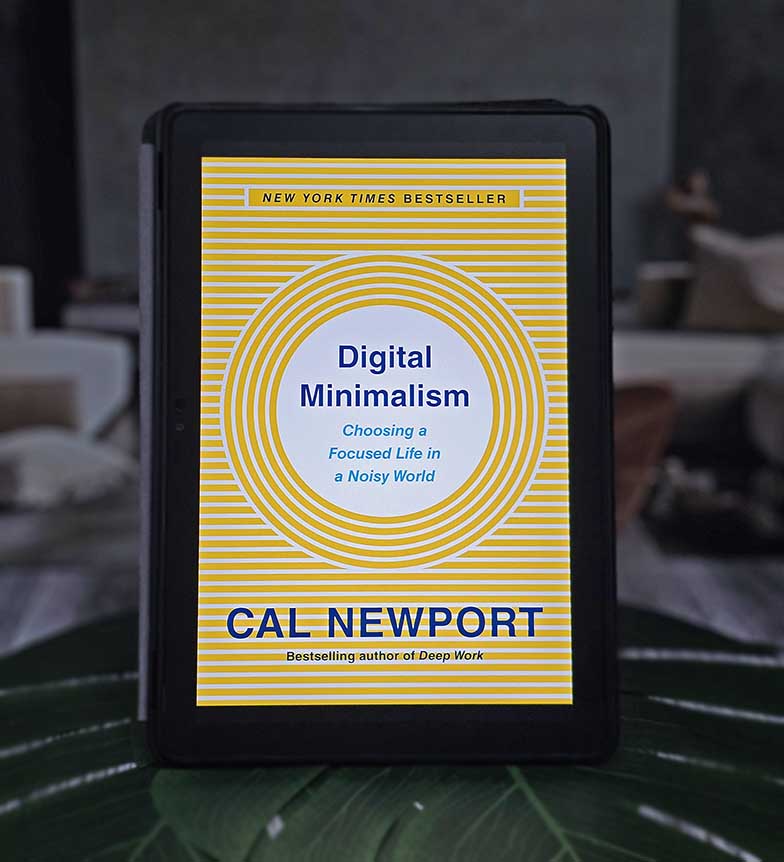
Digital Minimalism
by Cal Newport
A compelling philosophy for technology use in the modern age, arguing for a minimalist approach to digital tools. Cal Newport makes the case for being highly intentional about which technologies you allow into your life and how you use them.
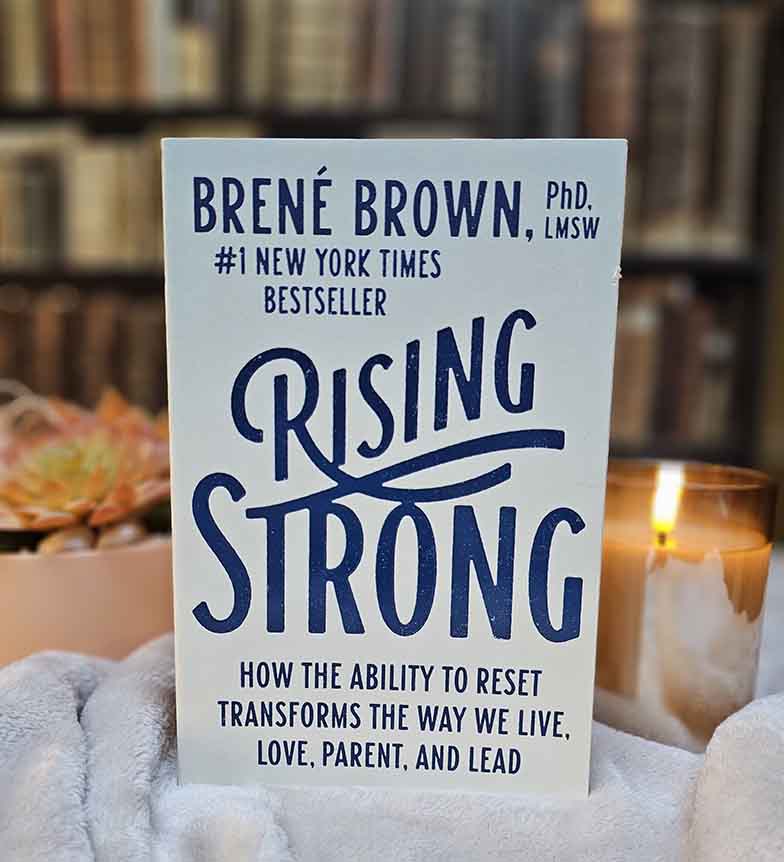
Rising Strong
by Brené Brown
Brené Brown explores the process of getting back up after failure, heartbreak, and disappointment, providing a research-based approach to resilience and emotional recovery.